

AVAYA DOCUMENTATION CENTER
Find answers to your technical questions and learn how to use our products
Avaya Aura® Session Manager Overview and Specification
Redundancy and high availability
An enterprise supports up to 28 Session Manager instances. You can implement the Session Manager instances in the same data center or in data centers that are separated geographically around the world. These instances do not need to exist on the same subnet.
Session Manager redundancy supports networks with round trip delays of less than one second.
Session Manager uses the active-active approach where two instances are active simultaneously and either of the instances can process any request. This feature is important for distributing traffic across the network.
Configuring more than one Session Manager in a network has the following benefits:
A failure of one of the Session Manager instances does not interrupt service.
You can use one System Manager to administer all the Session Manager instances.
The centralized dial plan is in effect for Avaya and third-party PBXs. The centralized dial plan connects the PBXs, using SIP either directly or using a SIP gateway, to one of the Session Manager instances.
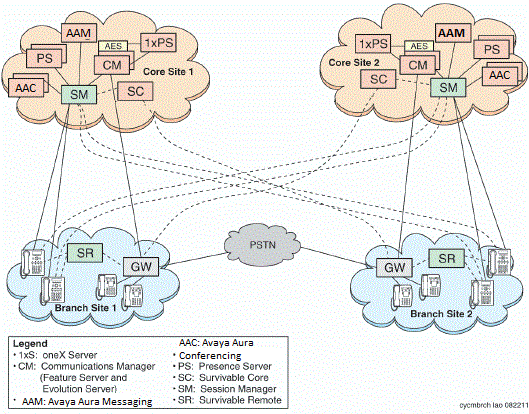
When SIP endpoints register simultaneously with two Session Manager instances at the core and with one Branch Session Manager, the SIP endpoints continue to be operational if any one of the associated Session Manager instances fails.
The following illustration shows solution-level survivability in the enterprise:
Note:
Session Manager does not support High Availability for call journaling because the primary Session Manager stores the call logs.