

AVAYA DOCUMENTATION CENTER
Find answers to your technical questions and learn how to use our products
Avaya Session Border Controller Overview and Specification
RTCP Monitoring
The RTCP monitoring feature in Avaya SBC updates RTCP packet with appropriate endpoint IP address and hop information. Endpoints are configured to send RTCPMON messages to the Avaya SBC to which the endpoint is registered. A single Avaya SBC is designated core Avaya SBC which is sent to Prognosis. Avaya SBC maintains the RTCP port mapping and updates this mapping on a per call basis as part of the SIP signaling. Avaya SBC implements a new feature in the application that has the capability to traceroute multiple destinations simultaneously.
APIs are provided for the SIP Application to fetch the traceroute information for later reuse when modifying the RTCPMON messages.
Avaya SBC tracerouting feature implementation reuses the linux based tracerouting APIs.
The ICMP/UDP/TCP Avaya SBC configuration modes can use tracerouting and can be administered from GUI.
On receiving RTCPMON message for Prognosis, Avaya SBC does a lookup in RTCP port-mapping. Avaya SBC then modifies the remote IP address and RTCP Port in rtcp message Avaya Subtype 4, based on the mapping. Avaya SBC then appends the trace hop information of the next network node where the RTP packets are forwarded in Avaya Subtype 5. If this Avaya SBC is the designated core Avaya SBC, then perform additional steps before forwarding the packets to Prognosis. Determine the SSRC field from RTCP monitoring packets from endpoint, for example SSRC1. Avaya SBC also determines the SSRC of the incoming RTP stream from media gateway or caller, for example SSRC2. Avaya SBC creates a mapping key using SSRC1 and SSRC2, if the mapping does not exist.The mapping key contains the following information:
Media origination IP address or port for SSRC1 – populated from the RTCPMON Subtype 4 message.
Media origination IP address or port for SSRC2 – populated from the RTCPMON Subtype 4 message.
Traceroute information for all the hops from the endpoint [Caller] up to the Core Avaya SBC – Populated from the RTCPMON Subtype 5 Message.
Traceroute information for all the hops from the endpoint [Callee] up to the Core Avaya SBC – Populated from the RTCPMON Subtype 5 Message.
If mapping exists in the Avaya SBC for SSRC1 and SSRC2, then Avaya SBC uses the mapping information to rewrite the following in the RTCPMON packets to be sent to Prognosis:
Subtype 4 RTCPMON.
Remote IP Address/port of SSRC1 will be set to media origination IP address/port of SSRC2 from the mapping.
Remote IP Address/Port of SSRC2 will be set to media origination IP address/port of SSRC1 from the mapping.
Subtype 5
Trace hop info for SSRC1 will include the current trace hop information received in RTCPMON packet plus trace hop information saved for SSRC2.
Trace Hop Info for SSRC2 will include the current trace hop information received in RTCPMON packet plus trace hop information saved for SSRC1.
Processed RTCPMON packets will now be sent to Prognosis based on the information filled in by Avaya SBC.
Modes of configuration
END-end Rewrite: Avaya SBC updates the RTCP subtype-4 packet from the media terminating endpoint. In Subtype-4, Avaya SBC rewrites the Remote IP Address field with the Remote endpoint address who is the recipient of the RTCP packets. End-end rewrite must be configured in all Avaya SBC devices which have media terminating endpoints connected to it directly. No other Avaya SBC devices exist between that particular Avaya SBC device and the media terminating endpoints.
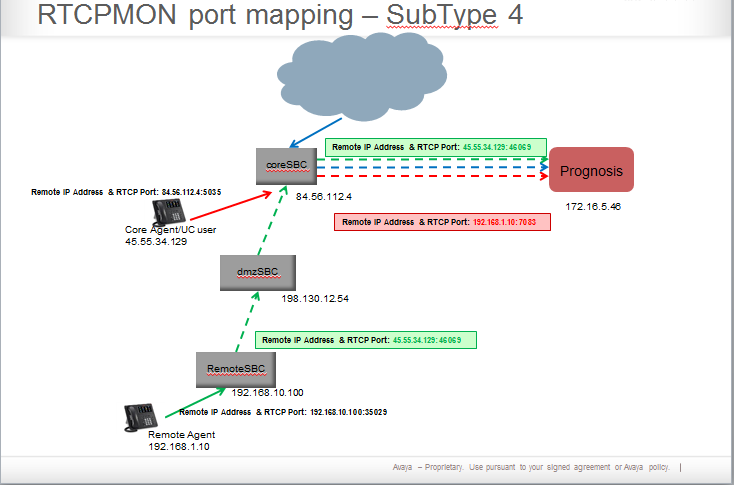
Hop-by-Hop trace route: Avaya SBC updates the RTCP subtype-5 packet with the trace route information. In subtype-5 packet, Avaya SBC appends the trace route towards the entity to which Avaya SBC forwards the RTP packet. Avaya SBC sends the trace route towards the entity from which the Avaya SBC received the RTP packet. You must configure hop-by-hop trace route for all Avaya SBC devices.
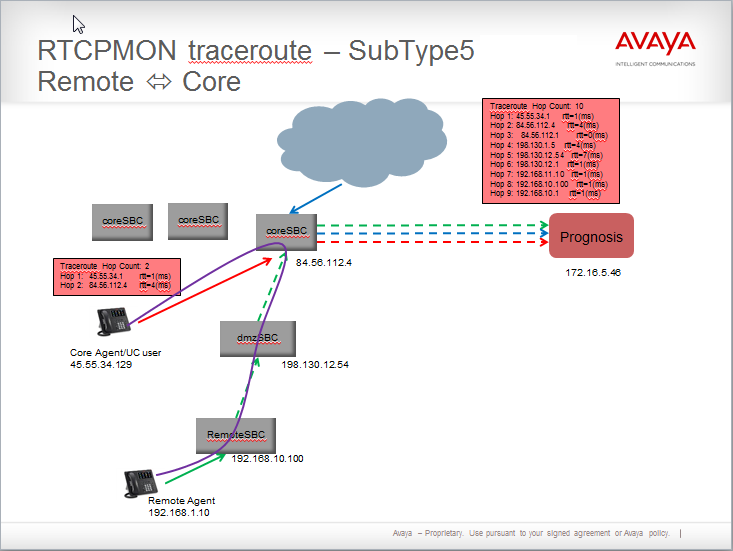
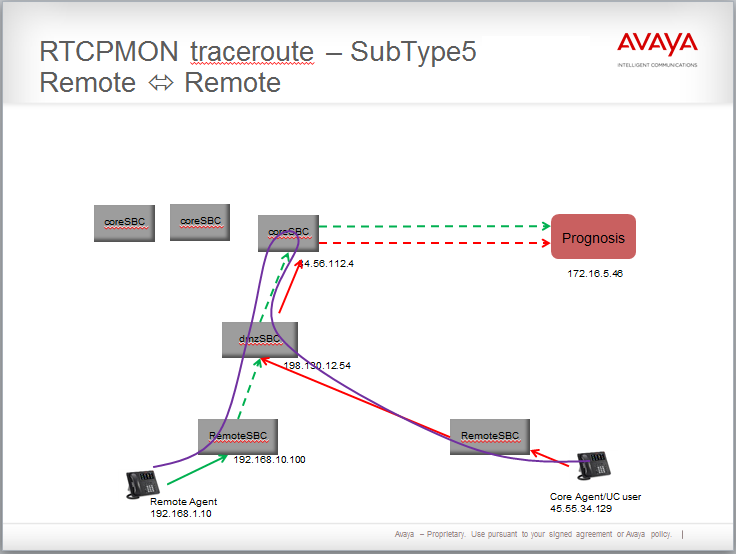
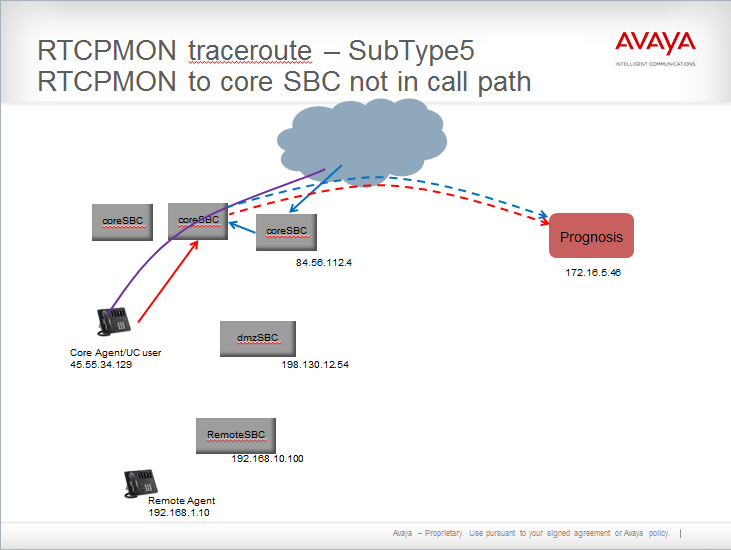
Bridging: Avaya SBC strips the reverse trace routes added by the Hop-by-Hop trace route and appends this data to the RTCP subtype-5 packet coming from the opposite side. Bridging must be configured only in CORE Avaya SBC devices.
Note:
If a solution includes only one Avaya SBC, all these configurations are required.