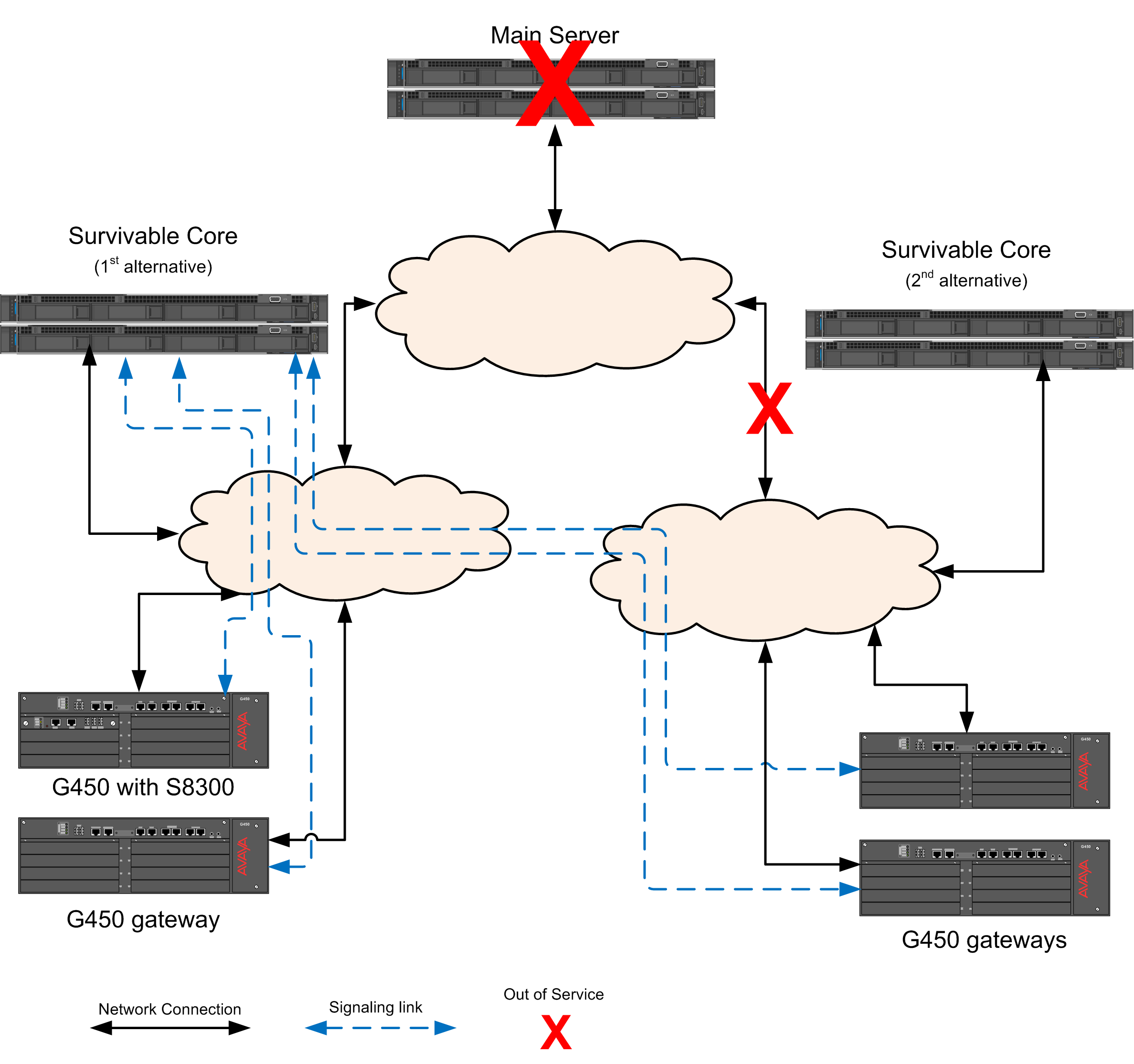
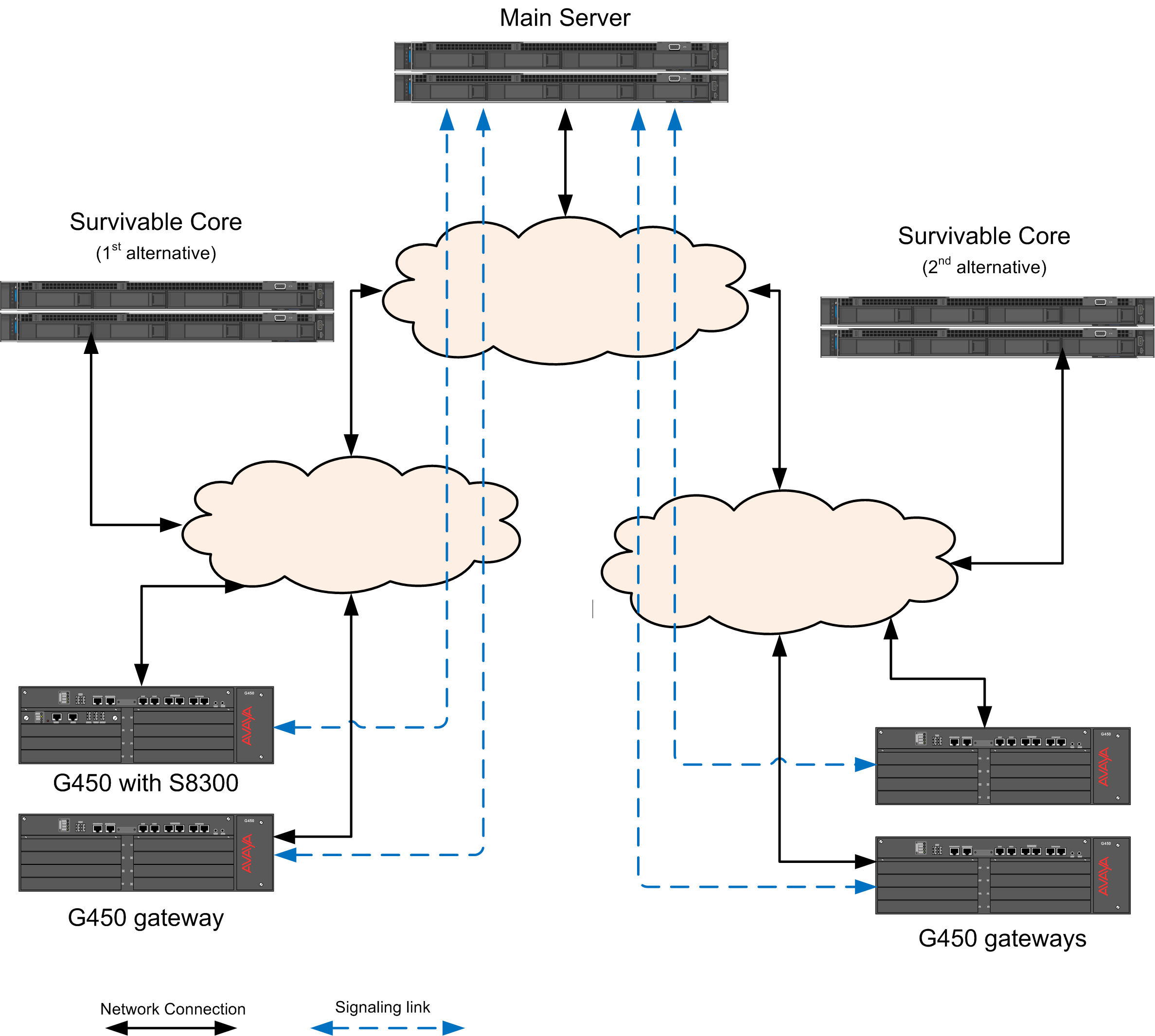
Example two uses the same configuration used in example one. The S8300E Server is the main server, with two S8300E survivable core servers (first alternative and second alternative). Due to a catastrophic failure the main server is out-of-service. All Media Gateways are now controlled by the 1st alternative survivable core server.
Up to this point this is the same scenario as example one. Now, the customer experiences a network outage resulting in fragmentation of the network (see Figure 4: Network fragmentation failure). Media Gateways three and four can communicate with the second alternative survivable core server but can no longer communicate with the main server or the first alternative survivable core server. Media Gateways one and two can still communicate with the first alternative survivable core server but can no longer communicate with the second alternative survivable core server.
Figure : 1. Network fragmentation failure
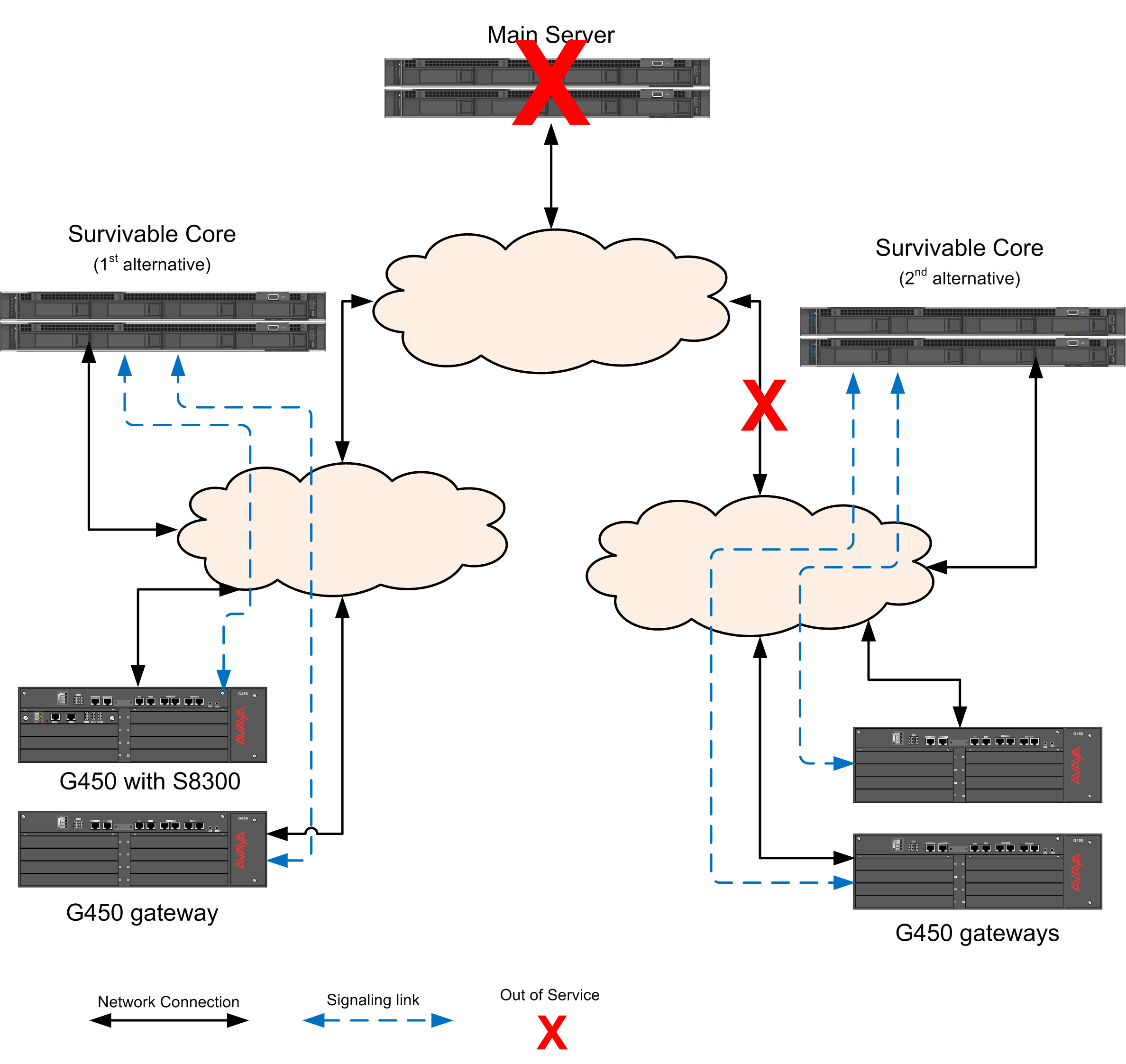
Because the Media Gateways three and four are no longer able to communicate with the main server or the 1st alternative server, they adjust their priority list and move the 2nd alternative server to the top of the list. The 2nd alternative server acknowledges the request and assumes control of gateways three and four (see Figure 5: Network failure - Survivable core server recovery). Note that Media Gateways one and two did not experience any service outage from the failure.
Figure : 2. Network failure - Survivable core server recovery
The users in gateways one through four experience the following:
During the primary search timer interval:
Stable calls remain up in the state they were in before the outage occurred. The stable calls do not have access to any features such as hold, conference, etc. The state of the stable call cannot be changed.
Users attempting to originate a telephone call, do not get dial tone.
Incoming calls to the system receive a fast busy (reorder tone) or an announcement from the facility provider saying all trunks are busy.
After the primary search timer expires:
For the users on an IP connected telephone call, the shuffled IP calls stay up. Once the call terminates, the user of the IP telephone cannot make another call until the IP telephone re-registers with a gatekeeper.
Calls on DCP or analog telephones terminate.
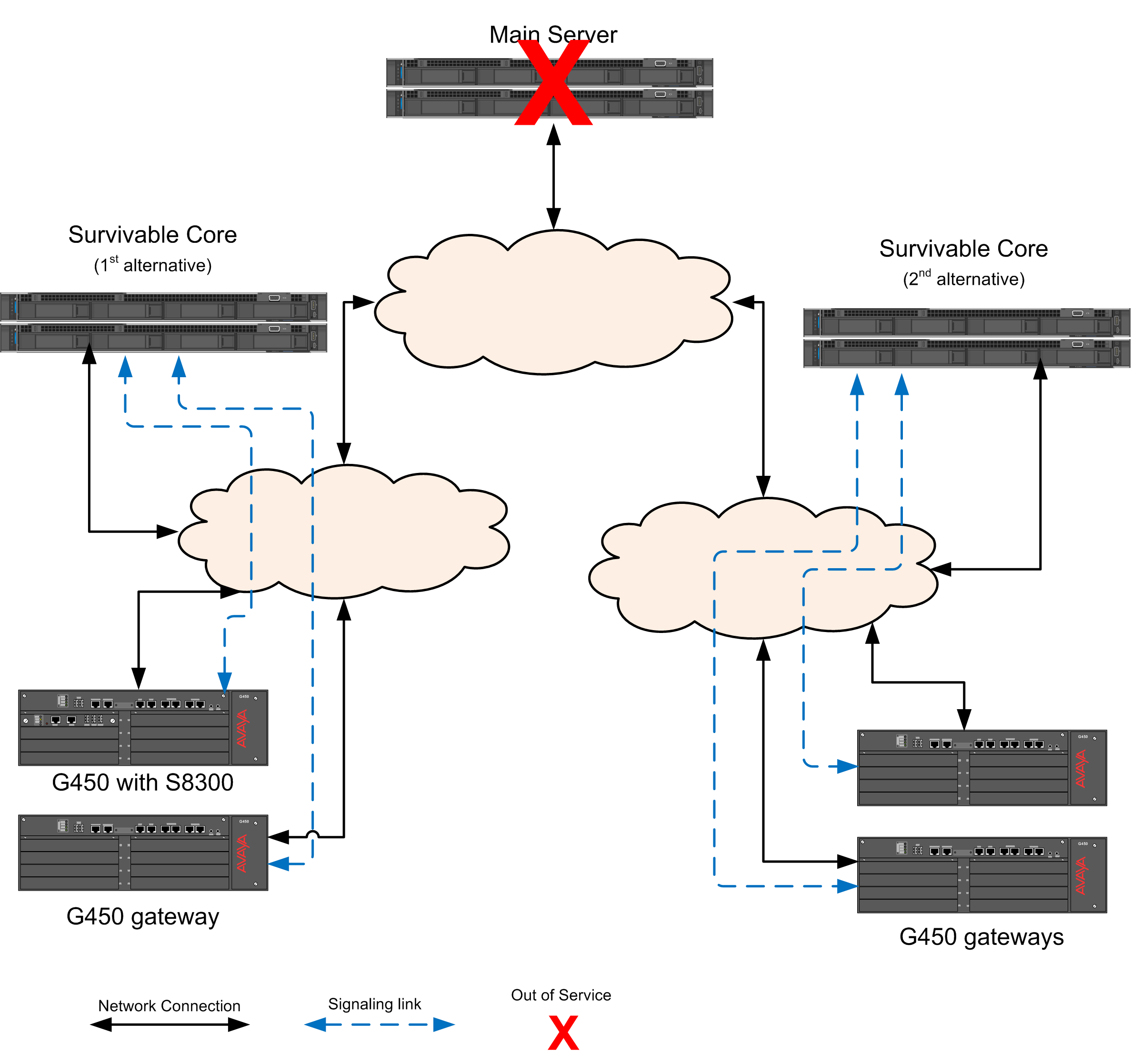
The customer is now in the process of recovering from both the network failure and the main server failure (see Figure 6: Network fragmentation recovery). As the network failure is fixed, the Media Gateways three and four can now communicate with the first server. The gateways do not automatically return to the control of the first secondary server. The gateways always try to return to the main (primary) controller. The return to main is defined by the recovery rule configured for each gateway in the add/change media-gateway form. The return to main can be set for a certain time of day/day of week, when there are no calls in progress or can be configured to be immediate. The return to the primary can be also set to manual using ‘no rule’ in that case the gateways return to main only when the administrator issue an enable mg-return command.
Figure : 3. Network fragmentation recovery
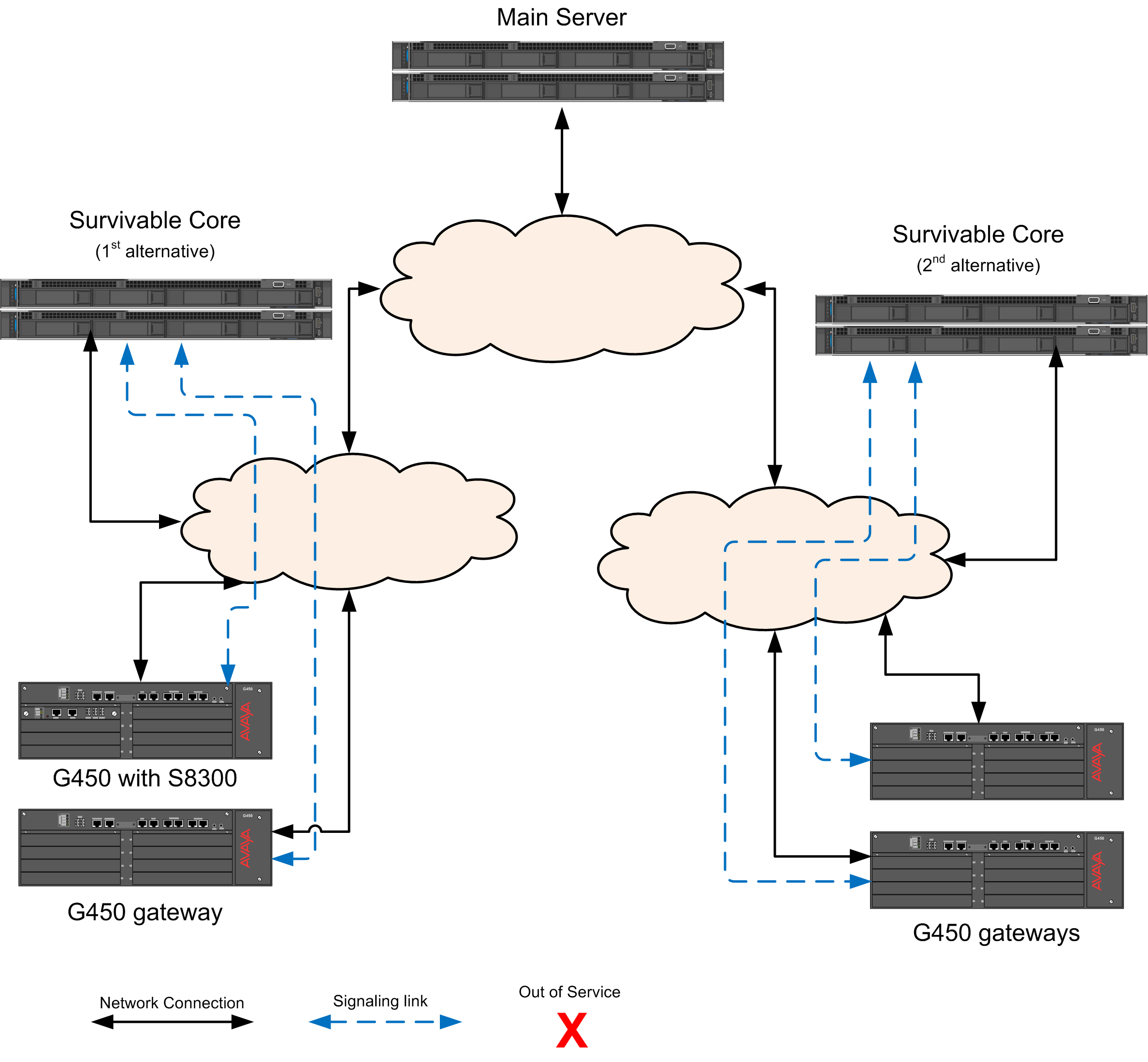
The main server is now restored (see Figure 7: Main server recovery). The Media Gateways can now communicate with the main server and each survivable server. The main server is always the highest priority on any Media Gateway priority list.
Figure : 4. Main server recovery
The return to main is defined by the recovery rule configured for each gateway in the add/change media-gateway form. The return to main can be set for a certain time of day/day of week, when there are no calls in progress or can be configured to be immediate. The return to the primary can be also set to manual using no rule in that case the gateways return to main only when the administrator issue an enable mg-return command.
Figure : 5. Survivable remote server working in a survivable core server environment - normal operation