

AVAYA DOCUMENTATION CENTER
Find answers to your technical questions and learn how to use our products
Installing and Administering the IP Office B179 SIP Conference Phone
B179 extension settings
Extensions for the B179 can be created manually using  | SIP Extension or automatically created during registration of the SIP device. Even if auto-created, the extension settings created in IP Office should be checked after installation.
This section looks just at the key configuration settings that affect B179 device extensions. For full details of all the fields shown, refer to the IP Office Manager manual.
Procedure
- Select
 Extensions and locate the B179 SIP extension. Select the Extn tab.
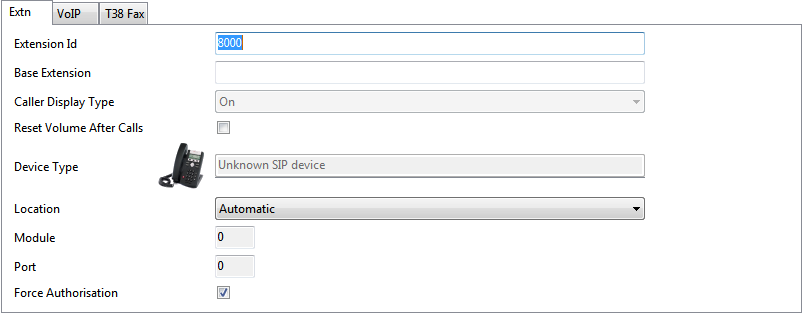
Base Extension
This should match the Extension setting of the SIP user added to the IP Office configuration.
Force Authorization: Default = On
If enabled, SIP devices are required to register with the IP Office system using the Name and Login Code configured for the user within the IP Office configuration.
- Select the VoIP tab.
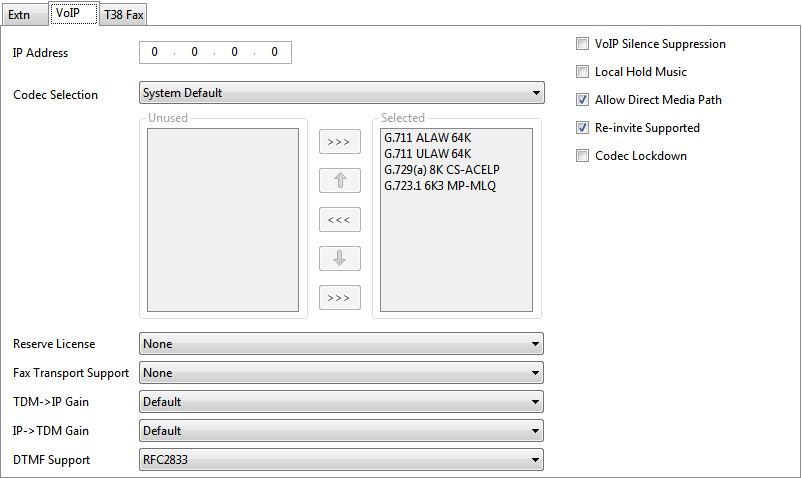
Reserve License
Each Avaya IP phone requires an Avaya IP Endpoint license. Normally the available licenses are issued in the order that devices register. This option allows an extension to be pre-licensed before the device has been registered. For a B179 device, select Reserve Avaya IP endpoint licence.
Codec Selection
See below.Codec Lockdown
Supports RFC 3264 Section 10.2 when RE-Invite Supported is enabled. In response to a SIP offer with a list of codecs supported, some SIP user agents supply a SDP answer that also lists multiple codecs. This means that the user agent may switch to any of those codecs during the session without further negotiation. The system does not support multiple concurrent codecs for a session, so loss of speech path will occur if the codec is changed during the session. If codec lockdown is enabled, when the system receives an SDP answer with more than one codec from the list of offered codecs, it sends an extra re-INVITE using just a single codec from the list and resubmits a new SDP offer with just the single chosen codec.
DTMF Support
This can be set to one of the two common methods used by SIP devices; RFC2833 or Inband. If the method is not known or varies on a per call basis, deselecting Allow Direct Media Path allows a VCM channel to be used for DTMF support when necessary. The selection should be set to match the method used by the B179, otherwise you will be unable to access voicemail in IP Office via the B179 as a result of incompatible signalling tones. Refer to Media settings for B179 configuration.
Local Hold Music
Select this option if you want the B179 to support its own Hold Music source.
Re-invite Supported
Select this option if you want the B179 to receive REINVITE messages.
Codec selection
The setting you choose for codec selection in IP Office must match the codec selection on the B179 itself (as described Media settings). When the codec settings do not match, calls between certain devices will fail to initiate and you may experience other issues.
The following codecs are supported:
Codec |
Explanation |
|---|---|
G.722 |
G.722 is an ITU-T standard codec that provides 7 kHz wideband audio at a data rate within 64 kbit/s. It offers greatly improved speech quality compared with older narrowband codecs such as G.711, but requires a high quality network connection between the devices. |
G.723 |
G.723 is an ITU-T standard codec that provides 300Hz to 3400Hz wideband audio using ADPCM. |
G.729 |
G.729 is an ITU-T standard codec that operates at 8 kbit/s. It is mostly used in VoIP applications with low bandwidth requirements. |
G.711 A-law G.711 μ-law |
G.711 is an ITU-T standard codec that uses audio companding. Companding algorithms reduce the dynamic range of an audio signal. In analog systems, this can increase the signal-to-noise ratio achieved during transmission and, in the digital domain, can reduce the quantization error. Two main compression algorithms are defined in the standard; the μ-law algorithm (used in North America and Japan) and A-law algorithm (used in Europe and the rest of the world). |
If Codec Selection is left set to System Default, the extension will use the system codec preferences. In most cases this is preferred and any changes required should be made at the system level to ensure consistency for all IP trunks and extensions.
If required, the Codec Selection of each individual trunk and extension can be adjusted to differ from the system defaults, although this is not recommended.
Procedure
- Using IP Office Manager, retrieve the system's configuration.
- To display the extension's settings, click Extension in the left-hand panel.
- Select the VoIP tab.
- Change the Codec Selection to Custom.
- The Unused and Selected lists can be used to select which codecs the B179 uses and their order of preference.
- Save the configuration changes back to the system.