

AVAYA DOCUMENTATION CENTER
Find answers to your technical questions and learn how to use our products
Avaya Session Border Controller Overview and Specification
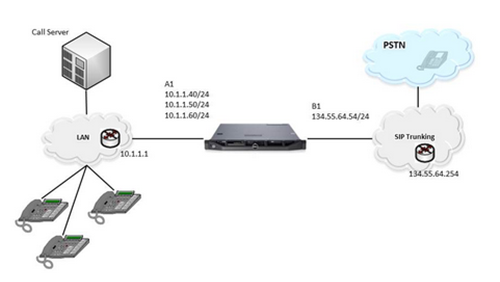
Avaya SBC connected to multiple subnets on two interfaces
In this scenario, Avaya SBC connects to a call server on one interface and a trunk server on another.
Configuration details
-
Avaya SBC interfaces: This configuration uses four IP addresses: three on the A1 interface and one on the B1 interface.
-
Surrounding networking equipment: The next-hop routers on both data interfaces do not need to support multiple Avaya SBC subnets or VLAN tagging.
-
Avaya SBC network interfaces: This scenario uses the A1 and B1 interfaces. Ensure that you configure the required interfaces.
-
Networks connected to Avaya SBC: In this example, Avaya SBC connects to two data networks through the A1 and B1 interfaces. Each configured IP address can use a unique next-hop router, if necessary, or the default gateway. Define each network that connects to Avaya SBC. Use the Networks tab in to define the network.
-
Other Avaya SBC setup: To configure media and signaling interfaces, flows, and routing profiles, see the related sections.