AVAYA DOCUMENTATION CENTER
Find answers to your technical questions and learn how to use our products
Avaya Session Border Controller Overview and Specification
Avaya SBC high availability
The Avaya SBC can be deployed as a pair either in the enterprise DMZ or core, or geographically dispersed, where each Avaya SBC resides in a separate, physical facility.
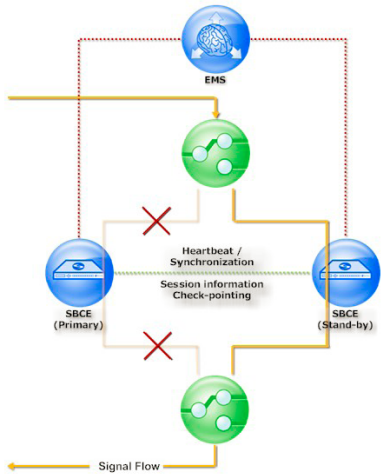
In either configuration, Avaya SBC HA pairs can be deployed in an enterprise in a parallel mode configuration. In the parallel configuration, the signaling packets are routed only to the active or primary Avaya SBC, which performs all data processing. The interface ports on the standby Avaya SBC do not process any traffic. The management interfaces on the Avaya SBC appliances have different IP addresses, but the signaling or media interfaces have the same IP address. On failover, the standby Avaya SBC advertises the new MAC as the L2 address for the common IP address. The Avaya SBC devices are synchronized through the heartbeat on the dedicated interfaces, and both Avaya SBC devices are in continuous communication with the Avaya EMS.
On detection of a failure on the active Avaya SBC, the active SBC network interface ports are automatically disabled. The ports of the standby SBC are enabled. Failure detection and operational transfer occur without dropping packets or adding any significant amount of latency into the data paths.
Note:
EMS is no longer involved for any HA failover. The HA failover is managed by the HA pair.