AVAYA DOCUMENTATION CENTER
Find answers to your technical questions and learn how to use our products
Avaya Session Border Controller Overview and Specification
Remote worker configuration
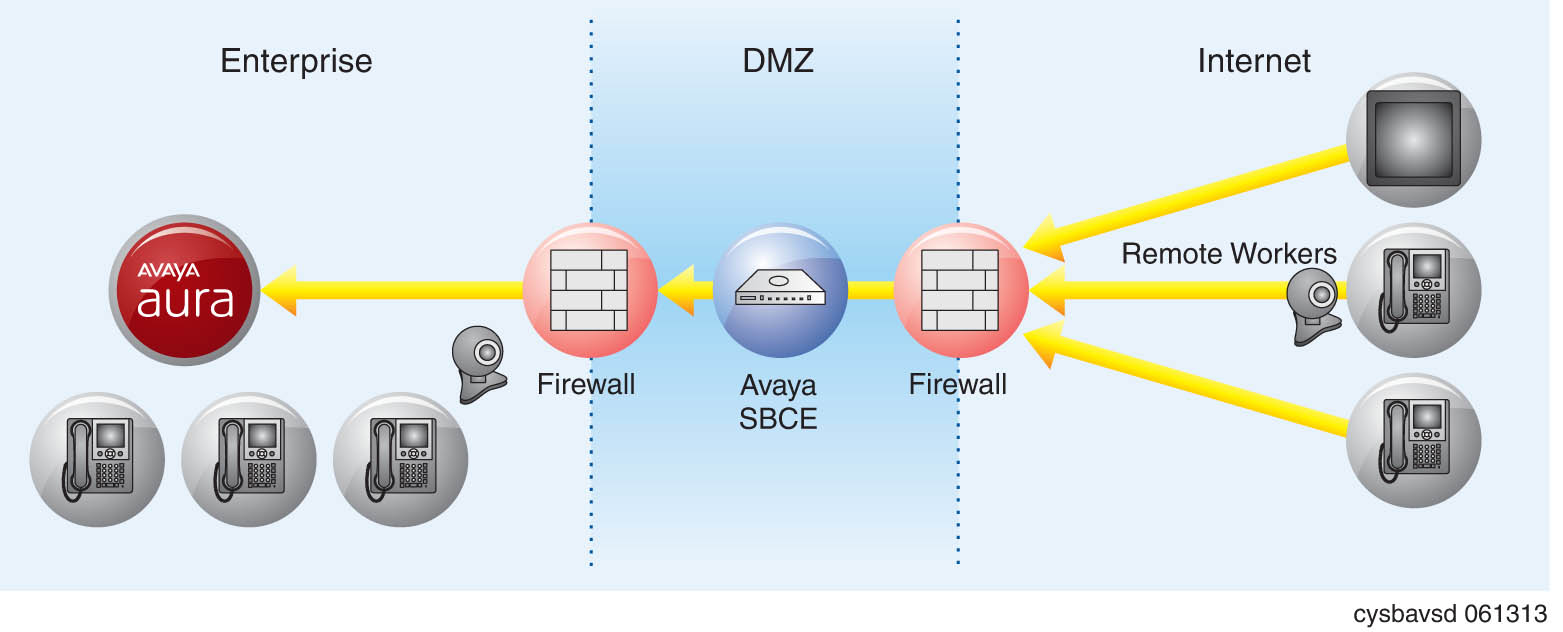
The Remote worker configuration gives remotely located SIP users access to the internal enterprise Unified Communication (UC) network by implementing comprehensive UC security features. These features include sophisticated firewall/NAT traversal, encryption, user authentication, and session and endpoint call policy enforcement.
Remote worker configuration is available for SIP deployments. This configuration uses authentication to verify the legitimacy of the remote user and decrypts TLS-encrypted signaling SIP traffic in real-time. When decryption is completed, the Avaya SBC analyzes traffic for anomalous behavior, attacks, and intrusions, and applies the user-defined UC policies.
The call can originate from a remotely located Remote worker configuration, outside the enterprise network, to an internal user inside the core enterprise network. Then, the Avaya SBC in the enterprise DMZ decrypts the SRTP media coming in to the enterprise from the external IP network or the Internet. The Avaya SBC performs any required Network Address Translation (NAT), analyzes traffic for anomalous behavior, and applies the relevant UC media policies. The Avaya SBC in the DMZ passes the RTP stream to the intended recipient.