

AVAYA DOCUMENTATION CENTER
Find answers to your technical questions and learn how to use our products
Avaya IP Office™ Platform in a Branch Environment Reference Configuration
Rainy day call flows
The next set of call flows are for Rainy day. In a Rainy day scenario, the SIP phones will failover to the IP Office in standalone mode. The standalone mode operates with a reduced SIP feature set which does not support all Sunny day features. In a Rainy day inbound call scenario, the process is as follows: an inbound call rings on all phones until that call is answered. Because bridged line appearances are not supported as a Rainy day feature, once that call is answered, the call will only appear on the active station, and all other stations will show idle. Note that all idle phones will continue to be available to make or answer incoming calls from the local PSTN or make and receive calls from within the store.
Moving an answered call from one phone to another requires a transfer. Only internal store and PSTN dialing is supported, and any non-PSTN extensions to extension dialing will not be routed. To dial any external number in Rainy day, users will need to dial 9 followed by the complete 7 or 10 digit number.
Additionally, due to the dial plan convention adopted, any store to store calling, or calls from corporate locations, are only supported through the PSTN to the main CO lines provisioned. Without any additional programming, all 7 digit dialing from the corporate location or other retail store to a store operating in Rainy day will receive a ‘wave-off’ tone. In order to mitigate this behavior the recommendation is to provide each station with a point of coverage that directs the calling party to primary DID for store where the extension resides.
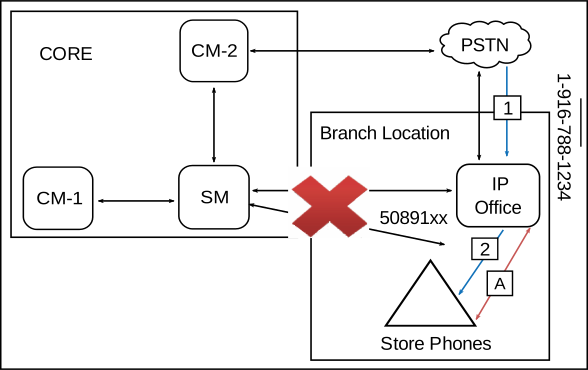
Incoming call — failover, inbound call
|
1
|
Customer dials store extension 1-916-788-1234.
|
|
2
|
IP Office Branch sends the call directly to all registered SIP stations in the hunt group.
|
|
A
|
RTP Media is established between the Store Phone and the IP Office Branch.
|
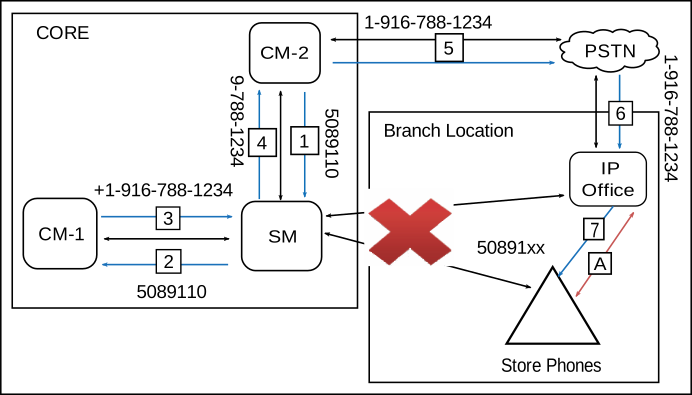
Incoming call from corporate – coverage
|
1
|
Corporate user dials branch extension 5089110
|
|
2
|
SM routes call to CM-1 for origination call processing.
|
|
3
|
CM-1 and SM identify that branch is unreachable. CM-1 routes call to coverage path for 5089110. In this case the remote coverage path would be the E.164 formatted DID of the store +1-916-788-1234.
|
|
4
|
SM sends the call back to the originating CM-2. SM adapts the call to a format that is routable at the local CM-2.
|
|
5
|
CM-2 sends the call to the PSTN.
|
|
6
|
Call is routed through the PSTN to the store through the local CO.
|
|
7
|
IP Office Branch routes the call to a hunt group. This hunt group in turn sends the call to all registered SIP stations at the branch.
|
|
A
|
RTP Media stream is established between the Store Phone and the IP Office Branch.
|