

AVAYA DOCUMENTATION CENTER
Find answers to your technical questions and learn how to use our products
IP Office Security Guidelines
Encryption
Encryption ensures that all data stored on a system or sent by one system to another cannot be 'read' by anyone else. There are two main types of encryption:
Symmetric encryption: is the application of a mathematical process at the originating end, and a reverse process at the receiving end. The processes at each end use the same 'key' to encrypt and decrypt the data.
Asymmetric encryption: uses different keys for encryption and decryption. A common usage is a certificate authority's private and public key.
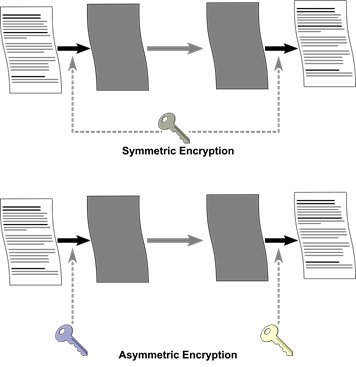
Most message data encryption is symmetric. The data sent may be optionally encrypted using a number of well known algorithms:
Algorithm |
Effective key size (bits) |
Use |
|---|---|---|
DES-40 |
40 |
Not supported – insufficient strength |
DES-56 |
56 |
Not supported – insufficient strength |
3DES |
112 (AKA two key DES) |
Not supported – insufficient strength |
3DES |
168 (AKA three key DES) |
'Low' security. |
RC4-128 |
128 |
'Low' security. |
AES-128 |
128 |
'Medium' security. |
AES-256 |
256 |
'Strong' security. |
In general the larger the key size, the more secure the encryption. However, smaller key sizes usually incur less processing.
IP Office supports encryption using:
Transport Layer Security (TLS v1.2 with v1.0 and v1.1 for legacy)
Secure Shell (SSH v2)
Secure RTP (SRTP)