AVAYA DOCUMENTATION CENTER
Find answers to your technical questions and learn how to use our products
Administering Network Connectivity on Avaya Aura® Communication Manager
Call Admission Control
Call Admission Control (CAC) is a feature to set a limit on the bandwidth consumption or number of calls between network regions.
Note:
If SRTP media encryption is used for SIP and H.323 calls, CAC must be adjusted for the additional overhead imposed by the authentication process. SRTP authentication can add 4 (HMAC32) or 10 (HMAC80) bytes to each packet.
The primary use of this feature is to prevent WAN links from being overloaded with too many calls. To use CAC, set either a bandwidth limit or a number-of-calls limit between network regions, as follows:
Bandwidth consumption is calculated using the methodology explained in Avaya Aura® Core Solution Description.
The L2 overhead is 7 bytes, which is the most common L2 overhead size for WAN protocols.
The calculated bandwidth consumption is rounded up to the nearest whole number.
The calculated bandwidth consumption takes into account the actual IP codec being used for each individual call. All calls do not use the same codec.
If the administrator chooses not to have the server calculate the bandwidth consumption, the user can enter a manual limit for the number of calls. However, this manually entered limit is adhered to regardless of the codec being used. Therefore, the administrator must be certain that all calls use the same CODEC, or that the manual limit calculates the highest possible bandwidth consumption for the specified inter-region codecset.
-
If a call between two network regions traverses an intervening network region, the call server keeps track of the bandwidth consumed across both inter-region connections.
With the Call Admission Control (CAC) sharing between Communication Manager and Session Manager feature, Session Manager acts as the central authority for bandwidth management. Communication Manager obtains bandwidth for voice and multimedia IP connections from Session Manager.
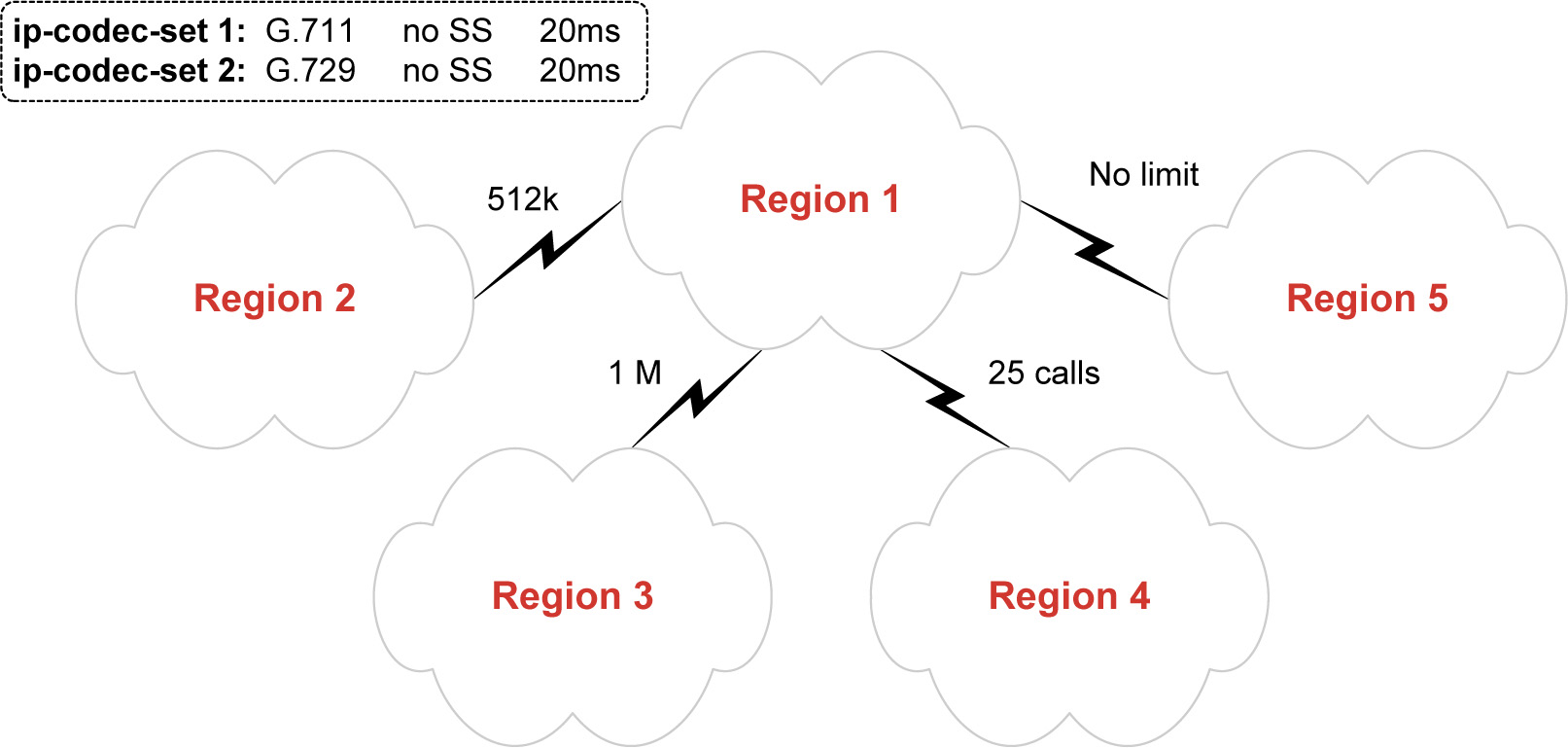
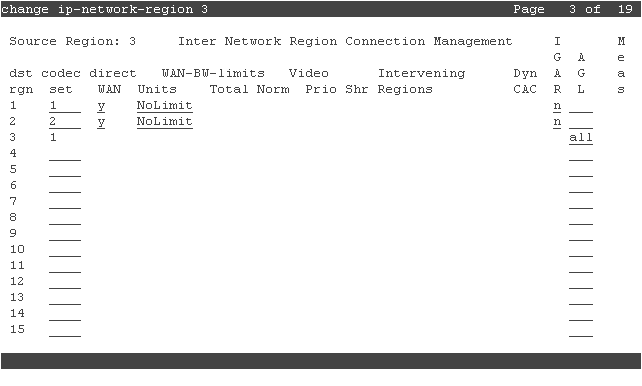
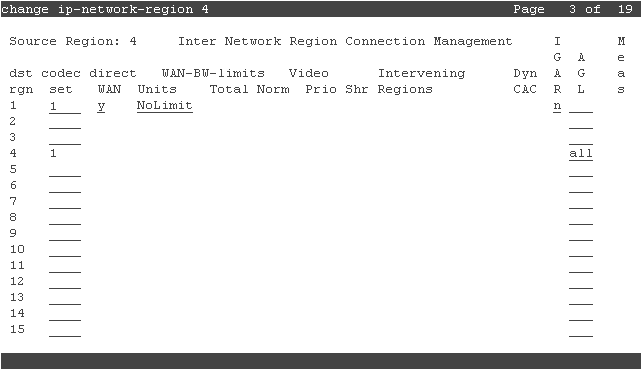
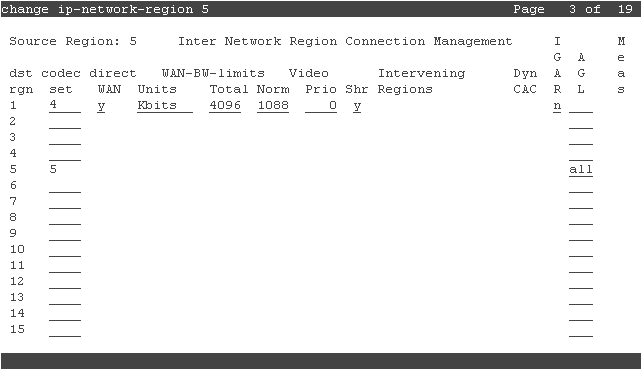
The figure above shows a simple hub-spoke network region topology. The WAN link between network regions 1 and 2 has 512 kbps reserved for VoIP. The WAN link between network regions 1 and 3 has 1 Mbps reserved for VoIP. The link between network regions 1 and 4 is one where the 7-byte L2 overhead assumption cannot hold, such as an MPLS or VPN link. In this case, the administration is such that all inter-region calls terminating in region 4 use the G.729 codec (with no SS at 20 ms).
Therefore, you can set a limit on the number of inter-region calls to region 4. You must know exactly how much bandwidth that CODEC consumes with the MPLS or VPN overhead added. Finally, the link between network regions 1 and 5 requires no limit, either because there are very few endpoints in region 5 or because there is practically unlimited bandwidth to region 5.
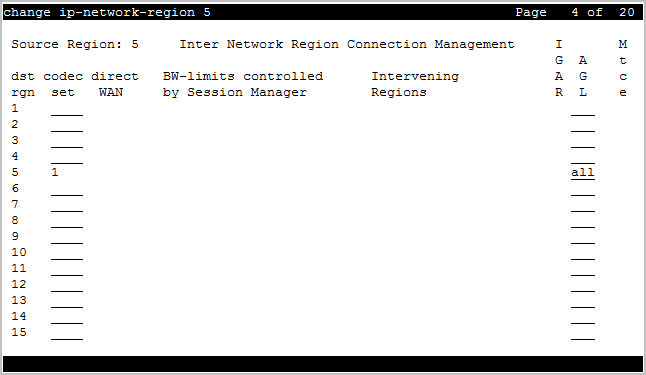
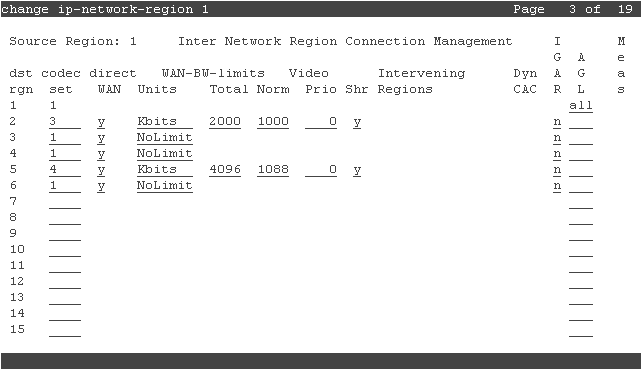
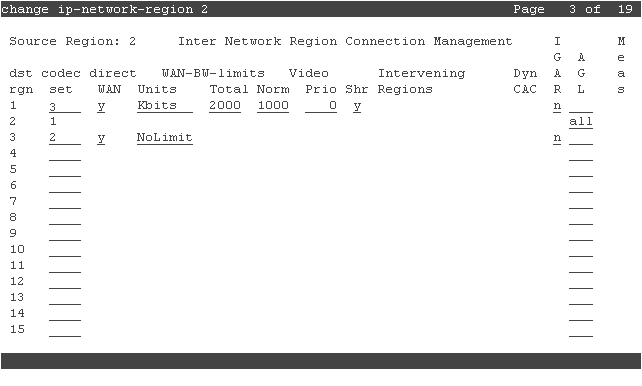
The corresponding IP Network Region screens for each network region are shown below.
Following is the screenshot of the screen when you set the BW Management Option field to shared-SM.