AVAYA DOCUMENTATION CENTER
Find answers to your technical questions and learn how to use our products
Administering Network Connectivity on Avaya Aura® Communication Manager
Considerations for administering FAX, TTY, modem, and Clear-Channel transmission
When configuring your system for FAX, TTY, modem, and Clear-Channel calls over an IP network, consider the following factors:
Encryption
You can encrypt most types of relay and pass-through calls using the Avaya Encryption Algorithm (AEA) or the Advanced Encryption Standard (AES). See Media encryption for FAX, modem, TTY, and clear channel.
Bandwidth usage
Bandwidth use of modem relay varies, depending on the packet size used and the redundancy level selected. The packet size for modem relay is determined by the packet size of the codec selected. Bandwidth use of modem pass-through varies depending on the redundancy level and packet size selected. The maximum packet size for modem pass-through is 20 ms.
Bandwidth use for other modes also varies, depending on the packet size used, whether redundant packets are sent and whether the relay or pass-through method is used.
For the bandwidth usage, see Table : 1 .
Calls with non-Avaya systems
Some FAX calls might have one communicating endpoint connected to a non-Avaya communications system. For such FAX calls, the non-Avaya system and the Avaya system must both have T.38 defined for the codecs.
Modem and TTY calls over the IP network cannot be successfully sent to non-Avaya systems. Modem V.150.1 calls are interoperable with other systems that also support the V.150.1 protocol.
Differing transmission methods at the sending or receiving endpoints
The transmission method or methods used on both the sending and receiving ends of a FAX/modem/TTY/clear channel call must be the same.
Sometimes, a call succeeds although the transmission method for the sending and receiving endpoints is different. Usually, for a call to succeed, the two endpoints must be administered for the same transmission method.
H.320 Video over IP using Clear Channel
H.320 Video over IP using Clear Channel is supported. To support H.320 Video over IP, the port networks or the gateways must have reliable Synchronization Sources and transport for framing integrity of the channels.
Hardware requirements
The relay and pass-through capabilities require the following hardware:
For Avaya S8300E Servers, G450, G430 Branch Gateway, and the Multi-Tech MultiVoIP Gateway, the firmware must be updated to the latest available on http://support.avaya.com
For T.38 FAX capability, endpoints on other non-Avaya T.38 compliant communications systems can send or receive FAX calls using endpoints on Avaya systems.
Multiple hops and multiple conversions
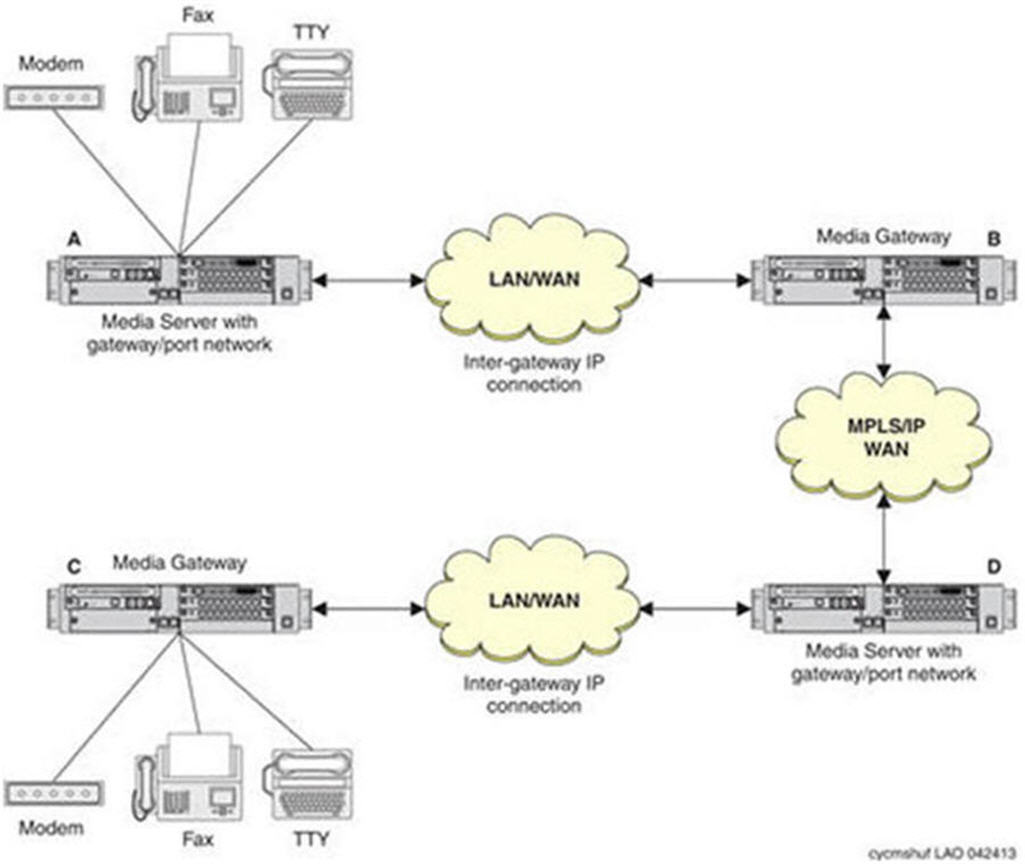
A FAX call can undergo two or more conversion cycles, from TDM protocol to IP protocol and back to TDM protocol. In such situations, the call can fail because of delays in processing through more than one conversion cycle. A modem or TTY call can undergo only one conversion cycle, from TDM to IP protocol and back to TDM protocol, on the communication path. If multiple conversion cycles occur, the call fails. Therefore, both endpoint gateways and any intermediate servers in a path containing multiple hops must support shuffling for a modem or TTY call to succeed.
For example, in the following figure, a hop occurs in either direction for calls between port network A and Gateway C. The calls are transcoded between point B and point D. In this case, shuffling is required on devices A, B, C, and D.
Figure : 1. Shuffling for FAX, modem, and TTY calls over IP