

AVAYA DOCUMENTATION CENTER
Find answers to your technical questions and learn how to use our products
Avaya Aura® Call Center Elite Call Vectoring Feature Description
Specific number dialing
The call center is set up in such a way that a VDN with an accompanying set of VDN skill preferences is assigned to each state that has a resort. For example, the following table shows how skill preferences are assigned to the Texas VDN 3222.
Texas VDN 3222 skill preferences |
||
|---|---|---|
Skill preference |
Skill number |
Agent skill |
1st |
30 |
Agent who has a Texas accent and has visited resorts in Texas |
2nd |
31 |
Agent who has visited resorts in Texas |
3rd |
130 |
Any agent who can make the reservation |
The following figure depicts how Call Vectoring processes a call to the VDN 3222.
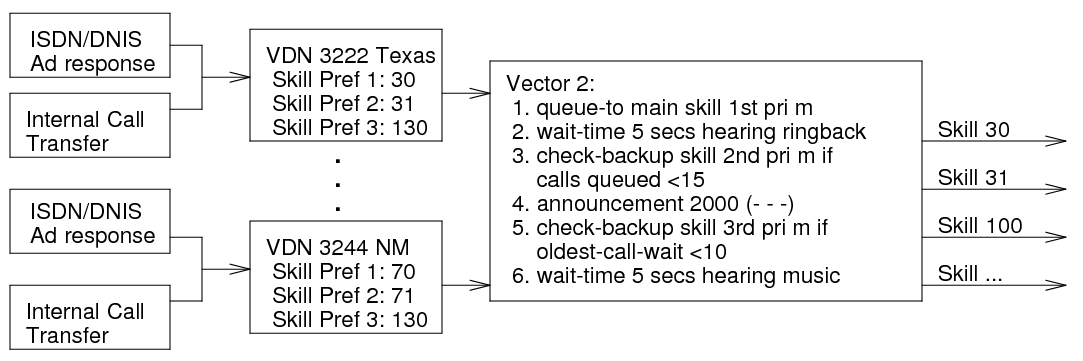
A single VDN for each state is assigned to vector 2. If a caller wants information on resorts in Texas and dials the correct number, for example, 615-3222, the call reaches Communication Manager and is directed to VDN 3222 which points to vector 2.
Once vector processing starts, the queue-to skill command in step 1 queues the call to the skill group that corresponds to the 1st VDN skill, 30-agent with a Texas accent who has visited resorts in Texas. If an agent with skill 30 is available, the agent answers the call. If the agent is not available, the check skill command in step 3 attempts to queue the call according to the stated conditions, if calls-queued < 15, to the skill group that corresponds to the 2nd VDN skill, 31-agent who has visited resorts in Texas. If step 3 fails, the check skill command in step 5 attempts to queue the call based on the stated conditions, that is, if the oldest-call waiting < 10, to the skill group that corresponds to the 3rd VDN skill, 100-any agent who can take a reservation.