

AVAYA DOCUMENTATION CENTER
Find answers to your technical questions and learn how to use our products
Avaya Aura® Call Center Elite Call Vectoring Feature Description
LAI with network ADR
Call Vectoring and LAI are compatible with and supplement the network services Alternate Destination Redirection (ADR) rerouting feature or equivalent service from other network providers. ADR uses ISDN-PRI connectivity with the switch in the same manner as LAI to allow the receiving system to indicate whether a call is to be accepted or rejected. The same type of vector that is used as a receiving ACD for LAI is used at the ADR-receiving ACD. If the call is accepted, it is connected to the system. If the call is rejected, the network routing number is translated to another number that routes the call to the alternate location within dialing-plan constraints. ADR allows for only one alternate location. LAI can be used at the alternate location to test other locations for less-busy conditions.
The following figure shows the configuration for a multilocation application.
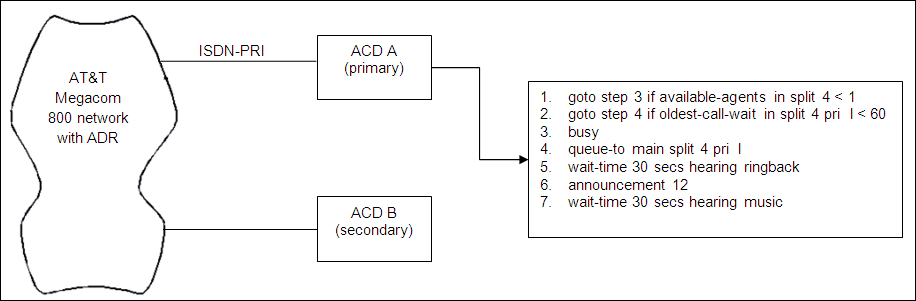
The network requires ISDN-PRI connectivity to primary location A. Connection to secondary location B does not have to be ISDN-PRI. ADR attempts to route the call to location A over the ISDN-PRI link using a routing number that selects a VDN that is assigned to the receiving vector shown.
When the routing attempt is made, Call Vectoring starts processing the vector. The example then proceeds at location A as follows:
Step 1 checks for staffing of the ACD split, and branches to step 3 if it is not staffed.
If the ACD split is staffed, step 2 checks the oldest call waiting time in the split, and branches to step 4 if it is less than 60 seconds.
If the ACD split is unstaffed or if the oldest call waiting time is more than 60 seconds, step 3 rejects the call and returns a busy indication to the network.
If the oldest call waiting time is less than 60 seconds, step 4 accepts the call and queues it. ADR then connects the call through to the receiving system.
Steps 5 through 7 provide ringback, announcement, and music to the caller.
If the vector at location A rejects the call by sending a busy indication back to the network over the ISDN-PRI link, ADR reroutes the call to location B which must accept the call. If location B is closed or too busy to take the call, location B can use Call Vectoring and LAI to check other locations. If other locations exist and can take the call, location B can forward the call. If other locations do not exist or cannot take the call, location B can use Call Vectoring to route the call to location A. If location A is not open, location B can use Call Vectoring to provide an announcement or a busy tone to the caller.