

AVAYA DOCUMENTATION CENTER
Find answers to your technical questions and learn how to use our products
Avaya G430 Branch Gateway CLI Reference
set type (dial-pattern)
Administers the type of outbound call in SLS. The SLS call-engine uses the dial pattern as part of its ARS routing for outbound trunk calls.
Syntax
set type dial-type
Parameters
|
Parameter
|
Description
|
Possible Values
|
Default Value
|
|---|---|---|---|
|
dial-type
|
The dial pattern as part of its ARS routing for outbound trunk calls.
|
emer – Emergency call
fnpa – 10-digit North American Numbering Plan (NANP) call
hnpa – 7-digit NANP call
intl – Public-network international number call
iop – International operator call
locl – Public-network local number call
natl – Non-NANP call
op – Operator assisted call
svc – Service call
|
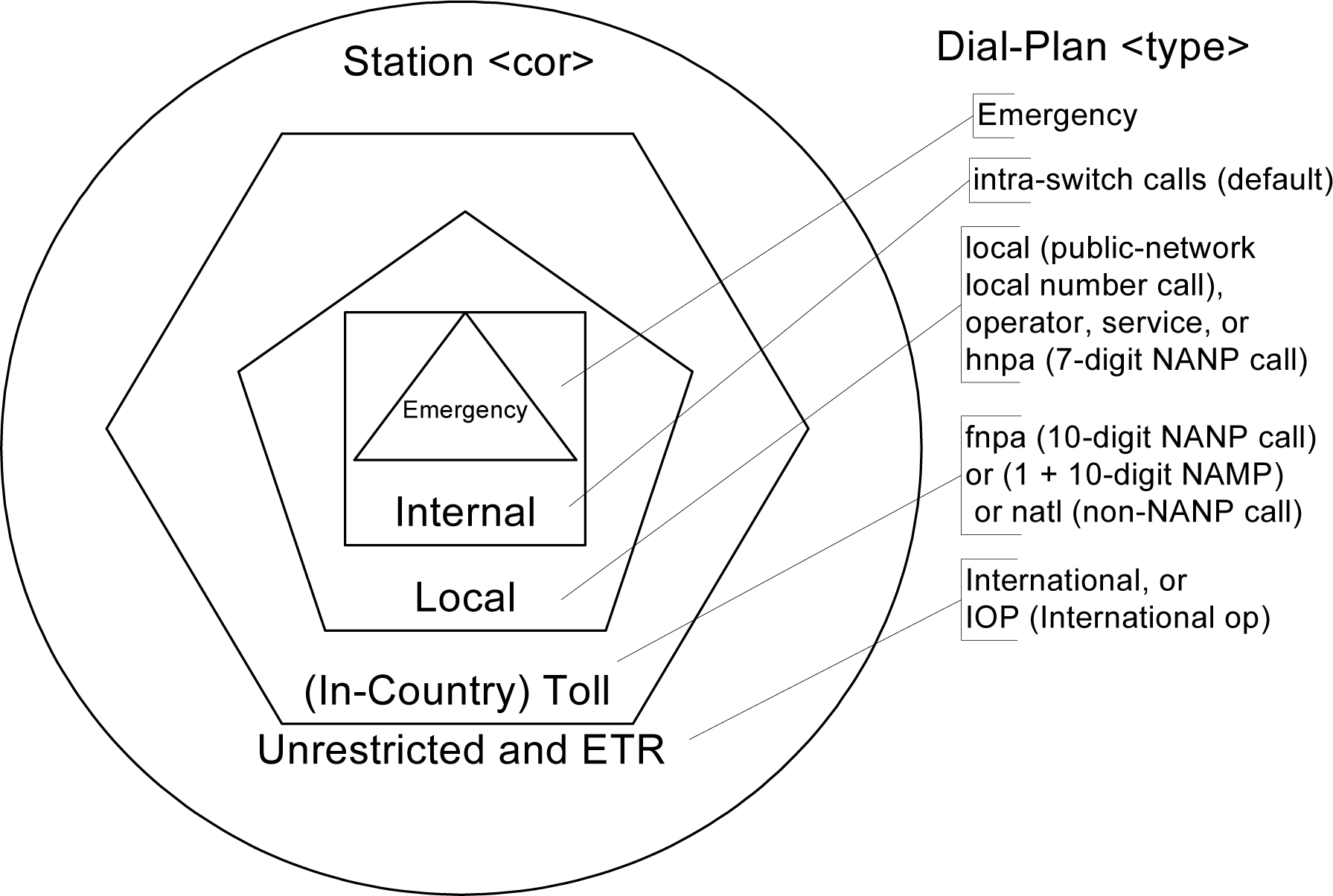
SLS uses the dial-pattern field as part of its ARS routing for station dialed calls that are to be directed to the other stations and to make outbound trunk calls. Make sure to synchronize your choice of station COR and dial-plan dial-type. The following figure illustrates the relationship between the dial-type value and the set cor value (configured in station context). Note the following:
-
The outer boundary of a station’s COR class inherit all the properties of the class symbols encompassed by this class. For example, the
Local
COR class is also able to dial the Emergency COR. -
COR set to
-
COR set to 'Internal' enables the station to place calls to other stations supported by this gateway. The station is also able to dial calls that match dial patterns with dial-type set to
-
COR set to
- ,
- , or
COR set to
COR set to
The Emergency Transfer Relay (ETR) mode is basically equivalent to the Unrestricted class. When power is lost and the gateway enters ETR mode, the station port is directly connected to the trunk port and receives central office dial tone directly. This ETR station port may dial any number that the central office dialing plan affords for this analog trunk.
User level
read-write
Context
sls > dial-pattern
Example
To designate the type of outbound call as a public-network local number call:
Gxxx-001(sls-dial-pattern <dialed-string>)# set type locl