

AVAYA DOCUMENTATION CENTER
Find answers to your technical questions and learn how to use our products
Avaya Aura® Core Solution Description
IEEE 802.1Q standard
Surprisingly, many data network engineers are still not familiar with CoS/QoS. Data networks were not designed for real-time protocols and this section helps the engineers to understand the protocols.
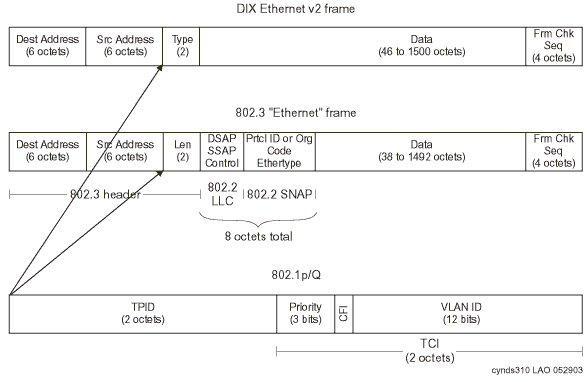
The IEEE 802.1Q standard is a Layer 2 tagging method that adds four bytes to the Layer 2 Ethernet header. IEEE 802.1Q defines the open standard for VLAN tagging. Two bytes house 12 bits that are used to tag each frame with a VLAN identification number. The IEEE 802.1p standard uses three of the remaining bits in the 802.1Q header to assign one of eight different classes of service. Communication Manager users can add the 802.1Q bytes and set the priority bits as desired. Avaya suggests that a priority of 6 be used for both voice and signaling for simplicity. However, the default values are: 5-Video, 6-Voice, and 7-Control. IEEE 802.1p and IEEE 802.1Q are OSI layer 2 solutions and work on frames.
Because 802.1Q is a Layer 2 (Ethernet) standard, it only applies to the Ethernet header. At every Layer 3 boundary (router hop), the Layer 2 header, including CoS parameters, is stripped and replaced with a new header for the next link. Therefore, 802.1Q does not enable end-to-end QoS.