

AVAYA DOCUMENTATION CENTER
Find answers to your technical questions and learn how to use our products
Avaya Aura® Core Solution Description
Processor occupancy and BHCC
The Busy Hour Call Attempt (BHCA) rate is the total number of calls attempted within that system during the busiest hour. This is distinct from the Busy Hour Call Completion (BHCC) rate, which counts only those calls that were actually completed. The BHCC rate determines the call capacity of a system.
In Communication Manager, processor occupancy, also known as server occupancy, consists of three main categories: static occupancy (ST), call processing occupancy (CP), and system management occupancy (SM).
Static occupancy: The processing required for keep-alive operations. Despite the nomenclature, the value of static occupancy in a List Measurements report can slightly vary.
Call processing occupancy: The processing required for setting up, maintaining, and tearing down calls, and for executing vectoring operations in call centers. The processor occupancy of Communication Release 6.3.6 and later for H323 RAS registration limit is 65% .
System management occupancy: The processing required for maintaining the sanity of the system, including periodic maintenance and audits. Due to the bursty nature of system management functions, a fixed portion of the overall processing capacity is allocated to system management for design purposes. For all Communication Manager servers, 27% of the total system processing capacity is assigned for system management. The 27% occupancy is not dedicated to system management but only used for traffic configuration calculations.
If the overall processor occupancy, ST + CP + SM, exceeds approximately 92%, all system management operations are temporarily delayed and subsequent call attempts are disallowed.
Therefore, the recommended total system processing occupancy is not more than 65%. That is, 100% - 27% for system management - 8% for the call throttling region.
Processing occupancy budgets for Communication Manager shows the various occupancy budgets involved. To illustrate, the relationship between Communication Manager processor occupancy and the call rate is depicted as linear, although that is not always the case.
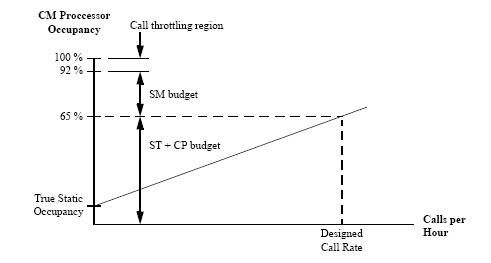
If the value of ST + CP occupancy is between 65% and 92%, some system management functions will be postponed to a quieter traffic period to allow static occupancy and call processing processes to use processor cycles from the system management budget. If the value of ST + CP occupancy exceeds 92%, all system management functions are suppressed and call throttling is initiated.
For more information, see Avaya Aura® Call Center Elite Performance Report.