

AVAYA DOCUMENTATION CENTER
Find answers to your technical questions and learn how to use our products
Maintenance Procedures for Communication Manager, Branch Gateways and Servers
Recovery timers and interactions
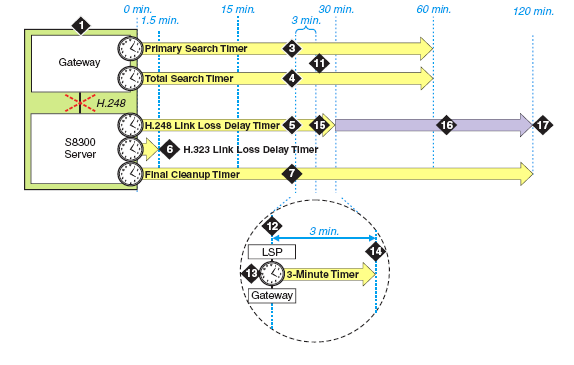
Numbers |
Description |
|---|---|
1 |
Supported servers (Processor Ethernet interface) or Duplicated server series: If the server fails, the Survivable Core Server feature, if available, is launched, starting the No Service Timeout Timer (NSTT; see Note 9). For supported servers, see Avaya Aura® Communication Manager Hardware Description and Reference.
Note:
If the Ethernet connection is broken, then the H.248 signaling connection to the gateway is also broken. |
2 |
Primary Search Timer (PST, see Link Recovery design) begins on the gateway. |
3 |
Total Search Timer (TST, see Link Recovery design) begins on the gateway. |
4 |
Link Loss Delay Timer (1-30 min.) starts when Communication Manager detects loss of connection with a gateway. |
5 |
H.323 Trunk Link Recovery starts a short (1.5 min.) timer to hold the call state information for H.323 (IP) trunks. |
6 |
Final Cleanup Timer (120 min.) cleans up preserved connections that do not have disconnect supervision. |
7 |
Media Gateway Controller list (MGC). The first element in this list is always the primary server; the fifth element is for G450 SLS (survivable-call-engine). |
8 |
Transition point (see Note 8 and Administrating the Media Gateway timer) |
9 |
Note not applicable. |
10 |
If the Primary Search Timer (PST) expires before the gateway can re-establish the link to the alternate resources that are above the Transition Point in the Media Gateway Controller (MGC) list, then the gateway crosses the Transition Point and begins searching the other resources in the list. The gateway makes only one connection attempt with any resources below the Transition Point. If the gateway cannot re-establish the link to any of the resources below the Transition Point, then it starts over at the top of the MGC list and continues to the end, making only one reconnection attempt to each element in the list. This continues until the Total Search Timer (TST) expires. |
11 |
Auto Fallback to Primary starts a 3-minute, administrable timer that checks for network stability before the server accepts the registration requests from the gateway. |
12 |
Auto Fallback to Primary: depending upon its recovery rule, the gateway connects to Survivable Remote Servers before the Link Loss Delay Timer (LLDT) expires. |
13 |
Auto Fallback to Primary: gateway sends registration requests to primary server at 30-second intervals (similar to keep alive signals). Server gives gateways without Survivable Remote Servers service priority to those with Survivable Remote Servers service; see Survivable Remote Servers. |
14 |
Link Loss Delay Timer (LLDT) expires, Connection Preserving failover and failback and Standard Local Survivability (SLS) on the G450 Branch Gateway and G430 Branch Gatewayand J4360/J6350 gateways begin. |
15 |
Connection Preserving failover and failback starts as soon as the gateway migrates to another server. |
16 |
Connection Preserving failover and failback Final Cleanup Timer (FCT) expires. |