AVAYA DOCUMENTATION CENTER
Find answers to your technical questions and learn how to use our products
Maintenance Procedures for Communication Manager, Branch Gateways and Servers
ISDN-BRI and ASAI problems
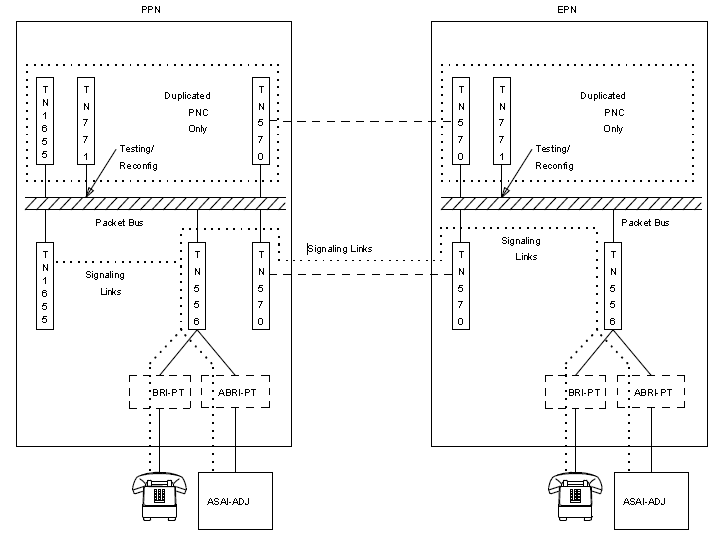
Troubleshooting ISDN-BRI/ASAI problems can be a complex and involved procedure. The reason for this is that ISDN-BRI devices communicate with the server over the packet bus, as opposed to the TDM bus. Therefore, it is possible for another component’s fault related to the packet bus) to cause problems with ISDN-BRI devices. Figure : 1 shows the connectivity of the packet bus as it applies to ISDN-BRI signaling.
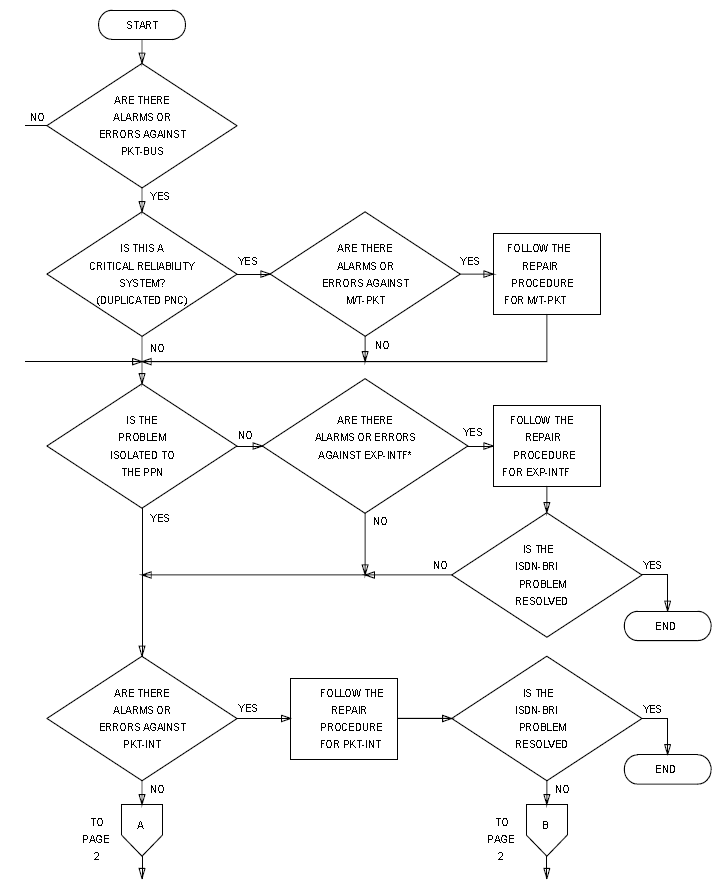
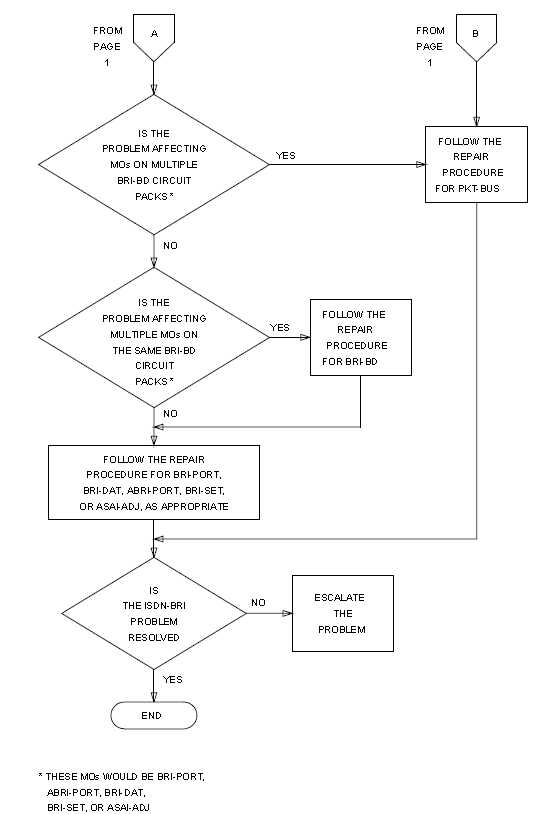
Flow for troubleshooting ISDN-BRI problems
The flowchart in Figure : 2 describes the steps needed to isolate and resolve an ISDN-BRI problem. The order of examining maintenance objects (MOs) can be determined by assessing how wide-spread the failure is. For example, since every ISDN-BRI device in the PN or IPSI-connected PN communicates with the TN2312AP IPSI circuit pack’s Packet Interface circuit, its MO should be examined early in the sequence. On the other hand, a failure of a PN’s TN570 EI circuit pack may cause an ISDN-BRI failure in one PN, but not in another.
Note:
If the flowchart query Is the problem affecting MOs on multiple BRI-BD circuit packs? is reached and the PN in question has only one ISDN-BRI circuit pack, then assume that the answer is Yes, and follow the repair procedure for PKT-BUS.
When directed by the flowchart to refer to the maintenance documentation for a specific MO, keep in mind that the repair procedure for that MO may refer you to another MO’s repair procedure. The flowchart tries to coordinate these activities so that a logical flow is maintained if the ISDN-BRI problems are not resolved with the first set of repair procedures.
The following commands can also be useful when diagnosing ISDN-BRI problems:
status port-network
status packet-interface
status bri-port
status station
status data-module