

AVAYA DOCUMENTATION CENTER
Find answers to your technical questions and learn how to use our products
Administering Avaya G430 Branch Gateway
ICMP keepalive
The ICMP keepalive feature, formerly known as extended keepalive, is available for WAN FastEthernet interfaces. ICMP keepalive is a mechanism for determining if a certain IP address is reachable. The source interface sends test packets (ping) and waits for a response. If no response is received after a certain number of tries, the connection is declared to be down.
This feature provides a quick means to determine whether the interface is up or down. This is especially important for policy-based routing, in which it is important to determine as quickly as possible whether the next hop is available. See Policy-based routing section.
Note:
ICMP keepalive has been replaced by the object tracking feature that supports keepalive probes over WAN, FastEthernet, Loopback, PPPoE, and Dialer PPP interfaces. ICMP keepalive is still supported for backward compatibility.
Normal keepalive is sufficient for testing the status of a direct connection between two points. However, in many situations, the system needs to know the status of an entire path in order to ensure that packets can safely traverse it.
ICMP keepalive is a mechanism that reports on the status of an IP address and its next hop. The destination interface is only declared to be alive if the next hop is also reachable. This feature is critical for mechanisms such as policy-based routing that must guarantee service on a particular path.
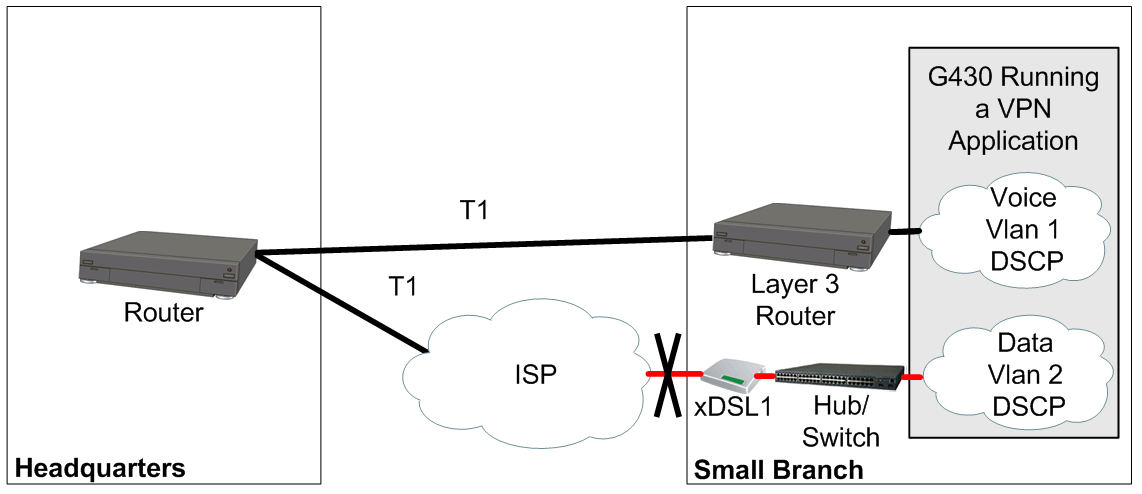
For example, your branch office might have a G430 that connects to an external router that connects to Headquarters over a T1 line and through an xDSL connection to the Internet. The T1 line is used for voice traffic, while data packets are sent over the xDSL line. If the Fast Ethernet line protocol is up but the xDSL connected to it is down, then ICMP keepalive, which checks the next hop, correctly reports that the WAN path is down. Policy-based routing, which relies on the interface status to determine how packets are routed, can use ICMP keepalive to know the status of the interfaces on its next hop list.
Note:
ICMP keepalive is not used with a GRE Tunnel interface. The GRE tunnel has its own keepalive mechanism.