

AVAYA DOCUMENTATION CENTER
Find answers to your technical questions and learn how to use our products
Administering Avaya G430 Branch Gateway
Typical DHCP server application
In the typical application shown in the following table, the Branch Gateway is configured as a local DHCP server and router for IP phones and PCs in the branch office. The remote DHCP server allocates IP addresses for headquarters users. The local DHCP server allocates IP addresses in the branch offices. If there is a local ICC or LSP, calls can still be made. If there is no ICC or LSP to control calls, the DHCP server can allocate IP addresses to all devices, but, since no calls can be made, the IP address allocation effectively applies to PCs only.
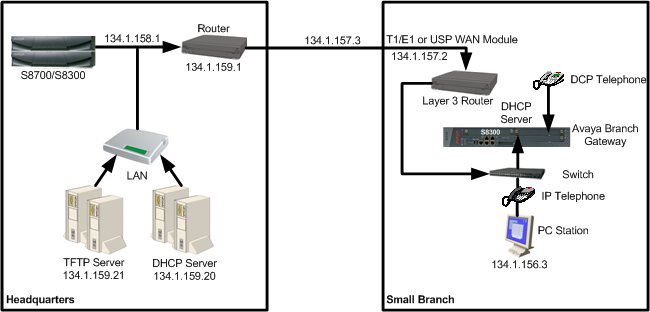
The branch DHCP server does not depend on the headquarters’ DHCP server. There is no backup mechanism between the servers. The branch DHCP server operates continually regardless of the status of the centralized DHCP server or the WAN link.
By default, the DHCP server is inactive. Before activating DHCP server, you configure DHCP pools to define ranges of IP addresses and other network configuration information to be assigned to clients. Create a minimum of two dynamic pools: at least one pool for data devices (PCs) and at least one pool for voice devices (IP phones). The Branch Gateway also supports reservation pools, which map hardware addresses/client identifiers to specific IP addresses. Reservation pools may be required for security issues or servers.
Overlap between pools is not allowed. You cannot configure a reservation pool on an IP address that falls within the range of another pool.