

AVAYA DOCUMENTATION CENTER
Find answers to your technical questions and learn how to use our products
Avaya Contact Center – Extended Capacity Solution Description
Topology
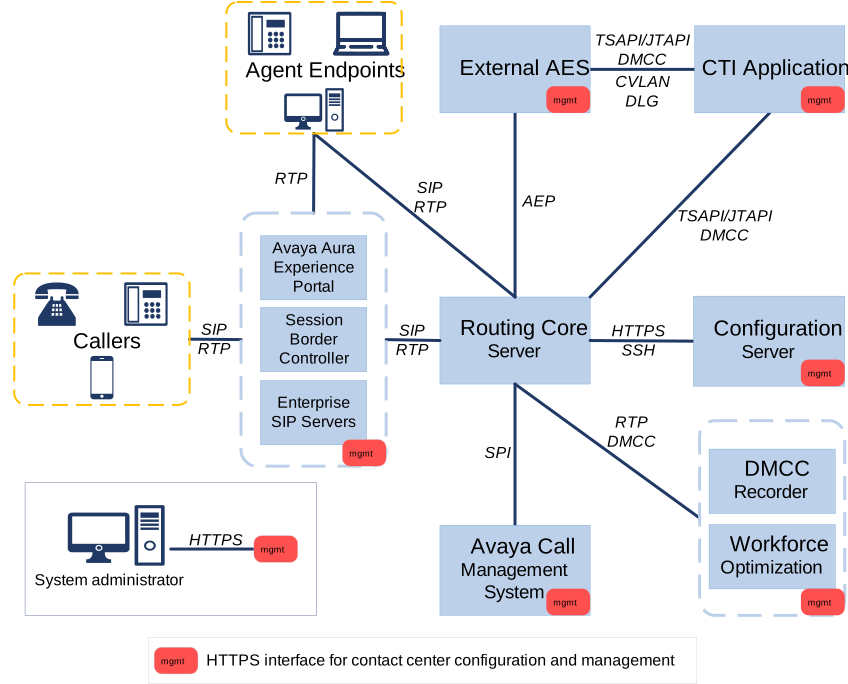
The following diagram provides an overview of the contact center architecture and components:
Component |
Description |
|---|---|
Routing Core Server |
Provides ACD functionality. |
Configuration Server |
Manages the contact center system, security, and maintenance configuration and operation. |
Call Management System |
Provides real-time and historical reports on contact center entities, such as agents and skills. It also provides an administrative interface for supervisors to manage the agent skills. |
DMCC Recorder |
Records calls using Device, Media, and Call Control (DMCC) APIs. |
Workforce Optimization |
Enhances contact center productivity through agent scheduling and quality management. |
External Application Enablement Services |
Provides CTI via TSAPI/JTAPI, DMCC, CVLAN, and DLG. Avaya Contact Center – Extended Capacity supports external AE Services for migration from Avaya Aura® Call Center Elite. The contact center also supports internal AE Services within the Routing Core Server. |
CTI applications |
Monitor and control endpoints, agents, and calls through Application Enablement Services. |
Avaya Experience Portal |
Manages all voice self-service and Integrated Voice Response (IVR) applications. |
Session Border Controller |
Provides network security and interoperability between networks. |
Enterprise SIP servers |
Manage other Unified Communications (UC) and Call Center (CC) systems with SIP interfaces, such as Avaya Aura®. |