

AVAYA DOCUMENTATION CENTER
Find answers to your technical questions and learn how to use our products
Administering Avaya Aura® Session Manager
Enterprise branch survivability configuration
In a typical Enterprise branch survivability setup:
A Branch Session Manager provides service to SIP users if a WAN failure occurs between the branch and core.
A Media Gateway connects the branch to the PSTN and provides media services such as conferencing, tones, and announcements.
A Survivable Remote Server (SRS), formerly known as Local Survivable Processor (LSP), is a survivable processor for the branch Media Gateways. The SRS provides telephony features to SIP users using application sequencing. The SRS becomes active when a Media Gateway loses connectivity to the main Communication Manager.
End user devices register with the primary Session Manager as a primary controller, and use the Branch Session Manager as a secondary or tertiary controller in case of a WAN failure.
A Branch Session Manager provides service when the branch loses WAN connectivity. When a WAN failure occurs:
The Branch Media Gateway loses connectivity with the main Communication Manager, and registers with the Branch Communication Manager SRS. As the result, the SRS starts providing service.
The SIP phones detect connectivity is lost with the core Session Manager and subscribe to the Branch Session Manager.
Configure each Branch Session Manager to support no more than two core Session Managers. You can configure either Session Manager as the primary or the secondary server for a branch user.
Important:
When a WAN outage occurs, the Branch Session Manager supports the SIP endpoints, possible PSTN access, and the ISDN trunks on the media gateways. The Branch Session Manager does not have access to other adjuncts due to the same WAN outage that caused the Media Gateways to register to the SRS.
For SIP trunks configured with adjuncts, the far-end node name ip-address field displays the Branch Session Manager IP address for the active SRS.
Branch Session Manager does not support SIP only users. The Branch Session Manager users must use the local SRS server along with the appropriate user suite license to support local SIP phones. In addition, SIP-only users in the core Session Managers must have a ASM User License.
The following diagram depicts an enterprise branch survivability configuration:
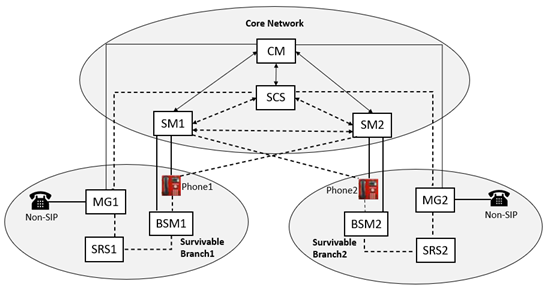
Legend
BSM: Branch Session Manager (Survivable Remote Session Manager)
CM: Main Communication Manager (Feature Server and Evolution Server)
SRS: Survivable Remote Server, formerly known as Local Survivable Processor (LSP)
SCS: Survivable Core Server, formerly known as Enterprise Survivable Processor
MG: Media Gateway
SM: Session Manager