

AVAYA DOCUMENTATION CENTER
Find answers to your technical questions and learn how to use our products
Administering Avaya Aura® Session Manager
Scenarios for Two-Tier Routing
Two-Tier Routing is a route-through mechanism of the Failover Group feature. Two-Tier Routing provides call preservation even if the source and the destination peer SIP entities in a call are associated with different Session Manager instances of different Failover Groups.
The following sample scenarios describe the call routing process in different situations.
Scenario 1
The source and the destination Peer SIP entities (PE) have different associated failover group domains and are connected to the same set of Session Manager instances.
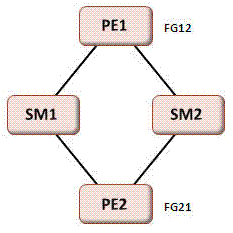
PE1 prefers SM1 (Failover Group FG12) while PE2 prefers SM2 (Failover Group FG21).
FG12 and FG21 resolve SM1 as well as SM2.
During normal condition, the request and response between PE1 and PE2 are routed as: PE1—SM1—SM2—PE2
If SM1 fails, the request and response is routed as: PE1—SM2—SM2—PE2
If SM2 fails, the request and response is routed as: PE1—SM1—SM1—PE2
The Failover Group preserves the call between PE1 and PE2.
Scenario 2
The source and the destination Peer SIP entities have different associated failover group domains and are connected to a different set of Session Manager instances. However, both the Peer SIP entities are connected to the common Session Manager instance.
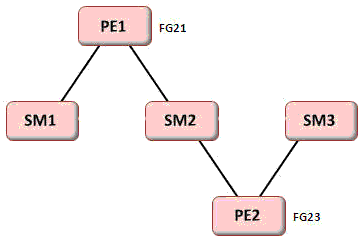
PE1 prefers SM2 (Failover Group FG21) and PE2 also prefers SM2 (Failover Group FG23).
FG21 and FG23 resolve SM2. There is no direct connectivity between SM1 and PE2 as well as SM3 and PE1.
During normal condition, the request and response between PE1 and PE2 is routed as: PE1–>SM2–>SM2–>PE2
If SM2 fails, the Failover Group feature establishes a connection (Two Tier Routing or route through) between SM1 and SM3.
The request and response is routed as: PE1–>SM1–>SM3–>PE2
The Failover Group preserves the call between PE1 and PE2.
Scenario 3
The source and the destination Peer SIP entities have different associated failover group domains, different set of Session Manager instances, and both the Peer SIP entities are connected to a different Session Manager instance.
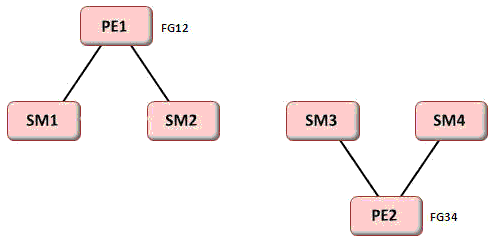
PE1 prefers SM1 (Failover Group FG12) while PE2 prefers SM3 (Failover Group FG34).
There is no direct connectivity between SM1 and PE2 as well as SM4 and PE1.
During normal conditions, the request and response between PE1 and PE2 is routed as: PE1–>SM1–>SM3–>PE2
If SM1 fails, the Failover Group feature establishes a connection (Two Tier Routing or route through) between SM2 and SM3.
The request and response is routed as: PE1–>SM2–>SM3–>PE2
If SM3 fails, the Failover Group feature establishes a connection (Two Tier Routing or route through) between SM1 and SM4.
The request and response is routed as: PE1–>SM1–>SM4–>PE2
The Failover Group preserves the call between PE1 and PE2.