

AVAYA DOCUMENTATION CENTER
Find answers to your technical questions and learn how to use our products
Administering Avaya Aura® Session Manager
Branch survivability: system behavior and remote SIP trunking
The branch survivability configuration, system behavior, and remote SIP trunking information in this topic is generic and is regardless of the Branch Session Manager survivability type, that is, Enterprise branch survivability and Edge friendly branch survivability.
However, in an Edge friendly branch survivability configuration, Avaya Session Border Controller (SBC) is required at the core edge for connectivity to the branch. The branch network is distinct from the enterprise network (core) and the connectivity between them is over the Internet rather than the VPN.
The following diagram depicts an example branch survivability configuration:
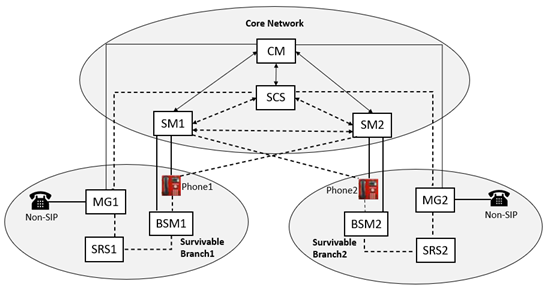
Legend
BSM: Branch Session Manager (Survivable Remote Session Manager)
CM: Main Communication Manager (Feature Server and Evolution Server)
SRS: Survivable Remote Server, formerly known as Local Survivable Processor (LSP)
SCS: Survivable Core Server, formerly known as Enterprise Survivable Processor
MG: Media Gateway
SM: Session Manager
Configuration details
Phone1 has SM1 as primary, SM2 as secondary, and BSM1 as the local Survivability Server.
Phone2 has SM2 as primary, SM1 as secondary, and BSM2 as the local Survivability Server.
Phone1 is served by CM (primary), SCS (backup), and SRS (survivable condition).
Phone2 is served by CM (primary), SCS (backup), and SRS (survivable condition).
MG1 is configured with CM, SCS, and SRS1 as reprioritized list of controllers.
MG2 is configured with CM, SCS, and SRS2 as reprioritized list of controllers.
System Behavior
Phones simultaneously register with multiple SMs in the core and BSM in the branch.
Gateways connect with the highest priority controller that is reachable.
If SM1 fails:
Phone1 registers with SM2 as the active controller
MG1 is served by CM
Phone1 is still served by CM
If Branch1 loses WAN connectivity:
MG1 cannot connect with CM or SCS. It registers with the SRS1 as the controller.
Phone1 cannot connect with SM1 or SM2. It re-registers with the BSM as the active controller.
Phones in the branch are served by survivable elements
SIP endpoints are served by SRS1 using BSM1.
Non-SIP endpoints are served by SRS1 using MG1.
If CM fails:
Media Gateways registers with the SCS as the controller.
SIP phones are served by SCS using SMs in the core.
Non-SIP phones are served by SCS using Media Gateways.
Remote SIP Trunking
With Public SIP Trunks in a branch location, an enterprise can build network topologies to route SIP traffic to external networks using the branch locations. The network topologies can include the following:
Intra-enterprise calls such as SIP to SIP, SIP to Non-SIP, Non-SIP to SIP, Non-SIP to Non-SIP.
Enterprise-bound call from the PSTN (destinations are SIP and non-SIP endpoints).
Enterprise-originated calls towards the PSTN (SIP and non-SIP originations).
The Branch Session Manager connects with the SIP Service Provider and supports incoming and outgoing SIP Service Provider traffic, irrespective of network connectivity to the data center.