

AVAYA DOCUMENTATION CENTER
Find answers to your technical questions and learn how to use our products
Programming Call Vectoring Features in Avaya Aura® Call Center Elite
Limitations of traditional ACD call processing
In the traditional Automatic Call Distribution (ACD) approach, all calls within a queue receive identical announcements and intraflow parameters. The following figure depicts a simplified version of the traditional ACD call processing approach.
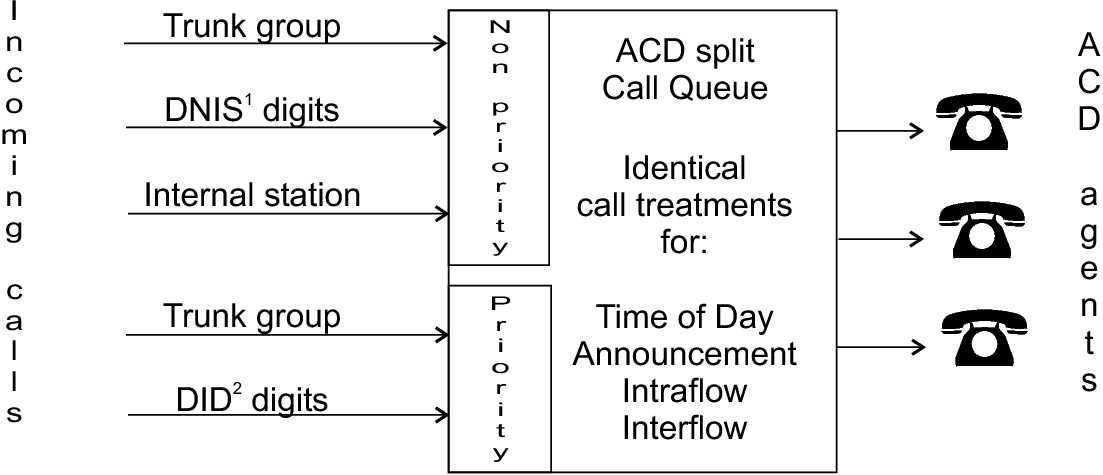
Dialed Number Identification Service (DNIS)
Direct Inward Dialing (DID)
With Call Vectoring, each call is unique and the call treatment is based on a number of factors, including the number that the caller dials, the number that the caller calls from, the number of calls in queue, the time of the day, and the day of the week. Call Vectoring also applies to calls that are handled by the same agent group.
Call Vectoring comprises the following basic components:
Vector Directory Numbers (VDN)
Vectors
Vector commands
The components direct incoming calls and ASAI event reports and requests to the destinations. The components also specify the call treatment. You can set up Call Vectoring as shown in the following figure.
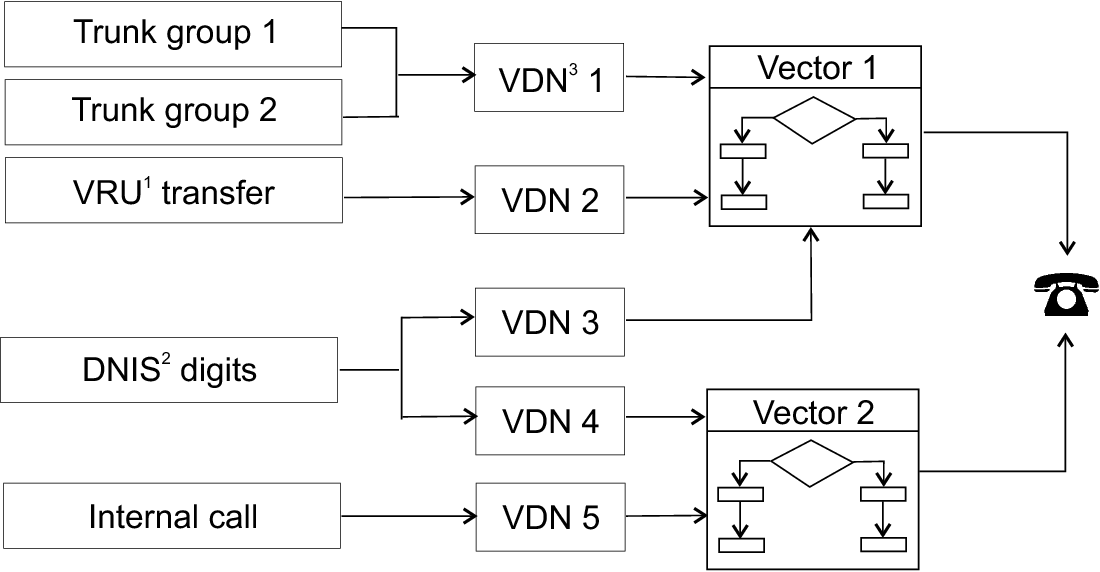
Voice Response Unit (VRU)
Dialed Number Identification Service (DNIS)
Vector Directory Number (VDN)
If you set Call Vectoring to y, Communication Manager directs the incoming call to a VDN, which is a soft extension number that directs the call to a specific vector. The VDN represents a call type or category, for example billing or customer service. The VDN defines the type of service required by the caller. You can use multiple VDNs to point to the same vector or to different vectors, depending on whether you want the relevant calls to receive the same or different treatment.
The following is an example of the function of a vector:
1. goto step 3 if calls-queued in split 9 pri l < 20
2. busy
3. queue-to split 9 pri l
4. wait-time 12 seconds hearing ringback
5. announcement 2921
6. wait-time 998 seconds hearing music
A vector can contain up to 99 command steps. You can link multiple vectors to extend the processing capabilities or to process calls to the same or different destinations. Any number of calls can use the same multiple vectors.