AVAYA DOCUMENTATION CENTER
Find answers to your technical questions and learn how to use our products
Avaya Aura® Communication Manager Alarms, Events, and Logs Reference
DS1 ISDN Trunk Service States
The status trunk command shows the following possible service states for ISDN trunks.
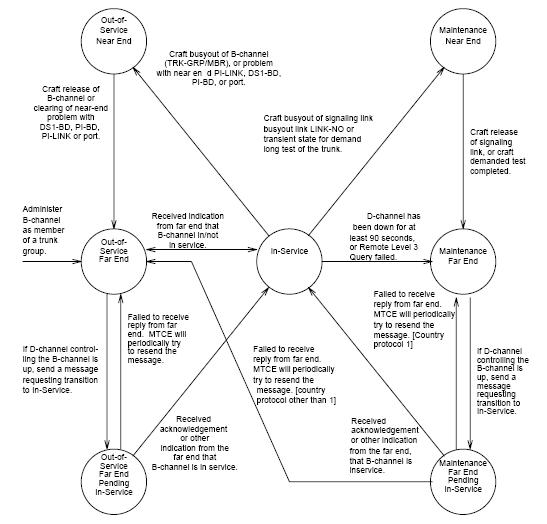
In-Service (INS)
The B-Channel is in its normal operating state.
Out-of-Service/Far-End (OOS/FE)
A B-Channel is initialized to this state when administered. The switch sends messages to the far end to negotiate the B-Channel into service. If the far end does not respond to the messages within a certain time period, then the service state remains out of service and maintenance will periodically resend the messages. The trunk is unusable for incoming and outgoing calls.
On US interfaces, the trunk is unusable for incoming calls, but on non-US interfaces, incoming calls will be accepted.
Out-of-Service/Near-End (OOS/NE)
This is the state of the trunk when the NPE Crosstalk Test fails or when the trunk is busied out by the system technician. In this state, the trunk is unusable for incoming or outgoing calls. No messages are sent to the far end until the signaling link comes back into service or the trunk is released by the system technician.
Maintenance/Far-End (MTC/FE)
This state is reached when the far end does not respond after a certain amount of time to messages sent over the signaling link for a particular trunk. This state is different from OOS/FE since the signaling link must have initially been up and the B-Channels in service. The switch will periodically send messages to the far end to try to negotiate the trunk (B-Channel) into service. The trunk is unusable for outgoing calls but will service incoming call requests from the far end. Note that transitions into MTC/FE do not drop stable calls. Therefore, if the service state changes from in service to MTC/FE, then stable calls are unaffected.
Maintenance/Near-End (MTC/NE)
The trunk (B-Channel) is in this state if the signaling channel (ISDN-PLK) is busied out by the system technician. The trunk (B-Channel) is also temporarily in this state if the system technician enters test trunk grp#/mem# long. This command executes the ISDN-PRI test call. This test changes the state of the trunk member to MTC/NE for the duration of the test unless a call request comes in from the far end. In that case, the test would abort. Note that transitions into MTC/NE do not drop stable calls. In this state, the B-Channel is not usable for new incoming or outgoing calls.
Pending States
In addition to one of the previous components, the service state may have a pending component, indicating that the switch is waiting for a reply from the far end. These service states remain in effect until either a response is received or the allotted waiting time expires.
Pending-in-Service
The near end is awaiting a far-end response to a B-Channel maintenance message requesting that a B-Channel be transitioned to in service.
The far-end has a certain amount of time to respond to the message. The service state will be PINS until either a response is received or the timer expires.
Pending-Maintenance
This state is supported only by systems using country protocol 1 (including US). The near end is awaiting a far-end response to a maintenance message requesting that a B-Channel be transitioned to the maintenance service state. The far-end has a certain amount of time to respond to the message. The service state will be PMTC until either a response is received or the timer expires.
Call Activity States
The in-service state also has a call activity component.
Active
A call is connected over the B-Channel. For example, in service active.
Idle
There is no call currently on the B-Channel. For example, in service .
The following diagram of the DS1 ISDN Trunk service states shows the common progression from one service state to another and the event that caused the change of state.