

AVAYA DOCUMENTATION CENTER
Find answers to your technical questions and learn how to use our products
Avaya Aura® Communication Manager Screen Reference
Feature Access Code (FAC)
Assigns feature access codes (FACs) that, when dialed, activate or cancel system features.
Example command: change feature-access-codes
Feature Access Code: page 1
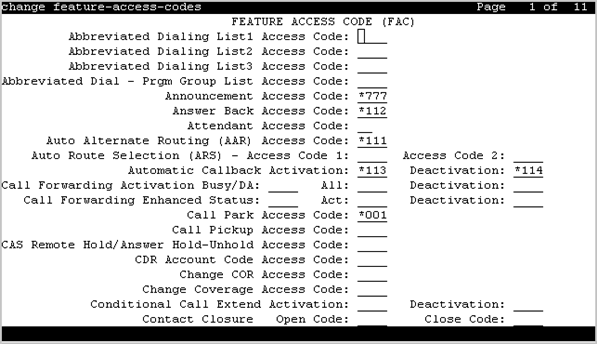
Abbreviated Dialing List1 Access Code
A feature access code (FAC) used to access AD list 1.
This value must conform to the FACs or dial access codes defined by the dial plan.
Abbreviated Dialing List2 Access Code
A feature access code (FAC) used to access AD list 2.
This value must conform to the FACs or dial access codes defined by the dial plan.
Abbreviated Dialing List3 Access Code
A feature access code (FAC) used to access AD list 3.
This value must conform to the FACs or dial access codes defined by the dial plan.
Abbreviated Dial - Prgm Group List Access Code
FAC used to enter a group list from a telephone. The user’s extension must be administered with permission to program the group list.
This value must conform to the FACs or dial access codes defined by the dial plan.
Announcement Access Code
FAC used to record announcements.
This value must conform to the FACs or dial access codes defined by the dial plan.
Answer Back Access Code
FAC used to retrieve parked calls. If no one answers the call before a system-wide expiration interval expires, the system redirects the call.
This value must conform to the FACs or dial access codes defined by the dial plan.
Auto Route Selection (ARS) Access Code 2
Additional FAC used to access ARS.
This value must conform to the FACs or dial access codes defined by the dial plan.
Attendant Access Code
FAC used to call the attendant. While only one attendant can be administered for the dial plan, more than one attendant FAC can be administered in a single distributed network. Attendant access numbers can start with any number from 0 to 9 and contain one or two digits. Available only if an attendant call type is not administered for the dial plan.
This value must conform to the FACs or dial access codes defined by the dial plan.
Auto Alternate Routing (AAR) Access Code
FAC used to access AAR. AAR routes calls to a different route than the first-choice route when facilities are unavailable.
This value must conform to the FACs or dial access codes defined by the dial plan.
Automatic Callback Activation/Deactivation
FAC used to activate or cancel Automatic Callback. Automatic Callback enables internal callers, upon reaching a busy extension, to have the system automatically connect and ring both originating and receiving parties when the receiving party becomes available.
This value must conform to the FACs or dial access codes defined by the dial plan.
Auto Route Selection (ARS) Access Code 1
FAC used to access ARS. The system can automatically choose the least-expensive way to send a toll call. You can have one ARS access code for local and one for long distance, and route accordingly.
This value must conform to the FACs or dial access codes defined by the dial plan.
Call Forwarding Activation Busy/DA
FAC used to forward calls to an administered number if the user is busy or does not answer.
This value must conform to the FACs or dial access codes defined by the dial plan.
Call Forwarding Enhanced Activation/Deactivation
FAC numbers used to activate and deactivate Enhanced Call Forwarding. Enhanced Call Forwarding forwards incoming calls to different destinations depending on whether they are from internal or external sources. The FACs for activation and deactivation must be administered together.
This value must conform to the FACs or dial access codes defined by the dial plan.
Call Forwarding Enhanced Status
FAC used to display the status of Enhanced Call Forwarding.
This value must conform to the FACs or dial access codes defined by the dial plan.
Call Park Access Code
FAC used to park an active call that can then be retrieved from a different station using the answer back access code. The call park access code cannot have the same first digit as another feature access code that is longer in length.
This value must conform to the FACs or dial access codes defined by the dial plan.
Call Pickup Access Code
FAC used to answer a call directed to a pickup group.
This value must conform to the FACs or dial access codes defined by the dial plan.
CAS Remote Hold/Answer Hold-Unhold Access Code
FAC used by a Centralized Attendant Service (CAS) attendant to place calls on hold and answer calls held at a remote server running Communication Manager. This FAC can also be used by an analog station. Flashing the switch-hook for the proper interval (between 200 and 1000 ms) while talking on an existing call causes the existing call to be placed on soft hold, using which the analog user can dial the Answer Hold-Unhold FAC to Hard hold the call.
This value must conform to the FACs or dial access codes defined by the dial plan.
CDR Account Code
FAC used prior to entering an account code for Call Detail Recording (CDR) purposes. CDR is a feature that uses software and hardware to record call data.
This value must conform to the FACs or dial access codes defined by the dial plan.
Change COR Access Code
Using FAC, users can change their class of restriction (COR) from a telephone. Available only if Change COR by FAC is enabled for the system.
This value must conform to the FACs or dial access codes defined by the dial plan.
Change Coverage Access Code
FAC used to change a coverage path from a telephone or remote station. The coverage path is the order in which calls are redirected to alternate answering positions.
An extension must have station Security Codes administered to use this FAC.
This value must conform to the FACs or dial access codes defined by the dial plan.
Contact Closure Close Code
FAC used to close a contact closure relay. Contact closures control electrical devices remotely. Users use an FAC to activate electrical devices such as electrical door locks. If Contact Closure Open Code is administered, then Contact Closure Close Code must also be administered.
This value must conform to the FACs or dial access codes defined by the dial plan.
Contact Closure Open Code
FAC used to open a contact closure relay. Contact closures control electrical devices remotely. Users use an FAC to activate electrical devices such as electrical door locks. If Contact Closure Close Code is administered, then Contact Closure Open Code must also be administered.
This value must conform to the FACs or dial access codes defined by the dial plan.
Feature Access Code: page 2
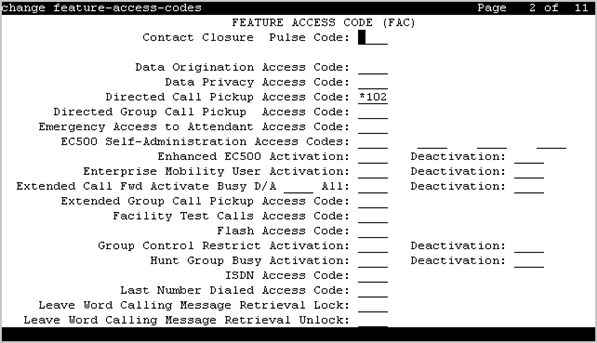
Contact Closure Pulse Code
FAC used to pulse a contact closure relay.
This value must conform to the FACs or dial access codes defined by the dial plan.
Data Origination Access Code
FAC used to originate a data call from a voice station.
This value must conform to the FACs or dial access codes defined by the dial plan.
Data Privacy Access Code
FAC used to isolate a data call from call waiting or other interruptions.
This value must conform to the FACs or dial access codes defined by the dial plan.
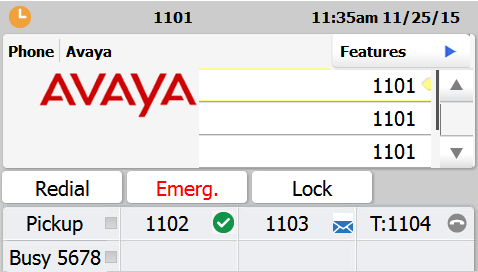
Directed Call Pickup Access Code
The FAC used with the extension number for which the user wants to pick up a call. To pick up a call for an extension, the user dials the FAC followed by the extension number. The called extension number stops ringing and the user connects to the call for pickup.
The FAC value must conform to the FACs or dial access codes defined in the dial plan.
Directed Group Call Pickup Access Code
The FAC used to pickup a call from any pickup group.
The FAC value must conform to the FACs or dial access codes defined in the dial plan.
EC500 Self Administration Access Code
Using FAC, users can self-administer their cell phone number for the Extension to Cellular feature. Users can add or change their cell phone number through this feature access code. An administrator can still enter or change cell phone numbers. The user calls the Self Administration Access Code access code and enters their cell phone number.
This value must conform to the FACs or dial access codes defined by the dial plan.
Emergency Access To Attendant Access Code
FAC used to gain access to the attendant in an emergency. Such calls alert as emergency calls.
Available only if Emergency Access to Attendant is enabled for the system.
This value must conform to the FACs or dial access codes defined by the dial plan.
Enhanced EC500 Activation
Using FAC, users can activate Extension to Cellular remotely.
This value must conform to the FACs or dial access codes defined by the dial plan.
Enhanced EC500 Deactivation
Using FAC, users can deactivate Extension to Cellular remotely.
This value must conform to the FACs or dial access codes defined by the dial plan.
Enterprise Mobility User Activation
FAC used to activate the Enterprise Mobility User feature for a particular user, associating the features and permissions of their primary telephone to a telephone of the same type anywhere within the customer’s enterprise.
This value must conform to the FACs or dial access codes defined by the dial plan.
Enterprise Mobility User Deactivation
FAC used to deactivate the Enterprise Mobility User feature.
This value must conform to the FACs or dial access codes defined by the dial plan.
Extended Call Fwd Activate All
FAC used to activate call forwarding from a telephone or remote location.
An extension must have station Security Codes administered to use this FAC.
This value must conform to the FACs or dial access codes defined by the dial plan.
Extended Call Fwd Activate Busy D/A
FAC used to activate call forwarding from a telephone or remote location.
An extension must have station Security Codes administered to use this FAC.
This value must conform to the FACs or dial access codes defined by the dial plan.
Extended Call Fwd Deactivation
FAC used to deactivate call forwarding from a telephone or remote location.
An extension must have station Security Codes administered to use this FAC.
This value must conform to the FACs or dial access codes defined by the dial plan.
Extended Group Call Pickup Access Code
FAC used to answer a call directed to another pickup group. Users must enter a valid pickup number following this field to complete the operation.
This value must conform to the FACs or dial access codes defined by the dial plan.
Facility Test Calls Access Code
FAC used to place a facility test call.
This value must conform to the FACs or dial access codes defined by the dial plan.
Security alert:
To ensure the security of your system, leave this field blank except when actually testing trunks.
Flash Access Code
FAC used to generate trunk flash. This code ensures that the flash signal is interpreted by the local telephone company central office switch, rather than by Communication Manager.
This value must conform to the FACs or dial access codes defined by the dial plan.
Group Control Restrict Activation/Deactivation
FAC used to change the restriction level for all users with a given class of restriction. Requires console permissions.
This value must conform to the FACs or dial access codes defined by the dial plan.
Hunt Group Busy Activation/Deactivation
Hunt group members use the Hunt Group Busy Activation FAC to make the extension unavailable and the Hunt Group Busy Deactivation FAC to make the extension available.
The hunt group member must dial:
a two-digit hunt group number for a hunt group supporting up to 99 extensions (small hunt group) or
a four-digit hunt group number for a hunt group supporting up to 8000 extensions (large hunt group)
If needed, the hunt group member must add zeros before the hunt group number to ensure that the small hunt group has a two-digit number and the large hunt group has a four-digit number.
This value must conform to the FACs or dial access codes defined by the dial plan.
ISDN Access Code
FAC used to place an ISDN call without using ARS, AAR, or UDP.
This value must conform to the FACs or dial access codes defined by the dial plan.
Last Number Dialed Access Code
FAC used to redial the last number dialed from this station.
This value must conform to the FACs or dial access codes defined by the dial plan.
Leave Word Calling Message Retrieval Lock
FAC used to lock the display module on telephones. The lock function activates at a telephone by dialing this system-wide lock access code. This prevents unauthorized users from displaying, canceling, or deleting messages associated with the telephone. Available only if Lock Messages is administered for the station.
This value must conform to the FACs or dial access codes defined by the dial plan.
Leave Word Calling Message Retrieval Unlock
FAC used to unlock a telephones display module. The lock function is canceled at the telephone by dialing this unlock FAC followed by the SCC.
This value must conform to the FACs or dial access codes defined by the dial plan.
Feature Access Code: page 3
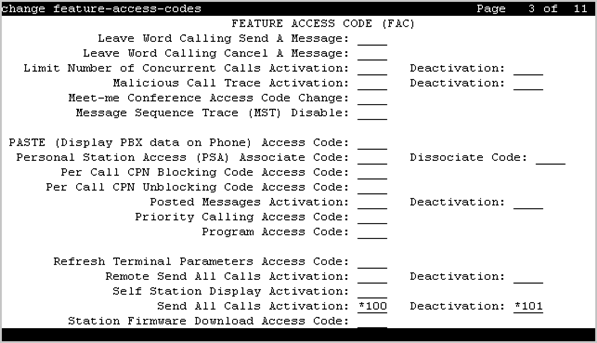
Leave Word Calling Cancel A Message
FAC used to cancel a leave word calling message.
This value must conform to the FACs or dial access codes defined by the dial plan.
Leave Word Calling Send A Message
Using FAC, users can send a leave word calling message that allows internal system users to leave a short pre-programmed message for other internal users.
This value must conform to the FACs or dial access codes defined by the dial plan.
Limit Number of Concurrent Calls Activation/Deactivation
Use this field to configure the feature access codes to enable or disable the Limit Number of Concurrent Calls feature. If a user dials the activation FAC, Communication Manager restricts the number of incoming calls on the station to one call at a time. If the station user is busy, the subsequent incoming calls receive a busy tone or are transferred to voice mail.
Note:
Communication Manager Release 6.2 and earlier supported the Limit Number of Concurrent Calls feature on H.323 and DCP stations. Communication Manager Release 6.3.6 extends this support to SIP stations.
Malicious Call Trace Activation
FAC used to activate a trace request on a malicious call.
This value must conform to the FACs or dial access codes defined by the dial plan.
Meet-me conference access code change
Using FAC, the controlling user of a Meet-me Conference VDN can change the access code. The Meet-me Conference feature is used to set up a dial-in conference of up to 6 parties.
Note:
For 12 parties to participate in a conference, you must enable the 12–party Conferences field in the Feature-Related System-Parameters screen.
This value must conform to the FACs or dial access codes defined by the dial plan.
Message Sequence Trace (MST) Disable
Provides the ability to disable the MST traces using a Feature Access Code.
PASTE (Display PBX data on telephone) Access Code
FAC used to view call center data on display telephones. PASTE is used in conjunction with Avaya IP Agent.
This value must conform to the FACs or dial access codes defined by the dial plan.
Per Call CPN Blocking Code Access Code
Use this FAC to activate Calling Party Number (CPN) blocking of a station. When users dial the code, the calling party information is not sent to the public network.
This value must conform to the FACs or dial access codes defined by the dial plan.
Per Call CPN Unblocking Code Access Code
Use this FAC to deactivate Calling Party Number (CPN) blocking of a station. When users dial the code, the calling party information is sent to the public network.
This value must conform to the FACs or dial access codes defined by the dial plan.
Personal Station Access (PSA) Associate Code
FAC used to associate a telephone with the telephone features assigned to a users extension.
Available only if Personal Station Access (PSA) is enabled for the system.
This value must conform to the FACs or dial access codes defined by the dial plan.
Personal Station Access (PSA) Dissociate Code
FAC used to remove the association between a physical telephone and an extension number.
Available only if Personal Station Access (PSA) is enabled for the system.
This value must conform to the FACs or dial access codes defined by the dial plan.
Posted Messages
FAC used to access the Posted Messages feature. The Posted Messages feature provide callers with a displayed message on the telephone that states why the user is unavailable to take a call.
Available only if the Posted Messages feature is enabled for the system.
This value must conform to the FACs or dial access codes defined by the dial plan.
Priority Calling Access Code
FAC used to enable priority calling, a special type of call alerting between internal telephone users, including the attendant. The called party hears a distinctive ringing when the calling party uses Priority Calling.
This value must conform to the FACs or dial access codes defined by the dial plan.
Program Access Code
FAC used to program abbreviated dial buttons on an individual telephone.
This value must conform to the FACs or dial access codes defined by the dial plan.
Refresh Terminal Parameters Access Code
Feature Access Code (FAC) is used to request a refresh of the terminal parameters on a telephone that supports downloadable parameters. This FAC is used after a DCP telephone is installed or replaced to ensure that all the terminal parameters, including button labels, are sent to the telephone.
Remote Send All Calls Activation/Deactivation
FAC used to activate or deactivate the Send All Calls feature. Requires console permissions.
This value must conform to the FACs or dial access codes defined by the dial plan.
Self Station Display Activation
FAC used on a digital station to display its primary extension number when the FAC is entered.
This value must conform to the FACs or dial access codes defined by the dial plan.
Send All Calls Activation/Deactivation
FAC used to activate or deactivate sending all calls to coverage with minimal or no alerting at the station.
This value must conform to the FACs or dial access codes defined by the dial plan.
Station Firmware Download Access Code
FAC used for 2420/2410 DCP station firmware downloads.
This value must conform to the FACs or dial access codes defined by the dial plan.
Feature Access Code: page 4
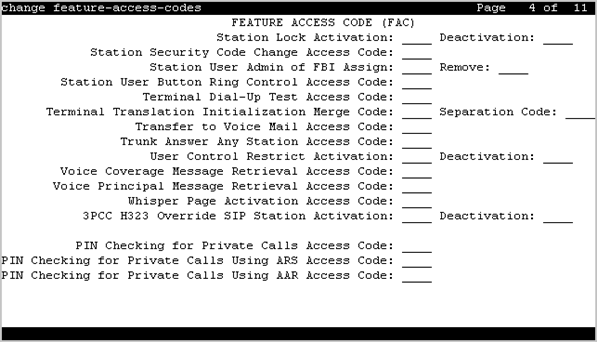
3PCC H323 Override SIP Station Activation/Deactivation
FAC used to activate and deactivate third party call control (3PCC) redirect actions from a SIP desktop station to a remote softphone or virtual private network H.323 telephone.
This value must conform to the FACs or dial access codes defined by the dial plan.
PIN Checking for Private Calls Access Code
This FAC enables the PIN Checking for Private Calls feature. Use this feature to allow users to make calls that are restricted and that prompt users to enter a Personal Identification Number (PIN) after dialing the FAC. The system displays this field only if PIN Checking for Private Calls is enabled.
This value must conform to the FACs or dial access codes defined by the dial plan.
PIN Checking for Private Calls Using AAR Access Code
This FAC enables the PIN Checking for Private Calls feature. Use this feature to allow users to make calls that are restricted and prompt users to enter a Personal Identification Number (PIN) after dialing the FAC. The system displays this field only if PIN Checking for Private Calls is enabled.
This value must conform to the FACs or dial access codes defined by the dial plan.
If a user dials and assigns this FAC, the Call Processing feature treats the call as if the user has dialed the FAC for AAR explicitly after entering the PIN code.
PIN Checking for Private Calls Using ARS Access Code
This FAC enables the PIN Checking for Private Calls feature. Use this feature to allow users to make calls that are restricted and prompt users to enter a Personal Identification Number (PIN) after dialing the FAC. The system displays this field only if PIN Checking for Private Calls is enabled.
This value must conform to the FACs or dial access codes defined by the dial plan.
If a user dials and assigns this FAC, the Call Processing feature treats this call as if the user has dialed the FAC for ARS explicitly after entering the PIN code.
Station Lock Activation/Deactivation
FAC used to activate or deactivate Station Lock. The Station Lock feature locks a telephone to prevent others from placing outgoing calls from the telephone.
This value must conform to the FACs or dial access codes defined by the dial plan.
Station Security Code Change Access Code
FAC used to change a Station Security Code (SSC). The SSC feature is used to deny other users access to the functions that are associated with the station. Each station user can change their own SSC if they know the current settings for the station. The SSC must be administered before the user can change it using this FAC.
This value must conform to the FACs or dial access codes defined by the dial plan.
Station User Admin of FBI Assign
FAC used to activate or deactivate Facility Busy Indicators that provide visual indicators of the busy or idle status of any particular trunk group, hunt group member, or station user.
This value must conform to the FACs or dial access codes defined by the dial plan.
Station User Button Ring Control Access Code
FAC used to control the ring behavior for each line appearance and bridged appearance from the station. Users can have their telephones ring either silently or audibly.
This value must conform to the FACs or dial access codes defined by the dial plan.
Terminal Dial-Up Test Access Code
FAC used to perform tests on digital telephones to make sure that the telephone and the buttons are communicating properly with the server running Communication Manager. The Terminal Dial-Up test ensures that the terminal and each of its buttons can communicate with the server. This test is initiated by a user entering this feature access code. This test is mostly for use by terminal service personnel, but can be used by any station user.
This value must conform to the FACs or dial access codes defined by the dial plan.
Terminal Translation Initialization Merge Code
FAC used to install, or merge, a station without losing any of its previous feature settings. The Terminal Translation Initialization Separation Code must already have been activated or the station administered without hardware, when the telephone was removed from its former location in order for the Terminal Translation Initialization Merge Code to be effective.
This value must conform to the FACs or dial access codes defined by the dial plan.
Terminal Translation Initialization Separation Code
FAC used to remove, or separate, a station from a location without losing any of its feature settings.
This value must conform to the FACs or dial access codes defined by the dial plan.
Transfer to Voice Mail Access Code
FAC used to activate coverage to transfer the caller to the original call recipient’s voice mail where the caller can leave a message. This FAC cannot have the same first digit as another FAC that is longer in length.
This value must conform to the FACs or dial access codes defined by the dial plan.
Trunk Answer Any Station Access Code
The FAC used to answer calls alerting on night bells.
This value must conform to the FACs or dial access codes defined by the dial plan.
User Control Restrict Activation/Deactivation
FAC used to activate and deactivate specific restrictions for an individual user or an attendant. Requires console permissions.
This value must conform to the FACs or dial access codes defined by the dial plan.
Voice Coverage Message Retrieval Access Code
FAC used to retrieve voice messages for another user used as a coverage point, using a digital display module.
This value must conform to the FACs or dial access codes defined by the dial plan.
Voice Principal Message Retrieval Access Code
FAC used by a user to retrieve their own voice messages for another user using a digital display module.
This value must conform to the FACs or dial access codes defined by the dial plan.
Whisper Page Activation Access Code
FAC used to place a page to another user’s telephone when active on a call. Only the paged user hears the page, not the other parties on the call.
This value must conform to the FACs or dial access codes defined by the dial plan.
Feature Access Code: page 5
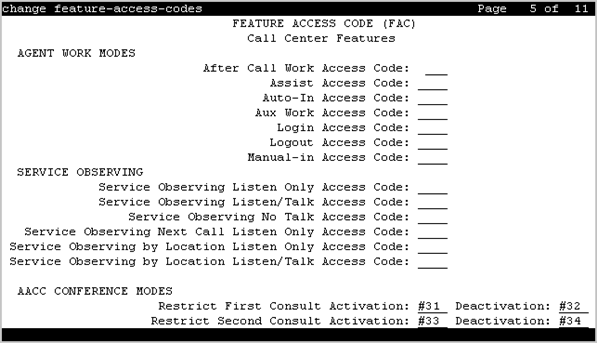
AACC Conference Modes
Avaya Aura® Contact Center uses the Agent Mode feature access codes to restrict the call transfers or conferences that an agent can initiate. In the Restrict First Consult mode, an agent can initiate only one conference or one transfer sequence at a time. When an agent initiates a call transfer or a conference, the system matches the held call appearance and the initiated call appearance. Before initiating a new conference or a transfer sequence, the agent must either complete the transfer with one of the two appearances or drop one of the calls.
Note:
The AACC Conference modes are not supported on ISDN-BRI telephones.
Restrict First Consult Activation/Deactivation
Use this field to enable the Restrict Call Joining feature. The Restrict Call Joining feature is supported only on Avaya Aura® Contact Center. With this feature, Communication Manager restricts the agents from initiating a transfer or a conference operation.
Restrict Second Consult Activation/Deactivation
Use this field to enable the Restrict Second Agent Consult feature. This feature is supported only on Avaya Aura® Contact Center. With this feature, Communication Manager allows the agents to use only one consult operation at a time. The consult operations include transfer and conference.
Note:
If you set the Restrict Second Call Consult field to n, after you dial the Restrict Second Consult feature access code, the feature access code overrides the setting of the Restrict Second Call Consult field on the COR group of the station.
Add Agent Skill Access Code
FAC dialed by an agent to add a skill to their current skill set.
This value must conform to the FACs or dial access codes defined by the dial plan.
After Call Work Access Code
FAC dialed by an agent when the agent performs work-related Automatic Call Distribution (ACD) activities.
This value must conform to the FACs or dial access codes defined by the dial plan.
Assist Access Code
FAC dialed by an agent to request assistance from the split supervisor. The split supervisor is someone working in a call center that uses various Communication Manager and Call Management System features to check split and agent performance and to provide assistance if necessary.
This value must conform to the FACs or dial access codes defined by the dial plan.
Auto-In Access Code
FAC dialed when an agent is ready to process another call as soon as the current call is completed.
This value must conform to the FACs or dial access codes defined by the dial plan.
Aux Work Access Code
FAC used when an agent is unavailable to receive ACD, or work-related, calls. Agents use this FAC for activities such as taking a break, going to lunch, or placing an outgoing call.
This value must conform to the FACs or dial access codes defined by the dial plan.
Login Access Code
FAC dialed by an agent to gain access to the ACD functions. This is a system-wide code for all ACD agents.
This value must conform to the FACs or dial access codes defined by the dial plan.
Logout Access Code
FAC dialed by the agent to exit ACD. This is a system-wide logout code for all ACD agents.
This value must conform to the FACs or dial access codes defined by the dial plan.
Manual-In Access Code
FAC dialed when an agent is ready to process another call manually.
This value must conform to the FACs or dial access codes defined by the dial plan.
Remote Logout of Agent Access Code
FAC typically used by a supervisor to logout an idle agent without being physically present at the agent station. The supervisor can be locally or remotely located. Available only if Service Observing (Remote/By FAC), Vectoring (Basic), and Vectoring (Prompting) are enabled on the system.
This value must conform to the FACs or dial access codes defined by the dial plan.
Remove Agent Skill Access Code
FAC dialed by an agent to remove a skill from their current skill set. Available only if Service Observing (Remote/By FAC) is enabled on the system.
This value must conform to the FACs or dial access codes defined by the dial plan.
Service Observing Listen Only Access Code
Dial FAC for a station with Service Observing permission to listen to other agent ACD calls without being heard on the ACD call.
This value must conform to the FACs or dial access codes defined by the dial plan.
Service Observing Listen/Talk Access Code
Dial FAC for a station with Service Observing permission to both listen and be heard on an ACD call.
This value must conform to the FACs or dial access codes defined by the dial plan.
Service Observing Next Call Listen Only Access Code
You can assign a Feature Access Code (FAC) to the Service Observing Next Call Listen Only Access Code feature. When you dial the Service Observing Next Call Listen Only Access Code, Communication Manager waits until the current call ends that the extension to be service observed is on. Communication Manager then starts service observing at the beginning of that station's next call. You can listen to the other call, but not speak into it.
Service Observing No Talk Access Code
Dial FAC for a station with Service Observing permission to listen only. Any attempt to toggle between listening and talking using the Service Observing button is denied. Available only if Expert Agent Selection (EAS) Enabled is administered for the system.
This value must conform to the FACs or dial access codes defined by the dial plan.
Feature Access Code: page 6
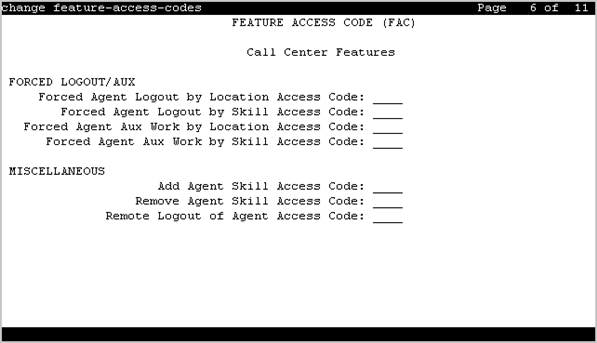
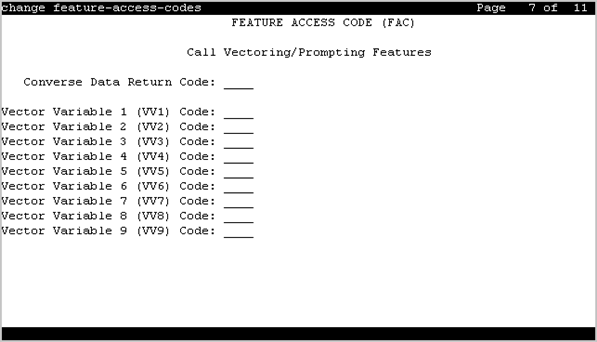
Converse Data Return Code
FAC used to pass values between a Voice Response Unit (VRU) and Communication Manager to play an announcement, collect digits from the caller, and so on.
Vector Variable x
FAC (# can be used as the first digit), used to change the value of defined variables.
Feature Access Code: page 7
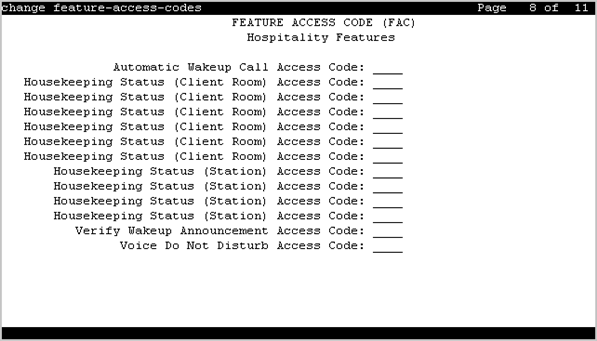
Automatic Wakeup Call Access Code
FAC dialed to schedule or cancel a wakeup call.
This value must conform to the FACs or dial access codes defined by the dial plan.
Housekeeping Status (Client Room) Access Code
FAC the housekeeper dials from a client room to provide room status. These codes are transmitted to the Property Management System (PMS) for processing.
This value must conform to the FACs or dial access codes defined by the dial plan.
Housekeeping Status (Station) Access Code
FAC the housekeeper dials to provide room status. This access code must be dialed from designated telephones.
This value must conform to the FACs or dial access codes defined by the dial plan.
Verify Wakeup Announcement Access Code
FAC dialed to verify a wakeup announcement.
This value must conform to the FACs or dial access codes defined by the dial plan.
Voice Do Not Disturb Access Code
FAC dialed to enter or cancel a do not disturb
request using voice prompting.
This value must conform to the FACs or dial access codes defined by the dial plan.
Feature Access Code: page 8
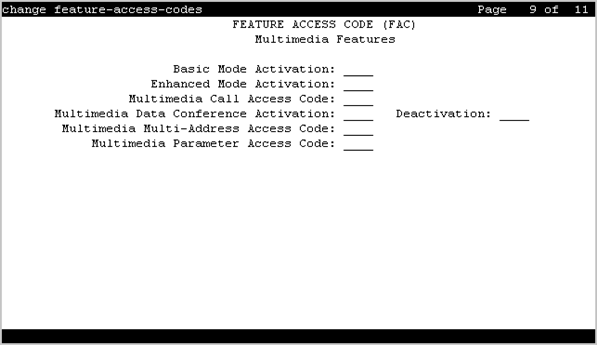
Basic Mode Activation
FAC dialed to revert an Enhanced multimedia complex to a Basic multimedia complex.
This value must conform to the FACs or dial access codes defined by the dial plan.
Enhanced Mode Activation
FAC used to convert a Basic multimedia complex to an Enhanced multimedia complex.
This value must conform to the FACs or dial access codes defined by the dial plan.
Multimedia Call Access Code
FAC that indicates to Communication Manager that an Enhanced mode multimedia call is being made. This FAC originates a multimedia call according to system-wide default settings.
This value must conform to the FACs or dial access codes defined by the dial plan.
Multimedia Data Conference Activation
FAC that when entered from any voice station that is participating in a multimedia call, alerts Communication Manager to enable data collaboration with the other parties on the call. If this FAC is entered a second time, multimedia data conference activation is denied since it is already active. This FAC only applies to voice stations on servers equipped with ESM adjuncts.
This value must conform to the FACs or dial access codes defined by the dial plan.
Multimedia Data Conference Deactivation
FAC that when entered from the telephone deactivates the data session and reverts to a voice and video call. This telephone supports data collaboration on a multimedia mode call. If a user enters this FAC while participating in a data collaboration multimedia call that the user did not initiate, the system denies the deactivation.
This value must conform to the FACs or dial access codes defined by the dial plan.
Multimedia Multi-Address Access Code
FAC that supports origination of a multimedia call from a voice station. It is used when the destination being dialed requires a different address for each of the 2B-channels.
For example, ISDN-BRI provided by a local telephone company central office is provisioned with separate listed directory numbers for each B-channel. To make a 2B multimedia call to such a device, two sets of addresses must be entered.
Originating a multimedia call with the multimedia multi-address access code originates a call according to system-wide default settings.
This value must conform to the FACs or dial access codes defined by the dial plan.
Multimedia Parameter Access Code
FAC that prompts Avaya Communication Manager to initiate a multimedia mode call with a specific bearer capability. This FAC would be followed by a 1 or 2 to indicate the following parameter selections respectively: 2x64 (unrestricted initial system default), 2x56 (restricted).
This value must conform to the FACs or dial access codes defined by the dial plan.
Feature Access Code: page 9
Precedence Calling Access Code
FAC used to access the Multiple Level Precedence and Preemption (MLPP) feature using which users can request priority processing of calls during critical situations.
This value must conform to the FACs or dial access codes defined by the dial plan.
WNDP PRECEDENCE ACCESS CODES
FAC used to determine the precedence level for a call when the Worldwide Numbering Dial Plan (WNDP) feature is active. The WNDP feature is compatible with the standard numbering system that the Defense Communications Agency (DCA) established. Different feature access codes are assigned for each PRECEDENCE level.
This value must conform to the FACs or dial access codes defined by the dial plan.
Flash Override Access Code
FAC that corresponds to the Flash Override preemption level.
This value must conform to the FACs or dial access codes defined by the dial plan.
This field is visible only if Multi level precedence preemption is set to Y on the system-features customer options form.
Flash Access Code
FAC that corresponds to the Flash preemption level.
This value must conform to the FACs or dial access codes defined by the dial plan.
Immediate Access Code
FAC that corresponds to the Immediate preemption level.
This value must conform to the FACs or dial access codes defined by the dial plan.
Priority Access Code
FAC that corresponds to the Priority preemption level.
This value must conform to the FACs or dial access codes defined by the dial plan.
Routine Access Code
FAC that corresponds to the Routine preemption level.
This value must conform to the FACs or dial access codes defined by the dial plan.
Destination Code Control
Note:
This field complies with the Unified Capabilities Requirements (UCR) 2008 Change 3 requirements and is approved by Joint Interoperability Test Command (JITC). This field is available only for the USA Department of Defense (DoD) and approved Federal government customers.
Control DCC activation and deactivation by dialing the Activation code and the Deactivation code. DCC activates and deactivates the functionality systemwide.
Activation Code
Note:
This field complies with the Unified Capabilities Requirements (UCR) 2008 Change 3 requirements and is approved by Joint Interoperability Test Command (JITC). This field is available only for the USA Department of Defense (DoD) and approved Federal government customers.
The FAC used to activate the DCC feature.
This value must conform to the FACs defined by the dial plan.
Deactivation Code
Note:
This field complies with the Unified Capabilities Requirements (UCR) 2008 Change 3 requirements and is approved by Joint Interoperability Test Command (JITC). This field is available only for the USA Department of Defense (DoD) and approved Federal government customers.
The FAC used to deactivate the DCC feature.
This value must conform to the FACs defined by the dial plan.