

AVAYA DOCUMENTATION CENTER
Find answers to your technical questions and learn how to use our products
Avaya Aura® Communication Manager Screen Reference
Calling Party Number Conversion for Tandem Calls
Use this screen to administer calling party number formats for tandem calls. Tandem calls are not originated locally on the switch.
For tandem calls to the public network, the system might not provide the correct calling party information. To rectify this problem, Communication Manager changes the calling party number. Communication Manager compares the incoming calling party number with the calling party digit lengths, calling party prefixes, and trunk groups. When a match is found, Communication Manager creates the calling party number by deleting the digits specified in the Delete field, and then inserting the digits specified in the Insert field or the values of Numbering Plan Identifier (NPI) and Type of Number (TON) for Calling Party Number Communication Manager uses the numbering format specified in the Number Format field.
Note:
Communication Manager does not update Calling Party Number in the NCA-TSC SETUP message.
To map numbers for ISDN-SIP interworking, Communication Manager uses the values of the fields on the Calling Party Number Conversion for Tandem Calls screen or sends the call to Session Manager. Session Manager uses the number adaptation module for the mapping.
Note:
During ISDN to SIP mapping, the number adaptation module does not have access to NPI and TON values in the incoming ISDN number. During SIP to ISDN mapping, Communication Manager uses the leading plus (+) sign to process an incoming SIP number as an international number and insert the plus (+) sign in the resulting number. To process an incoming SIP number, Communication Manager uses the values of the fields on the Calling Party Number Conversion for Tandem Calls screen.
The following rules apply to an incoming calling party number with a leading plus (+) sign:
For an incoming SIP calling party number with a leading plus (+) sign, Communication Manager includes the plus (+) sign when searching for a match.
For an incoming SIP calling party number with a leading plus (+) sign, if a match is not found with the plus (+) sign, Communication Manager removes the plus (+) sign.
For an incoming ISDN calling party number reconstructed as an international number, Communication Manager searches for a match. If a match is not found, Communication Manager adds a leading plus (+) sign.
For an incoming SIP calling party number, if Communication Manager finds a match, the matching entry overrides the setting of the Prepend ‘+’ to Outgoing Calling/Alerting/Diverting/Connected Public Numbers field for the SIP signaling group.
Use one of the following ways to modify calling party numbers for a SIP endpoint:
Through the Calling Party Number Conversion for Tandem Calls form.
Through the System Parameters and Location Parameters forms.
Note:
Do not use both the options at the same time to modify the calling numbers sent to SIP endpoints. Using both the options at the same time leads to inconsistent display. For example, the calling number display on a direct incoming call may differ from the display if that same incoming call is forwarded to another station.
If you choose the System Parameters and Location Parameters forms, you can use the Calling Party Number Conversion for Tandem Calls form for other purposes. To do so, use the Outgoing Trunk Group (s) column to ensure that no entry on that form affects the trunk groups used for SIP stations.
To modify the value of the fields on the Calling Party Number Conversion for Tandem Calls screen, use the following command:
change tandem-calling-party-num
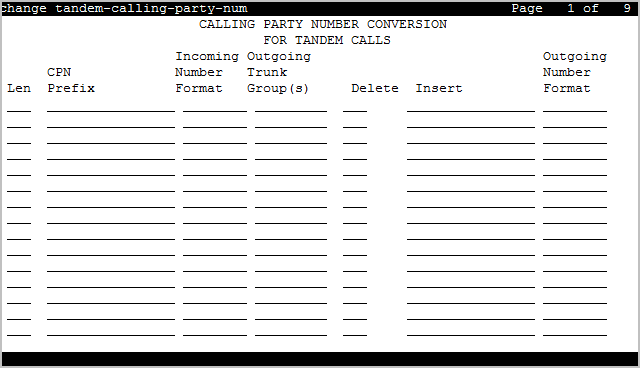
CPN Prefix
Valid Entry |
Usage |
|---|---|
0 to 9, + |
Any combination of digits 0 to 9, up to 16 digits to indicate the calling party prefix. The '+' sign is also valid. |
any |
Any incoming calling number matches the entry. |
Delete
Valid Entry |
Usage |
|---|---|
1 to 15 |
The number of digits deleted when modifying the tandem calling party number. |
all |
All digits are deleted. |
blank |
No digits are deleted from the received calling party number. This is the default value. |
Insert
Valid Entry |
Usage |
|---|---|
0 to 9, + |
Any combination of digits 0 to 9, up to 16 digits. The '+' sign is also valid. |
natl-prefix |
Communication Manager adds the Long distance access code number as the prefix to the calling-party number. The Long distance access code field is on page 1 of the Location parameter screen. If the Long distance access code field is blank, Communication Manager uses the prefix number in the National CPN Prefix field on the Feature related system parameter screen. |
intl-prefix |
Communication Manager adds the International access code number as the prefix to the calling-party number. The International access code field is on page 1 of the Location parameter screen. If the International access code field is blank, Communication Manager uses the prefix number in the International CPN Prefix field on the Feature related system parameter screen. |
blank |
The received calling party number is not prefixed with any digits. This is the default value. |
Incoming Number Format
Use this field to specify the numbering format of the calling party number.
Note:
Unlike ISDN calling party numbers, SIP calling party numbers do not include a numbering format. The only descriptor is the optional leading plus sign (+). Therefore, to match the calling number in an incoming SIP trunk call, you must do one of the following:
To match a calling number that does not start with a plus sign (+), you must leave the Incoming Number Format field blank.
To match a calling number that starts with a plus sign (+), you can leave the Incoming Number Format field blank, or you can set the field to intl-pub.
Valid Entry |
Usage |
|---|---|
intl-pub, lev0-pvt, lev1-pvt, lev2-pvt, locl-pub, natl-pub, pub-unk, unk-unk |
The numbering format to use in modifying the tandem calling party number. |
blank |
All numbering formats match this entry. |
Len
Valid entry |
Usage |
|---|---|
1 to 16 |
A number between 1 and 16 that indicates the length of calling party number. |
any |
A calling party number of any length.
Note:
If after insertion and deletion the resulting calling number is longer than 21 digits, the system will not perform the conversion. |
Outgoing Number Format
Valid Entry |
Usage |
|---|---|
intl-pub, lev0-pvt, lev1-pvt, lev2-pvt, locl-pub, natl-pub, pub-unk, unk-unk |
The numbering format to use in modifying the tandem calling party number. |
blank |
All numbering formats match this entry. |
Outgoing Trunk Group(s)
Valid entry |
Usage |
|---|---|
Trunk group number |
Enter an ISDN or a SIP outgoing trunk group number. |
blank |
If you leave this field blank, any ISDN and SIP trunk group matches this entry, if it has the Modify Tandem Calling Number field enabled. By default, this field is blank. |