

AVAYA DOCUMENTATION CENTER
Find answers to your technical questions and learn how to use our products
Avaya Aura® Communication Manager Screen Reference
System Parameters Call Coverage/Call Forwarding
Sets the system-wide parameters for call coverage and call forwarding.
Example command: change system-parameters coverage-forwarding
System parameters call coverage/ call forwarding: page 1
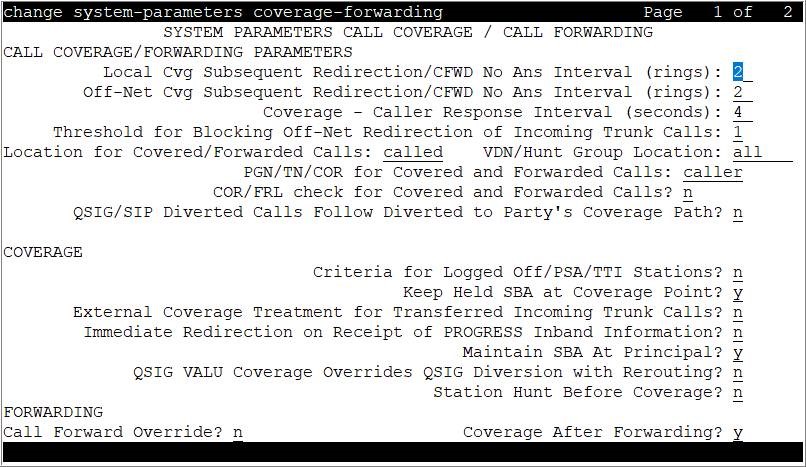
CALL COVERAGE / FORWARDING PARAMETERS
Coverage - Caller Response Interval (seconds)
Valid Entry |
Usage |
|---|---|
0 to 10 |
The time in seconds an internal caller has before a call redirects to the called party’s first coverage point. |
COR/FRL check for Covered and Forwarded Calls
Valid Entry |
Usage |
|---|---|
y |
Communication Manager checks the following:
|
n |
Communication Manager does not check the following:
|
Diverted Party Identification
The Diverted Party Identification field is available only if the QSIG/SIP Diverted Calls Follow Diverted to Party's Coverage Path field is enabled. The default setting is last-fwd.
The field settings do not work if the incoming call is over a non-QSIG or non-SIP trunk or the call is routed through a route-to vector step.
Valid entry |
Usage |
|---|---|
principal |
To play voice mail greeting of the principal and save the voice message at the voicemail box of the principal. |
last-fwd |
To play voice mail greeting of the last-forwarded party and save the voice message at the voicemail box of the last-forwarded party. The default configuration. |
Local Cvg Subsequent Redirection/CFWD No Ans Interval (rings)
Valid Entry |
Usage |
|---|---|
1 to 99 |
Specifies:
Note:
When ringing local destinations, such as an office environment, a short interval often is appropriate because the intended party either is near the telephone or not present. However, if the call is left at an off-net destination for only a short interval, the call can be redirected to the next destination before the intended party has any real chance of answering the call. |
Location for Covered and Forwarded Calls
Determines the location number used for coverage and forwarding.
Valid Entry |
Usage |
|---|---|
called |
This is the default. |
caller |
Coverage and forwarding use the caller’s physical phone’s location number. |
VDN/Hunt Group Location
Determines the location to be used when a VDN or hunt group launches a call.
Valid Entry |
Usage |
|---|---|
all |
The Communication Manager uses the default Dial Plan, Automatic Route Selection (ARS), and Automatic Alternate Routing (AAR) forms to route the call. These forms have the Location set to “all”. |
caller |
The Communication Manager uses the Dial Plan, Automatic Route Selection (ARS), and Automatic Alternate Routing (AAR) forms associated with the location of the calling station or trunk to route the call. These forms have a specific location in the range 1-2000. As per normal routing rules, Communication Manager prefers the specific-location entries over the all-location entries if both tables match the called number. |
Off-Net Cvg Subsequent Redirection/CFWD No Ans Interval (rings)
Valid Entry |
Usage |
|---|---|
1 to 99 |
Specifies:
Note:
When ringing local destinations, such as an office environment, a short interval often is appropriate because the intended party either is near the telephone or not present. However, if the call is left at an off-net destination for only a short interval, the call can be redirected to the next destination before the intended party has any real chance of answering the call. |
PGN/TN/COR for Covered and Forwarded Calls
Valid Entry |
Usage |
|---|---|
called |
Communication Manager checks for permissions (tenant number, partition group number, and COR) between the actual called party (forwarding party) and forwarded-to party. When the check is successful, the call is routed to the forwarded-to party. Permission check for COR is only done if the COR/FRL check for Covered and Forwarded Calls field is set to y. |
caller |
Communication Manager checks for permissions (tenant number, partition group number, and COR) between the calling party and forwarded-to party. When the check is successful, the call is routed to the forwarded-to party. Permission check for COR is only done if the COR/FRL check for Covered and Forwarded Calls field is set to y. This is the default value. |
QSIG/SIP Diverted Calls Follow Diverted to Party's Coverage Path
When a party with a defined coverage path does not answer the call, Communication Manager determines whether to continuously ring the call or redirect the call to a station or a messaging system. The calls follow the coverage path of the diverted-to party only if the calls route over QSIG and SIP trunks.
Valid entry |
Usage |
|---|---|
y |
Communication Manager forwards the call to the coverage path of the last redirected party. The Diverted Party Identification field displays the default value as last-fwd. |
n |
The default configuration. The call continuously rings at the extension of the redirected party even if that extension has a coverage path. The call does not reach the messaging system of the last party in the coverage path. |
Threshold for Blocking Off-Net Redirection of Incoming Trunk Calls
Valid Entry |
Usage |
|---|---|
1 to 7 |
If the number of incoming trunk calls routes within the Call Forward timer, the block commences. Applies for those occasions when an incoming call to a station redirects off-net. At that time, the Call Forward timer activates to block any further incoming calls to that station from being redirected off-net until the timer expires. |
n (all) |
Call processing never activates the Call Forward timer. Therefore, any number of calls to a principal can be redirected off-net. |
COVERAGE
Criteria for Logged Off/PSA/TTI Stations
Enables or disables the call coverage criteria for logged-off IP/PSA/TTI stations. By default, the value is n.
Default treatment for logged off phones is a busy tone. If you set the Criteria for Logged Off/PSA/TTI Stations field to y, calls follow the coverage treatment as configured on the station screen. The call is redirected to coverage after the number of rings exceed the number specified in the Number of Rings field for Criteria for Logged Off/PSA/TTI Stations.
External Coverage Treatment for Transferred Incoming Trunk Calls
Enables or disables external coverage treatment for incoming trunk calls that redirect to coverage.
Immediate Redirection on Receipt of PROGRESS Inband Information
This field determines if a call is immediately redirected to coverage when an ISDN PROGRESS message is received. This field pertains only to CCRON and QSIG VALU coverage calls redirected over end-to-end ISDN facilities.
However, the message might indicate that the cell telephone is not available to receive calls and should be redirected.
The system displays this field only if:
The Coverage of Calls Redirected Off-Net field shows y.
The Value-Added Avaya (VALU) feature is enabled for the system.
Valid entry |
Usage |
|---|---|
y |
Immediately redirect an off-net coverage/forwarded call to the next coverage point. Users in European countries following the ETSI standard and redirecting to GSM cellular telephones should enable the field. |
n |
Does not immediately redirect an off-net coverage/forwarded call to the next coverage point. Users in the United States should disable this field because PROGRESS messages with the Progress Indicator field set to inband information are sent for a variety of reasons that are not associated with unavailable cellular telephones. |
Keep Held SBA at Coverage Point
Determines how a covering user who has placed an answered coverage call on hold is treated if the original principal bridges onto the call.
Valid Entry |
Usage |
|---|---|
y |
Keeps the coverage party on the call. The coverage party remains on hold, but might enter the call along with the principal and the calling party. |
n |
Drops the coverage party from the call. |
Maintain SBA At Principal
Using this, a user can maintain a simulated bridged appearance (SBA) when a call redirects to coverage.
Valid Entry |
Usage |
|---|---|
y |
Maintains a simulated bridged appearance on the principal’s telephone when a call redirects to coverage. DCS with rerouting will not be attempted after coverage. |
n |
No SBA is maintained on the principal’s telephone. DCS with rerouting is attempted, and if successful, the principal loses the bridged appearance and the ability to bridge onto the coverage call. |
QSIG VALU Coverage Overrides QSIG Diversion with Rerouting
Specifies whether or not, with both QSIG Diversion with Rerouting and QSIG VALU turned on, Coverage After Forwarding for the station works for calls that go to remote coverage.
Available only if Basic Supplementary Services and Supplementary Services with Rerouting are both enabled for the system.
Valid Entry |
Usage |
|---|---|
y |
QSIG VALU call coverage takes precedence. If Coverage After Forwarding is enabled for a station, the call can receive coverage after rerouting. |
n |
With QSIG Diversion with Rerouting turned on, the local system passes control of a forwarded call to the remote QSIG server on which the forwarding destination resides. The forwarded call cannot return to coverage for the user who originally received the call. |
Station Hunt Before Coverage
Determines whether or not a call to a busy station performs station hunting before going to coverage.
FORWARDING
Call Forward Override
Specifies how to treat a call from a forwarded-to party to the forwarded-from party.
Valid Entry |
Usage |
|---|---|
y |
Overrides the Call Forwarding feature by allowing a forwarded-to station to complete a call to the forwarded-from station. |
n |
Directs the system to forward calls to the forward-to station even when the calls are from the forwarded-to station. |
Coverage After Forwarding
Determines whether or not an unanswered forwarded call is provided coverage treatment.
Valid Entry |
Usage |
|---|---|
y |
Coverage treatment is provided to unanswered forwarded calls. |
n |
No coverage treatment is provided to unanswered forwarded calls. The call remains at the forwarded-to destination. |
System parameters call coverage/ call forwarding: page 2
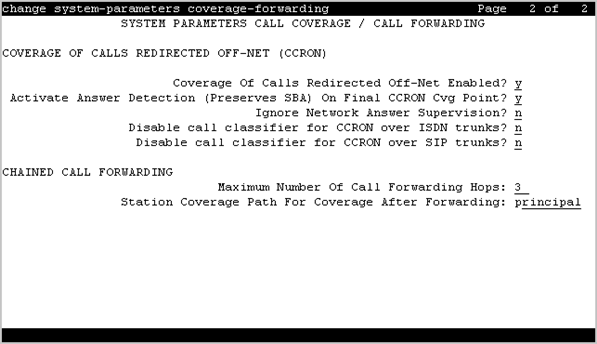
COVERAGE OF CALLS REDIRECTED OFF-NET (CCRON)
Activate Answer Detection (Preserves SBA) On Final CCRON Cvg Point
Determines whether or not a simulated bridge appearance (SBA) is maintained on the principal when a call is directed to a final off-net coverage point. This field has no consequence when the off-net call is carried end-to-end by ISDN facilities; the SBA is maintained and there is no cut-through delay.
Available only if Coverage of Calls Redirected Off-Net Enabled is enabled.
Valid Entry |
Usage |
|---|---|
y |
Maintains a simulated bridged appearance on the principal when redirecting to a final off-net coverage point. |
n |
Drops the SBA on the principal’s telephone when the call redirects off-net at the last coverage point, eliminating the cut-through delay inherent in CCRON calls, but sacrificing the principal’s ability to answer the call. |
Coverage Of Calls Redirected Off-Net Enabled
Controls the Coverage of Calls Redirected Off-Net (CCRON) feature. Disables this feature if the demand on the call classifier port resources degrades other services provided by Communication Manager.
Available only if Coverage of Calls Redirected Off-Net is enabled for the system.
Valid Entry |
Usage |
|---|---|
y |
Communication Manager monitors off-net coverage/forwarded calls and provides further coverage treatment for unanswered calls. |
n |
Communication Manager does not monitor off-net coverage/ forwarded calls. No further coverage treatment is provided if the calls are unanswered. |
Disable call classifier for CCRON over ISDN trunks
Enables or disables the use of a call classifier on a CCRON call over ISDN facilities. When a CCRON call routes offnet over ISDN end-to-end facilities, no call classifier is attached to the call. If, subsequently during the call, an ISDN PROGRESS or ALERT message is received that indicates that interworking has occurred, a call classifier is normally attached to the call and has precedence over ISDN trunk signalling. This field can direct Communication Manager to dispense with the call classifier on interworked calls and rely on the ISDN trunk signalling messages.
Valid Entry |
Usage |
|---|---|
y |
Disables the call classifier for CCRON calls over interworked trunk facilities. |
n |
Enables the call classifier for CCRON calls over interworked trunk facilities. |
Disable call classifier for CCRON over SIP trunks
Valid Entry |
Usage |
|---|---|
y |
Disables the call classifier for CCRON calls over interworked trunk facilities. Directs Communication Manager to dispense with the call classifier on interworked calls and rely on the SIP trunk signalling messages. |
n |
Enables the call classifier for CCRON calls over interworked trunk facilities. |
Ignore Network Answer Supervision
Administers whether or not a call classifier for network answer supervision is used to determine when a call is answered. CCRON might use a call classifier port to determine whether an off-net coverage or forwarded call has been answered, discarding other information that might indicate an answered state.
Available only if Coverage of Calls Redirected Off-Net Enabled is enabled.
Valid Entry |
Usage |
|---|---|
y |
Ignore network answer supervision and rely on the call classifier to determine when a call is answered. Provides accurate answer supervision for tandem calls redirected to the public network. |
n |
Treat network answer supervision as a true answer. Preserves network answer supervision information. |
CHAINED CALL FORWARDING
Maximum Number of Call Forwarding Hops
Available only if Chained Call Forwarding is enabled.
Valid Entry |
Usage |
|---|---|
3 to 10 |
The number of hops allowed in the forwarding chain. |
Station Coverage Path For Coverage After Forwarding
This field specifies what coverage path the call must follow. The system displays the Station Coverage Path For Coverage After Forwarding field only when you enable the Chained Call Forwarding and the Coverage After Forwarding fields.
Valid entry |
Usage |
|---|---|
principal |
The call follows the coverage path of the principal. |
last-fwd |
The call follows the coverage path of the last-forward-to party. |