

AVAYA DOCUMENTATION CENTER
Find answers to your technical questions and learn how to use our products
Avaya Aura® Communication Manager Screen Reference
Trunk Group: page 3
Caution:
Do not change fields on this page without assistance from Avaya or your network service provider.
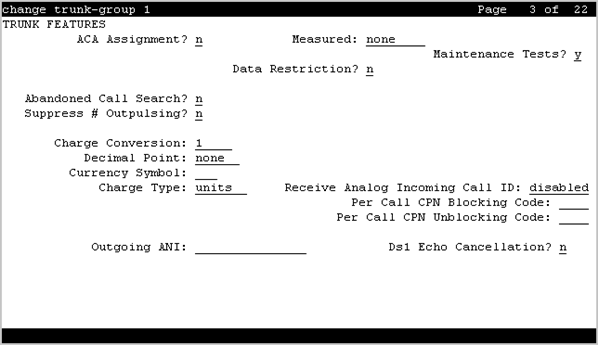
Abandoned Call Search
Indicates whether this trunk group conducts an Abandoned Call Search to identify ghost calls. Abandoned Call Search is designed to work with analog ground-start local telephone company central office (CO) trunks that do not provide disconnect supervision. The CO must support Abandoned Call Search for the feature to work properly. If the CO provides disconnect supervision, the Abandoned Call Search feature is not needed.
Available only for ground-start type trunks.
ACA Assignment
Indicates whether Automatic Circuit Assurance (ACA) measurements are taken for this trunk group.
Charge Conversion
Available only for outgoing or two-way CO, DIOD, FX, and WATS trunk groups. Also available for isdn trunk groups, if the Charge Advice field is set to a value other than none.
Valid Entry |
Usage |
|---|---|
1 to 64 500 |
Communication Manager multiplies the number of charge units by the value of this field and displays it as a currency amount. Without a value in this field, Communication Manager displays the number of charge units without converting it to currency. |
Charge Type
Text string used to describe charges related to a telephone call. These words or characters appear on telephone displays after the charge amount. Typically uses either the currency symbol or the charge type, but not both. Accepts up to seven characters. Embedded spaces count as characters.
Available only for outgoing or two-way CO, DIOD, FX, and WATS trunk groups.
Connected to CO
Enables or disables overlap sending to a local telephone company central office (CO).
Available only for tie trunk groups.
Currency Symbol
The telephone displays the symbol before the charge amount. Accepts from one to three characters. Leading and embedded spaces count as characters.
Available only for outgoing or two-way CO, DIOD, FX, and WATS trunk groups. Also available for ISDN trunk groups, if the Charge Advice field is set to a value other than none.
Data Restriction
Enables or disables data restriction that is used to prevent tones, such as call-waiting tones, from interrupting data calls. Data restriction provides permanent protection and cannot be changed by the telephone user. Cannot be assigned if Auto Answer is administered as all or acd. If enabled, whisper page to this station is denied.
Decimal Point
The appropriate representation for a decimal point as telephone displays it. Available only with outgoing or two-way CO, DIOD, FX, and WATS trunk groups. Also available for isdn trunk groups, if the Charge Advice field is set to a value other than none.
Note:
If the received charge contains no decimals, no decimal point is displayed (that is, the administered decimal point is ignored for charge information received with no decimals). On a QSIG trunk group, unlike other trunk groups, the Decimal Point field is independent whether the calling display shows a decimal point. Instead, it tells what symbol should be displayed if the QSIG AOC received has a 1/10 or 1/100 or 1/1000 Multiplier.
Valid Entry |
Usage |
|---|---|
comma |
If the received charge contains decimals, the charge is displayed at the calling endpoint’s display with a comma as the decimal point. Divides the charge value by 100. |
period |
This is the default. If the received charge contains decimals, the charge is displayed at the calling endpoint’s display with a period as the decimal point. Divides the charge value by 100. |
none |
No decimal point is displayed. |
DS1 Echo Cancellation
Enables or disables echo cancellation on a per port basis. If enabled, reduces voice call echo.
Note:
Changes to the DS1 Echo Cancellation field is incomplete until one of the following occurs:
Port is busied-out or released.
Trunk group is busied-out or released.
SAT command test trunk group is performed.
Periodic maintenance runs.
DSN Term
Enables or disables the trunk group as a DSN termination telephone. The default is disabled.
Glare Handling
Determines the reaction of Communication Manager to glare.
The following circuit packs can detect glare:
TN767 (all releases)
TN760C (or later releases)
TN464C (or later releases)
Available only for two-way trunks when the outgoing side of the Trunk Type is either …/wink or …/delay.
Valid Entry |
Usage |
|---|---|
control |
Communication Manager seizes the trunk and proceeds with call setup. The other switch finds another trunk. |
backoff |
The other server or switch seizes the trunk and proceeds with call setup. The server or switch finds another trunk. |
none |
Not administered. |
Hold/Unhold notification
Use this field to enable Communication Manager to send a notification to the far end SIP endpoint when the far end SIP endpoint is put on hold or unhold.
When you upgrade to Communication Manager Release 8.1.3, the Hold/Unhold Notifications field is not visible for all SIP trunks and the existing values for all sip trunks are reset to n. For the Hold/Unhold Notifications field to be visible for all SIP trunks, you must enable the SA9143 Hold/Unhold Notifications for SIP Trunks field on the system-parameters special-applications screen. .
The default value of Hold/Unhold Notifications field on the trunk group for SIP trunks is n. For example, if you add a new SIP trunk when SA9143 Hold/Unhold Notifications for SIP Trunks field is already enabled, the value in the Hold/Unhold Notifications field appears as n.
The Hold/Unhold Notifications field appears for all SIP trunks, only if the SA9143 Hold/Unhold Notification for SIP Trunks field on the system-parameters special-applications screen is set to y. Also, if the Hold/Unhold Notifications field for any SIP trunk-group is set to y, then you cannot disable the SA9143 Hold/Unhold Notifications for SIP Trunks field on the system-parameters special-applications screen. For more information, see Avaya Aura® Communication Manager Special Application Features document.
Valid entry |
Usage |
|---|---|
y |
Communication Manager sends the reINVITE to the far end SIP endpoint to notify the far end SIP endpoint that the endpoint is put on hold or unhold. The media direction in this reINVITE is sendonly when Music On Hold is enabled and is inactive when Music On Hold is disabled. When far end SIP endpoint is put on unhold then reINVITE with media direction sendrecv is send. |
n |
Communication Manager does not send the reINVITE to the far end SIP endpoint. The default value is n. |
Incoming Tone (DTMF) ANI
Digits received through Automatic Number Identification (ANI) are printed on a CDR record, passed to the Intuity Audix and ASAI interfaces, and displayed on the telephone (and on tandem calls if the outgoing trunk requires ANI). Then the digits are sent to the outgoing trunk.
Available only if the Incoming Dial Type is tone.
Valid Entry |
Usage |
|---|---|
*ANI*DNIS* |
If 555-3800 calls extension 81120, the trunk group receives *55538000*81120*. The telephone displays Call from 555-3800. |
ANI*DNIS* |
If 555-3800 calls extension 81120, the trunk group receives 55538000*81120*. The telephone displays Call from 555-3800. |
no |
Not administered. |
Internal Alert
Indicates if internal ringing and coverage is used for incoming calls.
Invoke ID for USNI Calling Name
Communication Manager uses the Invoke ID for USNI Calling Name field to select an Invoke ID each time a calling name is sent over the ISDN trunk group using the USNI protocol.
The system displays the Invoke ID for USNI Calling Name field only when:
The Group Type field is set to ISDN.
The Carrier Medium field is set to PRI/BRI.
The Supplementary Service Protocol field is set to a.
However, the valid entries, variable and fixed-1, have an impact only when the following conditions are met:
On the Feature-related system parameters screen, the USNI Calling Name for Outgoing Calls field is set to y.
On the Trunk group screen, the Send Name field is set to y.
Valid entry |
Usage |
|---|---|
variable |
Communication Manager selects a new Invoke ID each time a calling name is sent over the ISDN trunk group. This entry is the default value. |
fixed-1 |
Communication Manager selects an Invoke ID with the fixed value 1 each time a calling name is sent over the ISDN trunk group. |
Long Holding Time (hours)
Available only if Automatic Circuit Assurance measurements are taken for the trunk group.
Valid Entry |
Usage |
|---|---|
0 to 10 |
The number of hours that the system considers a long holding time. A value of 0 indicates that the system does not support long holding calls. |
Maintenance Tests
Enables or disables hourly maintenance tests on this trunk group.
Available only for aplt, isdn, sip, or tie trunk groups.
Measured
Indicates if the system transmits data for this trunk group to the Call Management System.
Valid Entry |
Usage |
|---|---|
internal |
Sends the data to the Basic Call Management System (BCMS), the VuStats data display, or both. Available only if BCMS (Basic) or VuStats is enabled for the system. |
external |
Sends the data to the CMS. |
both |
Collects data internally and sends it to the CMS. Available only if BCMS (Basic) or VuStats is enabled for the system. |
none |
Trunk group measurement reports are not required. |
MF Tariff Free
If enabled, Communication Manager generates an MFC Tariff-Free Backward Signal during call setup instead of the free
signal. This aids local telephone company central office billing.
Available only for Access, APLT, DID, DIOD, DMI-BOS, and Tandem trunk groups when the Incoming Dial Type is mf or for tie trunk groups when the Trunk Signaling Type is blank, cont, or dis, and the Incoming Dial Type is mf.
Modify Tandem Calling Number
The system displays this field for the SIP and ISDN trunk groups. This field is available with outgoing or two-way trunks.
Valid Entry |
Usage |
|---|---|
natl-intl-prefix |
Adds the national or international prefixes from the Locations Parameters screen when the calling party number is appropriate. |
tandem-cpn-form |
Modifies the calling party number IE in the previously administered format specified for the Tandem Calling Party Number. |
no |
Does not modify the calling party number. |
Numbering Format
Available only for sip trunk groups.
Valid Entry |
Usage |
|---|---|
public |
Indicates that the number plan according to CCITT Recommendation E. 164 is used. |
private |
Indicates the Numbering Plan Indicator is PNP. |
Outgoing ANI
The digit string sent in place of normal ANI. Overrides the normal ANI if this trunk group is used for an outgoing call with ANI. The ANI is sent exactly as administered, except for the normal truncation to seven digits for Russian ANI. This ANI override works both for calls originated in Communication Manager and calls tandemed through it. Accepts up to 15 digits.
Available only for CO, DIOD, FX, and WATS trunk groups.
Path Replacement Method
Available only if the Group Type is ISDN, the Supplementary Service Protocol is b or e, and Supplementary Services with Rerouting or DCS with Rerouting is enabled for the system. Unavailable if Path Replacement with Retention is enabled.
Valid Entry |
Usage |
|---|---|
always |
Use any QSIG (SSB) trunk group as the replacement trunk group. A new call is always originated, even when the original trunk group is determined to be the replacement trunk group. |
BR (better route) |
Route pattern preferences help determine trunk group path replacement. The original trunk group is retained if Path Replacement with Retention is enabled. Path replacement fails (and the original trunk group is retained) if Path Replacement with Retention is disabled. |
Path Replacement with Retention
Available only if the Group Type is ISDN, the Supplementary Service Protocol is b or e, and Supplementary Services with Rerouting or DCS with Rerouting is enabled for the system.
Valid Entry |
Usage |
|---|---|
y |
Retains the original trunk group. |
n |
Provides path replacement according to settings for the Path Replacement Method. |
PBX ID
Valid Entry |
Usage |
|---|---|
1 to 63 blank |
Identifies the remote switch in the network with which the trunk communicates on a DCS signaling link. Available only for trunks that are used for DCS. |
Per Call CPN Blocking Code
A one- to four-digit number used for access, APLT, CO, DIOD, FX, tandem, tie, and WATS trunk groups only. The characters * and # can be used as the first digit.
Per Call CPN Unblocking Code
A one- to four-digit number used for access, APLT, CO, DIOD, FX, tandem, tie, and WATS trunk groups only. The characters * and # can be used as the first digit.
Precedence Incoming
Available only when the trunk group is a DSN termination telephone and the trunk group type is tie.
Valid Entry |
Usage |
|---|---|
digit |
Precedence level for dual-tone multifrequency (DTMF) or tone trunks is received as digits (rotary pulses). |
dtmf (a-d) |
Precedence level for dual-tone multifrequency (DTMF) or tone trunks is received as DTMF signals (touchtones). |
Precedence Outgoing
Available only when the trunk group is a DSN termination telephone and the trunk group type is tie.
Valid Entry |
Usage |
|---|---|
digit |
Precedence level for dual-tone multifrequency (DTMF) or tone trunks is sent as digits (rotary pulses). |
dtmf (a-d) |
Precedence level for dual-tone multifrequency (DTMF) or tone trunks is sent as DTMF signals (touchtones). |
R2 MFC Signaling
Available only if:
Multinational Locations is enabled for the system, and either of the following:
Outgoing Dial Type is mf.
Incoming Dial Type or Outgoing Dial Type is rotary, and Country code is 15 (Russia).
Valid Entry |
Usage |
|---|---|
1 to 8 |
The MFC signaling parameters set used by this trunk group. |
Receive Analog Incoming Call ID
Enables or disables the collection of incoming call ID information on analog trunks. Fifteen characters of name and number information associated with an incoming call (ICLID, or incoming call line identification information) is stored and displays.
Available for CO, DID, and DIOD trunk groups when Analog Trunk Incoming Call ID is enabled. The trunk must be incoming or two-way.
Valid Entry |
Usage |
|---|---|
Bellcore |
Collects ICLID information in the U.S. |
NTT |
Collects ICLID information in Japan. |
disabled |
Stops the collection of ICLID information on analog trunks. |
V23–Bell |
For Telcordia Technologies protocol with V.23 modem tones. Used in Bahrain and similar countries. |
Replace Unavailable Numbers
If enabled, replaces unavailable numbers with administrable strings for incoming and outgoing calls assigned to the specified trunk group. Applies to BRI/PRI, H.323, and SIP trunks. Also applies to analog trunks if Analog Trunk Incoming Call ID is enabled for the system and Receive Analog Incoming Call ID for the trunk is set to any value except disabled.
Available only if the group type is isdn or sip.
Request Category
Indicates if Communication Manager should request a call category from the local telephone company central office (CO).
Available only if the Country code is 15 and MF shuttle signaling is enabled.
Replace Restricted Numbers
The Replace Restricted Numbers field indicates whether to replace restricted numbers with administrable strings for incoming and outgoing calls assigned to the specified trunk group. If the Replace Restricted Numbers field is enabled, Communication Manager replaces the display irrespective of the service type of the trunks such as BRI, PRI, H.323, and SIP trunks. The Replace Restricted Numbers field is available if the Group Type is ISDN or SIP.
Seize When Maintenance Busy
Indicates whether this server generates an outgoing seizure when a trunk in this trunk group is maintenance busied and whether the far-end server or switch is administered to do likewise. This supports the Electronic Tandem Network Busyout feature, which is intended to prevent a far-end server or switch from reporting problems with a trunk that has been removed from service. This field does not affect the behavior of the far-end server or switch. It controls the behavior of your server and defines the expected far-end behavior.
This field only affects ports on TN760C (or later release), TN767, and TN464C (or later release) circuit packs. For DIOD trunks using TN464F (or later release) or TN2464 circuit packs, available only for diod trunk groups when the Trunk Signaling Type is pulsed, cont, or dis.
Valid Entry |
Usage |
|---|---|
near-end |
Communication Manager generates an outgoing seizure when a trunk is maintenance busied, but the far-end server or switch does not. The seizure is maintained until the maintenance busyout is released. |
far-end |
The far-end server or switch generates an outgoing seizure when a trunk is maintenance busied, but this server running Communication Manager does not. |
both-ends |
Both this server running Communication Manager and the far-end server or switch generate an outgoing seizure when a trunk is maintenance busied. |
If a server generates an outgoing seizure when a trunk is busied out, the seizure will probably cause alarms at the far-end server or switch, perhaps leading to a far-end maintenance busy out, unless the far-end server or switch is administered to expect this behavior.
If the administered value of this field is either far-end or both-ends, any abnormally long incoming seizure (including failure to drop from a completed call) is the result of a far-end maintenance busy condition. This assumption might be incorrect, since the abnormally long seizure might actually be due to failure of the trunk circuit.
Send Called/Busy/Connected Number
Specifies if the dialed number, whether called (ringing), busy (busy tone), or connected (answered) is sent on incoming or tandemed ISDN calls.
Available only if QSIG Value-Added is enabled for the trunk group.
Valid Entry |
Usage |
|---|---|
y |
The dialed number is sent on incoming or tandemed ISDN calls. This field must be enabled in order for the Calling Party Number of an incoming ISDN call to display at the transferred-to station after a QSIG transfer operation. If enabled, the Numbering - Public/Unknown Format is accessed to construct the actual number sent, or the Numbering - Private Format is used. |
n |
Disables the sending of the dialed number on incoming or tandemed ISDN calls. |
r |
Restricted. The connected number is sent |
Send Calling Number
Specifies whether the calling party’s number is sent on outgoing or tandemed ISDN calls.
Note:
The Numbering - Public/Unknown Format can override the Send Calling Number administration
Valid Entry |
Usage |
|---|---|
y |
The calling party's number is sent on outgoing or tandemed ISDN calls. If enabled, the Numbering - Public/Unknown Format is accessed to construct the actual number sent, or the Numbering - Private Format is used. |
n |
Disables the sending of the calling party's number on outgoing or tandemed ISDN calls. If disabled, an incoming number is not tandemed out again. This applies to all Supplementary Service Protocols. |
r |
Restricted. The calling number is sent |
Send Connected Number
Specifies if the connected party’s number is sent on incoming or tandemed ISDN calls.
Available only if QSIG Value-Added is disabled for the trunk group.
Valid Entry |
Usage |
|---|---|
y |
The connected party's number is sent on outgoing or tandemed ISDN calls. If enabled, the Numbering - Public/Unknown Format is accessed to construct the actual number sent, or the Numbering - Private Format is used. This field must be enabled for the Calling Party Number of an incoming ISDN call to display at the transferred-to station after a QSIG transfer operation. |
n |
Disables the sending of the connected party's number on outgoing or tandemed ISDN calls. If disabled, an incoming number is not tandemed out again. This applies to all Supplementary Service Protocols. |
r |
Restricted. The connected number is sent |
Note:
The AT&T Switched Network Protocol does not support restricted displays of connected numbers. Therefore, if you administer the 1a country-protocol/ protocol-version combination for the media module, you should not administer the Send Connected Number as restricted, as this causes display problems. The Numbering - Public/Unknown Format overrides the Send Connected Number administration for any administrable block of extensions.
Send EMU Visitor CPN
Controls which calling party identification (extension of the primary telephone or extension of the visited telephone) is used when a call is made from a visited telephone. There are areas where public network trunks disallow a call if the calling party information is invalid. In this case, there can be instances where the extension of the primary telephone is invalid and the extension of the visited telephone must be used.
Valid Entry |
Usage |
|---|---|
y |
Sends calling party identification information on the extension of the EMU user’s telephone. |
n |
Sends calling party identification information on the primary telephone. |
Send Name
Specifies whether the calling, connected, called, or busy party’s administered name is sent to the network on outgoing or incoming calls. Available only for isdn or sip trunk groups.
Valid Entry |
Usage |
|---|---|
y |
When the Supplementary Service Protocol is e (DCS with Rerouting), only values of y and n are permitted. |
n |
When the Supplementary Service Protocol is e (DCS with Rerouting), only values of y and n are permitted. |
r (restricted) |
The calling/connected name will be sent by Communication Manager, but will be marked |
Note:
If name information is not administered for the calling station or the connected, called, or busy station; the system sends the extension number instead of the name.
Short Holding Threshold
Available only if Automatic Circuit Assurance measurements are taken for this trunk group.
Valid Entry |
Usage |
|---|---|
0 to 30 |
The number of times the system will record a short holding call before alerting an attendant to the possibility of a faulty trunk. If 0 is entered, no short holding calls are recorded. |
Short Holding Time (seconds)
Available only if Automatic Circuit Assurance measurements are taken for this trunk group.
Valid Entry |
Usage |
|---|---|
0 to 160 |
The length of time that the system considers as being a short holding time. If 0 is entered, the system does not support short holding calls. |
Show ANSWERED BY on Display
Available only for isdn pri/bri, isdn h.323, and sip trunk groups.
Valid Entry |
Usage |
|---|---|
y |
The words
Note:
Based on display language settings for stations, |
n |
Only the connected telephone number displays. This might be preferred when outgoing calls are over a trunk that might be redirected. |
Shuttle
Enables or disables MF shuttle signaling.
Available only for co, fx, or wats trunk groups, with a Country code of 15, when the Outgoing Dial Type is rotary.
Signaling Group
The signaling group number.
Start B Signal
Indicates which B-signal should be used to start a call. The value administered in this field must be coordinated with the local telephone company central office.
Available only when the Country code is 15 and MF shuttle signaling is enabled.
Valid Entry |
Usage |
|---|---|
1 |
Start calls with signal B1 (first digit). |
2 |
Start calls with signal B2 (next digit). |
3 |
Start calls with signal B3 (previous digit). |
Start Position
Available only when the Country code is 15 and MF shuttle signaling is enabled.
Valid Entry |
Usage |
|---|---|
1 to 9 |
Indicates which digit in the digit string is the previously sent digit. The value administered in this field must be coordinated with the local telephone company central office. |
Suppress # Outpulsing
Indicates whether or not to suppress the final #
in cases where the system would normally outpulse it. Used if end-to-end signaling begins with (and includes) #
. This field should be enabled when the local telephone company central office or any other facility treats #
as an error.
Time (sec) to Drop Call on No Answer
Available only for co or diod trunk groups when the Outgoing Dial Type is mf, or for co, diod, fx, or wats trunk groups when the Country code is 15.
Valid Entry |
Usage |
|---|---|
0 to 1200 |
The duration in seconds that Communication Manager should wait for outgoing calls to be answered. If the call is unanswered in the specified number of seconds, the call drops. If 0 is entered, the timer is not set and no calls drop. |
Used for DCS
If enabled, this trunk group sends and receive messages on a DCS signaling link.
Note:
This field cannot be enabled if the trunk group number is greater than 255 or if the Trunk Access code is more than 3 digits long.
Used Only for Paging
Indicates whether or not this trunk is used only for paging. Default is disabled.
UUI Treatment
UUI treatment field specifies whether the User-to-User Information (UUI) is shared.
Valid Entry |
Usage |
|---|---|
shared |
The trunk is connected to the server. |
service-provider |
When forwarding the other data as MSI, Communication Manager forwards the ASAI user data in a non-shared codeset 0 UUI. |
Voice Paging Timeout (sec)
Available only if the trunk is used only for paging.
Valid Entry |
Usage |
|---|---|
10 to 6000 |
The number of seconds before a paged trunk call drops. Default is 10. |
Wideband Support
Note:
This feature is not supported on the DS1 interfaces on branch gateways (G700).
Enables or disables wideband switching on this trunk group.
Available only if Wideband Switching is enabled for the system.
Note:
Wideband trunk calls are treated as a single trunk call when Automatic Circuit Assurance (ACA) measurements are taken. This way, if an ACA referral call is generated (for short or long holding time), the wideband call only triggers a single referral call using the lowest B-channel trunk member associated with the wideband channel.