

AVAYA DOCUMENTATION CENTER
Find answers to your technical questions and learn how to use our products
Avaya Aura® Communication Manager Screen Reference
Feature-related system parameters: page 8
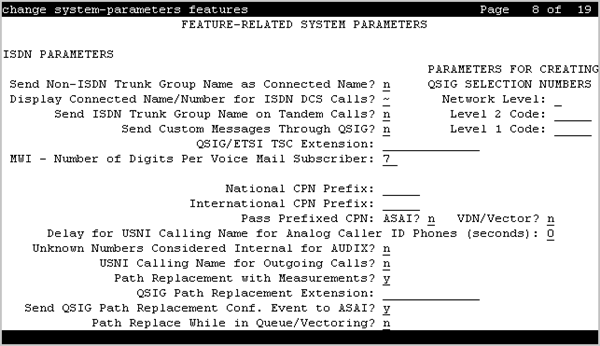
ISDN PARAMETERS
Delay for USNI Calling Name for Analog Caller ID Phones (seconds)
For analog caller ID telephones, Communication Manager waits for the FACILITY message (includes the caller information) before delivering an incoming call to the receiver.
Valid Entry |
Usage |
|---|---|
0 to 6 |
Communication Manager waits for the administered duration for the FACILITY message before delivering the incoming call to the receiver. The default value of the field is 0 which indicates that the feature is disabled. Use the timer value of 3 seconds. |
Note:
On page 3 of the ISDN Trunk Group screen, you must set US NI Delayed Calling Name Update field to y for this feature to work.
Display Connected Name/Number for ISDN DCS Calls
If enabled, displays the connected name/number (if received) for ISDN DCS calls.
Feature Plus Ext
An extension used for proper termination of Feature Plus signaling. For example, Message Waiting Indication (MWI) requires this extension to send the indication to the appropriate server running Communication Manager. Available only if ISDN Feature Plus signaling is enabled for the system.
International CPN Prefix
You can use this number to apply prefixes to international calling numbers for display at receiving telephones. Accepts up to five digits and includes the characters * and #. This number is useful for those telephones that use or implement call back features based on incoming call numbers.
When an ISDN-PRI call arrives, the incoming call setup is analyzed for:
Whether the Type of Address (TOA) is national or international
Whether the Numbering Plan Identifier (NPI) is Unknown or ISDN/Telephony
This administered prefix is applied to international calls.
Prefixing applies to any subsequent display on the same server when the call is transferred, covered, or forwarded. The same prefixing applies to outgoing ISDN-PRI calls when the connected number information is returned and meets the same TOA and NPI criteria. The prefix plus the calling/connected number digit string is limited to 15 digits, with truncation occurring at the least significant digits.
Maximum Length
Available only if unknown numbers are administered as internal for the voice messaging system.
Valid Entry |
Usage |
|---|---|
1 to 20 |
The maximum length of an unknown private number. Any unknown number longer than the administered value is external. This field cannot be blank. |
MWI - Number of Digits Per Voice Mail Subscriber
The number of digits per voice messaging system subscriber. Available only if Basic Supplementary Services or ISDN Feature Plus signaling is enabled for the system.
Valid Entry |
Usage |
|---|---|
3 to 7 |
The digit string length of subscribers translated in the Message Center entity. The value in this field must match the value administered for the voice messaging system. |
National CPN Prefix
Applies prefixes to national calling numbers for display at receiving telephones. This is useful for those telephones that use or implement call back features based on incoming call numbers. When an ISDN-PRI call arrives, the incoming call setup is analyzed for: (1) whether the Type of Address (TOA) is national or international, and (2) whether the Numbering Plan Identifier (NPI) is Unknown or ISDN/Telephony.
This administered prefix is applied to national calls. Prefixing applies to any subsequent display on the same server when the call is transferred, covered, or forwarded. The same prefixing applies to outgoing ISDN-PRI calls when the connected number information is returned and meets the same TOA and NPI criteria. The prefix plus the calling/connected number digit string is limited to 15 digits, with truncation occurring at the least significant digits.
Valid Entry |
Usage |
|---|---|
0 to 9 * or # blank |
A five-digit number that you can apply as prefixes to national calling numbers for display. |
Pass Prefixed CPN to ASAI
If enabled, passes Calling Party Number information (CPN) to ASAI. The prefixed number is not passed on to other adjuncts, Call Detail Recording, or servers/switches.
Path Replacement While in Queue/Vectoring
Use this field to allow Path Replacement after queue/vector processing has started. Depending on the version of CMS, some calls can go unrecorded if this capability is enabled. For more information, go to Avaya Support website at http://support.avaya.com/.
Path Replacement with Measurements
Use this field to allow QSIG path replacement or DCS with Reroute to be attempted on measured calls.
QSIG/ETSI TSC Extension
The phantom endpoint extension for QSIG Call Independent Signaling Connections (CISCs) that are similar to NCA Temporary Signaling Connections (TSCs) (both incoming and outgoing). ETSI protocol TSCs as well as QSIG TSCs are supported.
QSIG Path Replacement Extension
The extension for the system used as part of the complete number sent in the Path Replacement Propose message.
Send Custom Messages Through QSIG?
If enabled, provides appropriate display information over QSIG links. Display information can include the Posted Messages feature.
Send ISDN Trunk Group Name on Tandem Calls
If enabled, provides consistent display information regardless of trunk type. Also provides only trunk group name.
Send Non-ISDN Trunk Group Name as Connected Name
If enabled, sends a name of the non-ISDN trunk group as the connected name when a call routes from ISDN to non-ISDN and the call is answered.
Unknown Numbers Considered Internal for AUDIX
Controls the treatment of an ISDN number whose numbering plan identification is unknown
in a QSIG centralized voice messaging system arrangement. Available only if ISDN trunks are enabled for the system and if the hunt group is administered to send the calling party number to the voice messaging system.
Valid Entry |
Usage |
|---|---|
y |
The unknown number is |
n |
The unknown number is |
USNI Calling Name for Outgoing Calls?
Valid Entry |
Usage |
|---|---|
y |
Sends a name on outgoing calls over NI PRI trunks. |
n |
Prevents sending calling name information with outgoing calls over NI PRI trunks. Overrides the trunk group Send Name if enabled. |
Caution:
The service provider’s local telephone company central office (CO) must be capable of accepting calling name information from Communication Manager in this way. For example, if the CO has a 5ESS, it must be a generic 5EXX or later. Failure to validate the CO capability might cause the CO to drop outgoing calls from the Avaya S8XXX Server. In this case, this field should be disabled.
PARAMETERS FOR CREATING QSIG SELECTION NUMBERS
Level 1 Code
The first level regional code of the Avaya S8XXX Server in the network.
Administer this field carefully. Communication Manager does not verify if you have entered a code that supports your entry in the Network Level field. Accepts up to five digits. Because blank regional codes are valid, an entry is not required if the Network Level field is 1 or 2.
In QSIG standards, this Level 1 code is called the Level 0 Regional Code.
Available only if the Network Level is set to 1 or 2.
Level 2 Code
The second level regional code of the Avaya S8XXX Server in the network.
Administer this field carefully. Communication Manager does not check to ensure you have entered a code that supports your entry in the Network Level field. Accepts up to five digits. Because blank regional codes are valid, an entry is not required if the Network Level field is 2.
Available only if the Network Level is set to 2.
In QSIG standards, this Level 2 code is called the Level 1 Regional Code.
Network Level
The value of the highest regional level employed by the PNP network. Use the following table to find the relationship between the network level and the Numbering Plan Identification/ Type of Number (NPI/TON) encoding used in the QSIG PartyNumber or the Calling Number and Connected Number IEs.
Valid Entry |
Usage |
|---|---|
0 |
NPI - PNP TON - local |
1 |
NPI - PNP TON - Regional Level 1 |
2 |
NPI - PNP TON - Regional Level 2 |
blank |
If this field is blank and the Send Calling Number and/or Send Connected Number field is y or r with private specified for the Numbering Format field on the ISDN Trunk Group screen, the Calling Number and/or Connected Number IEs is not sent. If the field is left blank but private has been specified in the Numbering Format field on the ISDN Trunk Group screen, the Identification Number (PartyNumber data type) is sent for QSIG PartyNumbers encoded in ASN.1-defined APDUs. In this case, the ASN.1 data type containing the PartyNumber (PresentedAddressScreened, PresentedAddressUnscreened, PresentedNumberScreened, or PresentedNumberUnscreened) is sent marked as PresentationRestricted with NULL for the associated digits. |