

AVAYA DOCUMENTATION CENTER
Find answers to your technical questions and learn how to use our products
Avaya Aura® Communication Manager Screen Reference
Feature-related system parameters: page 1
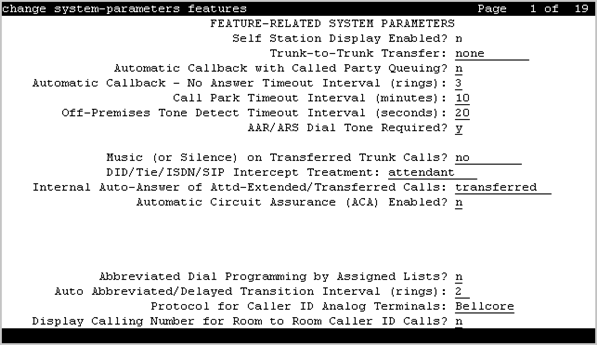
AAR/ARS Dial Tone Required
Enables or disables a second dial tone that tells the user that additional dialing can occur. The second dial tone is provided on a incoming tie or DID trunk call routed through AAR/ARS.
Abbreviated Dial Programming by Assigned Lists
Valid Entry |
Usage |
|---|---|
y |
Programming is done by the station-assigned list. |
n |
Indicates that a Program Access code is being used to indicate which personal list is to be programmed. |
ACA Long Holding Time Originating Extension
The extension number that the ACA feature uses when sending a long holding time referral call. This extension number must be different from the extension number used for ACA Short Holding Time Originating Extension. Available for local or primary ACA Referral Calls. Available only when Automatic Circuit Assurance (ACA) Enabled is enabled for the system.
ACA Referral Calls
Indicates where Automatic Circuit Assurance (ACA) referral calls generate. The Automatic Circuit Assurance (ACA) feature is used to identify possible trunk malfunctions. If a possible trunk malfunction is identified, Communication Manager sends the attendant a referral call that consists of a display message or a voice-synthesized message indicating the problem and where the problem is located. Available only when Automatic Circuit Assurance (ACA) Enabled is enabled for the system.
Valid Entry |
Usage |
|---|---|
local |
Generate on and for the local switch. |
primary |
Generate on the local switch for remote servers and switches as well as the local switch. |
remote |
Generate at another server in a DCS network. In this case, the remote node number must also be entered. The remote node number is the same node number administered for the dial plan. Also, ACA button status transmits to other servers and switches when in a DCS network. |
ACA Referral Destination
The specified extension or attendant must be equipped with a display module. Available only for local or primary ACA Referral Calls. Available only when Automatic Circuit Assurance (ACA) Enabled is enabled for the system.
Valid Entry |
Usage |
|---|---|
extension number |
The extension on a local server running Communication Manager receives the ACA referral call. |
attd |
The attendant receives the ACA referral call. |
ACA Remote PBX Identification
Available for remote ACA Referral Calls. Available only when Automatic Circuit Assurance (ACA) Enabled is enabled for the system.
Valid Entry |
Usage |
|---|---|
1 to 63 |
Identifies the switch in a DCS network that makes the referral call. The switch identified here cannot be the remote server or switch identified as local on the system Dial Plan. |
ACA Short Holding Time Originating Extension
The extension number that the ACA feature uses when sending a short holding time referral call. This extension number must be different from the extension number used for ACA Long Holding Time Originating Extension.
Available for local or primary ACA Referral Calls. Available only when Automatic Circuit Assurance (ACA) Enabled is enabled for the system.
Auto Abbreviated/Delayed Transition Interval (rings)
Valid Entry |
Usage |
|---|---|
1 to 16 |
The number of rings before an automatic abbreviated or delayed transition is triggered for a call. |
Automatic Callback — No Answer Timeout Interval (rings)
Valid Entry |
Usage |
|---|---|
2 to 9 |
The number of times the callback rings at the calling station before the callback is canceled. Using Automatic Callback, internal users who place a call to a busy or an unanswered internal telephone can be called back when the called telephone becomes available. |
Automatic Circuit Assurance (ACA) Enabled
Enables or disables the ACA feature to measure the holding time of each trunk call to identify possible trunk malfunctions. Long duration thresholds are designed to detect trunks that have been connected beyond the limit. Short duration thresholds detect trunks that might be dropping. Requires that an aca-halt button is administered on the user station.
Call Park Timeout Interval (minutes)
Valid Entry |
Usage |
|---|---|
1 to 90 |
The number of minutes a call remains parked before it cancels. Using the Call Park, users can retrieve a call on hold from any other telephone within the system. |
DID/Tie/ISDN/SIP Intercept Treatment
Valid Entry |
Usage |
|---|---|
announcement |
Routes intercepted calls to a recorded announcement that indicates that the number reached is inoperative or restricted.
Note:
This intercept treatment is provided as a system option. Only one message is given to the user. |
attendant |
Routes intercept calls to the attendant so that the attendant knows when a problem exists. |
vdn |
Routes intercepted calls to a vector directory number. |
Display Calling Number for Room to Room Caller ID Calls
Enables or disables displaying the calling number for room to room hospitality calls.
Internal Auto-Answer of Attd-Extended/Transferred Calls
Using Internal Automatic Answer (IAA), users can answer internal calls on digital telephones (except BRI) using a speakerphone or a headset.
Valid entry |
Usage |
|---|---|
attd-extended |
Enables IAA for only attendant-extended calls. |
both |
Enables IAA for station-transferred and attendant-extended calls. |
none |
Disables IAA for all calls. |
transferred |
Enables IAA for only station-transferred calls. |
Music (or Silence) On Transferred Trunk Calls
Valid Entry |
Usage |
|---|---|
all |
All transferred trunk calls receive music until the call is answered if the Music-on-Hold feature is available. |
no |
When the Trunk callers are waiting to be answered, they hear music or nothing if Music-on-Hold is not administered. When the transfer is completed, the callers then hear ringback till the call is answered. |
call-wait |
Trunk calls are transferred to stations that require the call to wait and hear music, if administered. All other transferred trunk calls receive ringback tone. |
Music/Tone on Hold
Indicates what a caller hears while on hold. Available only if Tenant Partitioning is disabled for the system.
Valid Entry |
Usage |
|---|---|
music |
The caller hears music while on hold. |
tone |
The caller hears a tone while on hold. |
none |
The caller hears silence while on hold. |
Off-Premises Tone Detect Timeout Interval (seconds)
Valid Entry |
Usage |
|---|---|
5 to 25 |
The number of seconds a call progress tone receiver (CPTR) tries to detect dial tone from a trunk during dialing. Once the time-out interval occurs, the call either outpulses on the trunk or gets intercept treatment depending on the Outpulse Without Tone settings administered for the system. |
Port
Available only when the music on hold type is port.
Valid Entry |
Usage |
|---|---|
1 to 250 |
Gateway |
V1 to V9 |
Module |
01 to 31 |
Circuit |
Protocol for Caller ID Analog Terminals
Determines the protocol or tones sent to a Caller ID telephone. The provider should have the correct protocol for each country.
Valid Entry |
Usage |
|---|---|
Bellcore |
Telcordia Technologies protocol with 212 modem protocol tones. Typically used in the U.S. |
V23–Bell |
Telcordia Technologies protocol with V.23 modem tones. Typically used in Bahrain. |
Self Station Display Enabled
Enables or disables the displaying of the primary extension associated with a digital display telephone when the inspect button is pressed or when a feature access code (FAC) is entered.
When using an FAC, the display continues until the user picks up the telephone or receives an incoming call.
When using the inspect button, the display continues until the user presses the normal or exit button, or until the user picks up the telephone or receives an incoming call.
Trunk-to-Trunk Transfer
Regulations in some countries control the settings for this field. For more information, go to the Avaya Support website at http://support.avaya.com/ for current documentation, product notices, knowledge articles.
Valid Entry |
Usage |
|---|---|
all |
Enables all trunk-to-trunk transfers. With this, telephone users can set up trunk-to-trunk transfer, go on-hook without disconnecting the call, and forward the call to a remote location. This value is required for SIP support. |
restricted |
Restricts all public trunks (CO, WATS, FX, CPE, DID, and DIOD) from being transferred. |
none |
Restricts all trunks (except CAS and DCS) from being transferred. |
Type
Indicates whether the source for Music on Hold is an announcement extension, an audio group, or a port on a VAL board.
Available only if music is administered as the treatment for calls placed on hold.
Valid Entry |
Usage |
|---|---|
ext |
Extension. Requires entry of the corresponding extension number of the announcement or audio source. |
group |
Analog group. Requires entry of the corresponding Music-on-Hold analog group number. |
port |
Analog/aux-trunk. Requires entry of the corresponding location of the Music-on-Hold analog or aux-trunk source.
Note:
A source identifier (extension number, audio group number, or port number) must be administered with the source type. |