

AVAYA DOCUMENTATION CENTER
Find answers to your technical questions and learn how to use our products
Avaya Aura® Communication Manager Screen Reference
SIT Treatment for Call Classification
The treatment of Special Information Tones (SITs) used for Outbound Call Management type calls with USA tone characteristics. Branch Gateway internal tone detector resources in classified mode are used to detect SITs. The classifiers are capable of detecting the following SITs:
SIT Ineffective Other
SIT Intercept
SIT No Circuit
SIT Reorder
SIT Vacant Code
SIT Unknown
AMD (Answering Machine Detected) Treatment
Available only if ASAI Link Core Capabilities and ASAI Link Plus Capabilities are enabled for the system.
Example command: change sit-treatment
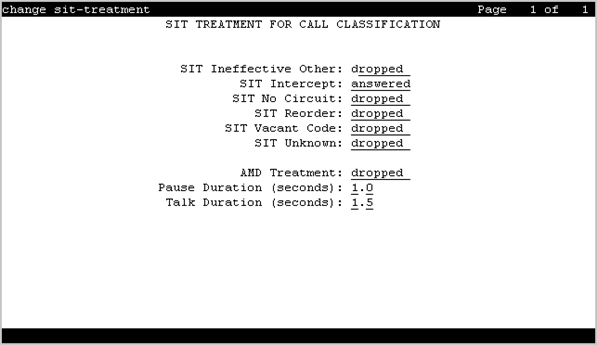
AMD Treatment
Specifies the treatment for Answering Machine Detected. An ASAI adjunct can request AMD for a call. If an Answering Machine is detected, one of two treatments is specified.
Valid Entry |
Usage |
|---|---|
answered |
Calls are classified as answered, and are therefore sent to an agent. |
dropped |
Calls are classified as unanswered, and are therefore not sent to an agent. This is the default. |
Pause Duration
Fractions of a second pause duration, as opposed to Talk Duration that is for full seconds.
Valid Entry |
Usage |
|---|---|
0.1 to 2.0 seconds in increments of 0.1 seconds |
The amount of time Communication Manager looks for a pause before it classifies the call as a live person. The Pause Duration timer should be set longer than the typical silence between words in an answering machine greeting, but shorter than the typical space between words in a live greeting. Defaults to 0.5 seconds. |
SIT Ineffective Other
The treatment for Ineffective Other
messages. An example of an Ineffective Other message is You are not required to dial a 1 when calling this number.
Valid Entry |
Usage |
|---|---|
answered |
Calls are classified as answered, and are therefore sent to an agent. |
dropped |
Calls are classified as unanswered, and are therefore not sent to an agent. This is the default. |
SIT Intercept
The treatment for intercept messages that direct callers to another number or extension.
Valid Entry |
Usage |
|---|---|
answered |
Calls are classified as answered, and are therefore sent to an agent. This is the default. |
dropped |
Calls are classified as unanswered, and are therefore not sent to an agent. |
An example of an intercept message is XXX-XXXX has been changed to YYY-YYYY, make a note of it.
SIT No Circuit
The treatment for calls with circuit problems, such as busy.
Valid Entry |
Usage |
|---|---|
answered |
Calls are classified as answered, and are therefore sent to an agent. |
dropped |
Calls are classified as unanswered, and are therefore not sent to an agent. This is the default. |
SIT Reorder
The treatment for reorder calls.
Valid Entry |
Usage |
|---|---|
answered |
Calls are classified as answered, and are therefore sent to an agent. |
dropped |
Calls are classified as unanswered, and are therefore not sent to an agent. This is the default. |
SIT Unknown
The treatment for calls when a situation or condition that is unknown to the network is encountered.
Valid Entry |
Usage |
|---|---|
answered |
Calls are classified as answered, and are therefore sent to an agent. |
dropped |
Calls are classified as unanswered, and are therefore not sent to an agent. This is the default. |
SIT Vacant Code
The treatment for calls when a vacant code is encountered.
Valid Entry |
Usage |
|---|---|
answered |
Calls are classified as answered, and are therefore sent to an agent. |
dropped |
Calls are classified as unanswered, and are therefore not sent to an agent. This is the default. |
Talk Duration
Full second talk duration, as opposed to Pause Duration that is for fractions of a second.
Valid Entry |
Usage |
|---|---|
0.1 to 5.0 seconds in increments of 0.1 seconds |
The amount of time Communication Manager looks for voice energy. If it finds that much continuous speech, Communication Manager classifies the call as an answering machine. The Talk Duration timer should be set to a time longer than it takes to say a typical live greeting. Defaults to 2.0 seconds. |