

AVAYA DOCUMENTATION CENTER
Find answers to your technical questions and learn how to use our products
Avaya Aura® Communication Manager Screen Reference
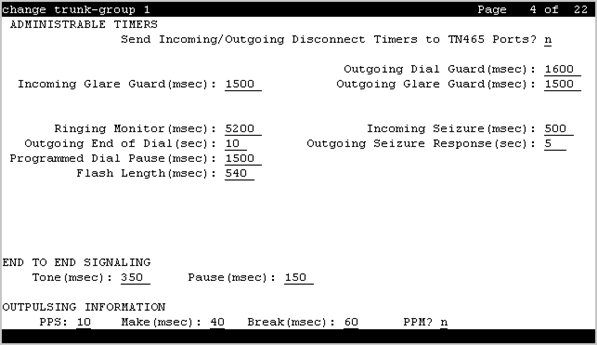
Administrable Timers
The system might not display this screen for all trunk group types.
Caution:
Customers: Do not change fields on this page without assistance from Avaya or your network service provider.
Answer Send (msec)
Available only for incoming or two-way trunk groups when the Trunk Type is dis. Only TN2140 and TN2199 ports receive this timer.
Valid Entry |
Usage |
|---|---|
10 to 2550 in increments of 10 |
The duration of the answer signal pulse. |
Busy Tone Disconnect
If enabled, Communication Manager recognizes a busy tone signal as a disconnect on this trunk group.
Available only if Enable Busy Tone Disconnect for Analog loop-start Trunks is enabled for the system country options.
Cama Outgoing Dial Guard (msec)
Available only for cama trunk groups (the trunk group type used for emergency 911 service).
Valid Entry |
Usage |
|---|---|
25 to 6375 in increments of 25 |
Minimum interval between the seizure acknowledgment on the receiving server or switch and the outpulsing of digits by this server. |
Cama Wink Start Time (msec)
Available only for cama trunk groups.
Valid Entry |
Usage |
|---|---|
20 to 5100 in increments of 20 |
The duration (the wait-for-wink-to-end time) for a wink-start CAMA trunk. The wink must begin before the Outgoing Seizure Response timer expires. |
Disconnect Signal Error (sec)
The system displays this field only for ground-start trunk groups.
Valid entry |
Usage |
|---|---|
1 to 255 in increments of 1 |
The maximum interval that Communication Manager waits to receive a disconnect signal from the far-end after the local party, such as a telephone or tie trunk, goes on-hook. If the timer expires, the disconnect signal fails. |
Flash Length (msec)
Valid Entry |
Usage |
|---|---|
10 to 2550 in increments of 10 |
The duration of a flash signal generated toward the local telephone company central office. This timer is sent to TN436B, TN459B, TN464C (or later), TN465B (or later), TN753 (if Country code is 23), TN2146, TN2147, TN2184, and TN2199 circuit boards. |
Glare
Available only for two-way or outgoing trunk groups when the Trunk Type is cont. Only TN2140 ports receive this timer.
Valid Entry |
Usage |
|---|---|
40 to 100 in increments of 10 |
The minimum acceptable interval between the moment your server running Communication Manager sends an outgoing seizure and the moment it receives a seizure acknowledgment. If acknowledgment is received before the timer expires, glare is assumed. |
Incoming Dial Guard (msec)
Valid Entry |
Usage |
|---|---|
10 to 2550 in increments of 10 |
The minimum acceptable interval between the detection of an incoming seizure and the acceptance of the first digit. Communication Manager does not accept digits before this timer expires. This timer is never sent to TN429 ports. |
Incoming Disconnect (msec)
Available only for incoming or two-way trunk groups when the Trunk Type is blank or cont.
Valid Entry |
Usage |
|---|---|
50 to 2550 in increments of 10 |
The minimum valid duration of a disconnect signal for an incoming call. Communication Manager does not recognize shorter disconnect signals. This field cannot be blank. For Brazil pulsed E&M signaling, use 600. |
Incoming Disconnect Send (msec)
Available only for incoming or two-way trunk groups when the Trunk Type is dis. Only TN2140 ports receive this timer.
Valid Entry |
Usage |
|---|---|
500 to 1200 in increments of 100 |
The duration of the backward release signal the server running Communication Manager sends at the end of an incoming call. |
Incoming Glare Guard (msec)
Available only for two-way trunk groups.
Valid Entry |
Usage |
|---|---|
100 to 25500 in increments of 100 |
The minimum interval that must elapse between a trunk’s release from an incoming call and its seizure for an outgoing call. This delay gives the far-end time to release all equipment after the trunk is released. This field cannot be blank. |
Incoming Partial Dial (sec)
Available only if the Incoming Dial Type is rotary. This timer is never sent to TN429 ports.
Valid Entry |
Usage |
|---|---|
5 to 255 in increments of 1 |
The maximum time allowed between incoming rotary digits. |
Incoming Seizure (msec)
Available only for incoming or two-way trunk groups, and, when applicable, the Trunk Type is cont. Only TN429, TN438 (any release), TN 447, TN464C (or later), TN465 (any release), TN767, TN2138, TN2140, TN2147, TN2184, and TN2199 ports receive this timer. For DID trunks, only TN2199 and TN429D (or later) receive this timer.
Valid Entry |
Usage |
|---|---|
20 to 2550 in increments of 10 |
The duration of the shortest incoming seizure signal the server running Communication Manager can recognize. For ICLID, set this field to 120. The field cannot be blank. |
Normal Outgoing Seize Send (msec)
Available only for two-way or outgoing trunk groups when the Trunk Type is dis. Only TN2140 ports receive this timer.
Valid Entry |
Usage |
|---|---|
10 to 990 in increments of 10 |
The duration of the signal the server running Communication Manager sends for an outgoing seizure. |
Outgoing Dial Guard (msec)
Valid Entry |
Usage |
|---|---|
100 to 25500 in increments of 100 |
The minimum interval between seizure acknowledgment of a trunk and the outpulsing of digits. For trunks that do not provide seizure acknowledgment, the timer specifies the minimum time between seizure and the outpulsing of digits. Any digit the caller dials after lifting the receiver, but before the timer expires, is not outpulsed until the timer expires. This field cannot be blank. |
Outgoing Disconnect (msec)
Valid Entry |
Usage |
|---|---|
50 to 2550 in increments of 10 |
The minimum valid duration of a disconnect signal for an outgoing call. Communication Manager does not recognize shorter disconnect signals. This timer begins timing when a disconnect signal is detected on an outgoing call and resets when the signal is no longer detected. If the timer expires, the trunk drops. This field cannot be blank. For Brazil pulsed E&M signaling, use 600. |
Outgoing Disconnect Send (msec)
Available only for two-way or outgoing trunk groups when the Trunk Type is dis. Only TN2140 ports receive this timer.
Valid Entry |
Usage |
|---|---|
100 to 9900 in increments of 100 |
The duration of the forward release signal the server running Communication Manager sends at the end of outgoing calls. |
Outgoing End of Dial (sec)
Available for outgoing or two-way trunk groups when the network does not provide answer supervision.
Valid Entry |
Usage |
|---|---|
1 to 254 in increments of 1 |
The maximum time Communication Manager waits to receive answer supervision for outgoing calls on the ports controlled by firmware timers. Controls firmware answer supervision timers on media module that have them. During a cut-through operation, timing begins after Communication Manager sends each outgoing digit and ceases when answer supervision is received. If the timer expires, Communication Manager acts as if it has received answer supervision. On senderized operation, the timer begins after the switch sends the last digit collected. The timer ceases when answer supervision is received. If the timer expires, Communication Manager acts as if it has received answer supervision. For Brazil pulsed E&M signaling, use 40. |
Outgoing Glare Guard (msec)
Available only for outgoing and two-way trunk groups.
Valid Entry |
Usage |
|---|---|
100 to 25500 in increments of 100 |
The minimum interval that must elapse between a trunk’s release from an outgoing call and its seizure for another outgoing call. This delay gives the far-end time to release all equipment after the outgoing trunk is released. This field cannot be blank. |
Outgoing Last Digit (sec)
Available only for two-way or outgoing trunk groups when the Trunk Type is dis or cont. Only TN497 and TN2140 ports receive this timer.
Valid Entry |
Usage |
|---|---|
1 to 40 in increments of 1 |
The maximum time that Communication Manager waits for the next digit dialed. After the timer expires, no more digits are accepted by the circuit pack. |
Outgoing Rotary Dial Interdigit (msec)
Available only if:
The trunk Group Type is access, aplt, co, diod, dmi-bos, fx, rlt, tandem, or wats, and the Outgoing Dial Type is rotary.
The trunk Group Type is tie, the Trunk Type is blank, cont, or dis, and the Outgoing Dial Type is rotary.
The trunk Group Type is tie, and the Trunk Type is tge, tgi, or tru.
Valid Entry |
Usage |
|---|---|
150 to 2550 in increments of 10 |
The minimum time between outpulsed digits on outgoing rotary trunks. |
Outgoing Seizure Response (sec)
Valid Entry |
Usage |
|---|---|
1 to 255 in increments of 1 |
The maximum interval that Communication Manager waits after sending a seizure signal to receive seizure acknowledgment from the far-end. If the acknowledgment is not received within this time, a seizure failure response is uplinked. For Brazil pulsed E&M signaling, use 255. |
Programmed Dial Pause (msec)
Valid Entry |
Usage |
|---|---|
100 to 25500 in increments of 100 |
The exact duration of the pause used during abbreviated dialing, ARS outpulsing, and terminal dialing operations. This timer is administrable for all outgoing and two-way trunk groups. All central office (CO) media module that accept administrable timers accept this timer. |
Release Ack Send (msec)
Available only for incoming and two-way trunk groups when the Trunk Type is dis. Only TN2140 ports receive this timer.
Valid Entry |
Usage |
|---|---|
500 to 1200 in increments of 100 |
The duration of the signal the server running Communication Manager sends for a forward release acknowledgment. After the server running Communication Manager receives a forward release signal, it must send a forward release acknowledgment signal. |
Ringing Monitor (msec)
The minimum time that Communication Manager requires to determine if a trunk disconnects.
You cannot leave the field blank.
Valid entry |
Usage |
|---|---|
200 to 51000 in increments of 200 |
If the ringing signal disappears for a duration longer than the time specified in this field, you can be sure that the call is disconnected. |
Seize Ack Delay (msec)
Available only for incoming or two-way trunk groups if the Trunk Type is dis. Only TN2140 ports receive this timer.
Valid Entry |
Usage |
|---|---|
40 to 120 in increments of 10 |
The maximum interval the server running Communication Manager waits after receipt of an incoming seizure to send seizure acknowledgment. |
Seize Ack Send (msec)
Available only for incoming or two-way trunk groups if the Trunk Type is dis. Only TN2140 ports receive this timer.
Valid Entry |
Usage |
|---|---|
10 to 990 in increments of 10 |
The duration of the seizure acknowledgment signal the server running Communication Manager sends in response to an incoming seizure. |
Send Incoming/Outgoing Disconnect Timers to TN465 Ports
If enabled, the incoming disconnect and outgoing disconnect timer values are sent to the trunk group ports that are on a TN465 board. Available only for a co, fx, or wats trunk group.
END TO END SIGNALING
Pause (msec)
Available only if the Trunk Type is blank.
Valid Entry |
Usage |
|---|---|
20 to 2550 in increments of 10 |
The interval (pause) between DTMF tones sent from a hybrid telephone. All CO, DIOD, and tie media module that accept administrable timers accept this timer. |
Tone (msec)
Available only if the Trunk Type is blank.
Valid Entry |
Usage |
|---|---|
20 to 2550 in increments of 10 |
The duration of the DTMF tone sent when a button on a hybrid telephone is pressed. All CO, DIOD, and tie media module that accept administrable timers accept this timer. |
OUTPULSING INFORMATION
Break (msec)
The duration of the break interval (the pulse duration) while the system is outpulsing digits using dial pulse signaling. The field cannot be blank.
Valid Entry |
Usage |
|---|---|
20 to 80 in increments of 5 |
If the PPS (pulses per second) value is 10, the sum of the Make (msec) and Break (msec) values must equal 100. |
10 to 40 in increments of 5 |
If the PPS (pulses per second) value is 20, the sum of the Make (msec) and Break (msec) values must equal 50. |
Make (msec)
The duration of the make interval (the pause between pulses) while the system is outpulsing digits using dial pulse signaling. The field cannot be blank.
Valid Entry |
Usage |
|---|---|
20 to 80 in increments of 5 |
If the PPS (pulses per second) value is 10, the sum of the Make (msec) and Break (msec) values must equal 100. |
10 to 40 in increments of 5 |
If the PPS (pulses per second) value is 20, the sum of the Make (msec) and Break (msec) values must equal 50. |
PPM
Determines if Periodical Pulse Metering (PPM) pulses should be collected from the public network to determine call cost. For CO, DIOD, FX, PCOL, and WATS trunks. Available only for outgoing or two-way trunk groups.
PPS
Available only for cama trunk groups.
Valid Entry |
Usage |
|---|---|
10 20 |
The rate (pulses per second) at which outgoing rotary pulses are sent over this trunk group. |