

AVAYA DOCUMENTATION CENTER
Find answers to your technical questions and learn how to use our products
Avaya Aura® Call Center Elite Feature Reference
Simple multisite BSR
Multisite BSR compares local and remote splits or skills and queues calls to the resource that provides the best service. Remember that each BSR application has the following main parts:
An application plan that identifies the remote servers for comparison.
A set of the following VDN or vector pairs:
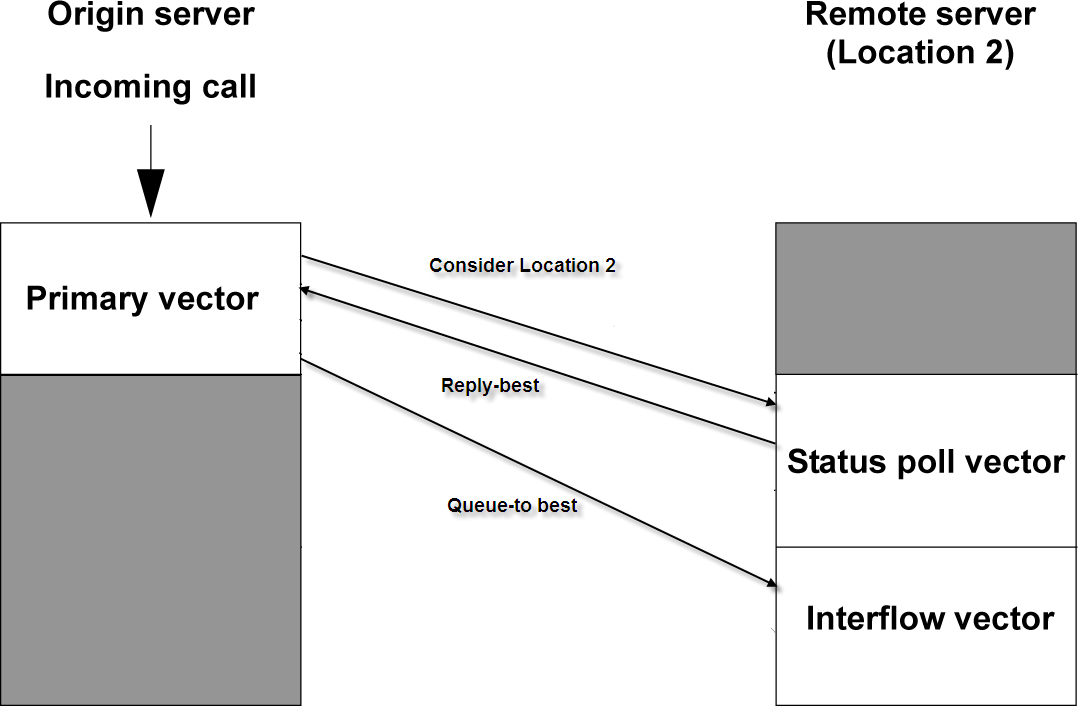
Primary: The primary vector, which is on the origin server, contacts the specified remote servers, collects information, compares the information, and routes the call to the server that is likely to provide the best service.
Status poll: The status poll vector, which is on the remote server, compares resources on the remote server and replies to the origin server with information on the best of the resource. Each remote server in a given application must have a dedicated status poll vector.
Interflow: When a given remote server is the best available, the origin server interflows the call to the vector on the remote server. Each remote server in a given application must have a dedicated interflow vector.
The general operational scheme for multisite BSR is shown in the following figure.
The following example shows the primary VDN using a multisite BSR application.
BSR example primary VDN
change vdn xxxxx                                                 page 1 of 3
        VECTOR DIRECTORY NUMBER

                            Extension: 52222
                                 Name: Multisite BSR
                        Vector Number: 222
                  Attendant Vectoring? n
                   Meet-me Conference? n
                   Allow VDN Override? n
                                  COR: 59
                                   TN: 1
                             Measured: internal
       Acceptable Service Level (sec): 20
              Service Objective (sec):
        VDN of Origin Annc. Extension:
                            1st Skill:
                            2nd Skill:
                            3rd Skill:
change vdn xxxxx                                                 page 2 of 3        VECTOR DIRECTORY NUMBER
                           Audix Name:
                   Return Destination:
               VDN Timed ACW Interval:
                      BSR Application: 15
         BSR Available Agent Strategy: UCD-MIA
In the example shown above for VDN 52222, the entry in the BSR Application field links this VDN to BSR Application Plan 15. Also note the UCD-MIA entry in the BSR Available Agent Strategy field. If vector 222 uses BSR commands, calls are not automatically delivered to the first resource found with an available agent. All consider steps in vector 222 are executed, and one of the following happens:
If |
Then |
|---|---|
There is no available agent in the local or the remote splits |
The call queues to the split with the lowest adjusted EWT. |
Only one split has an available agent |
The call is delivered to the split. |
More than two splits have available agents |
The call is delivered to the split with the most idle agent. |
Note that the Allow VDN Override field is set to n. If a second VDN and vector are used to process the call, the UCD-MIA strategy and the application plan specified in VDN 52222 are used.
Application plan 15, which is shown in the sample multisite BSR application plan, identifies the remote server and provides the digit strings to dial into the VDNs for both the status poll vector and the interflow vector.