

AVAYA DOCUMENTATION CENTER
Find answers to your technical questions and learn how to use our products
Avaya Aura® Call Center Elite Feature Reference
Configuration - IVR before the communication server
This scenario illustrates a system configuration where a call comes in to (Interactive Voice Response (IVR) before reaching the communication server. In this configuration, IVR provides voice response services or call screening so that the number of incoming calls to the communication server is reduced.
Note:
This configuration is less common than the communication server before the IVR configuration.
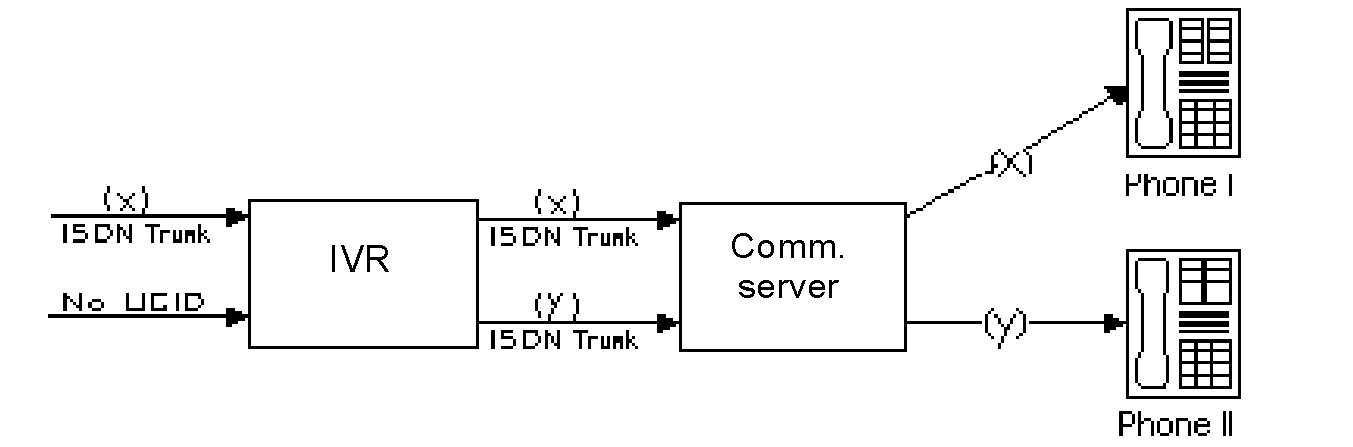
When IVR is before the communication server:
IVR receives an incoming call with UCID x.
or
IVR creates a new UCID y and associates it with the incoming call (if the call has no UCID already associated with it).
Note:For IVR to recognize an incoming UCID (such as UCID x) from an ISDN trunk, special IVR scripting is required. When IVR receives a call from the public network, it automatically creates a new UCID because it cannot recognize whether or not the call already has a UCID.
IVR sends UCID to the communication server over an ISDN-PRI trunk.
The communication server receives UCID and reuses it for the incoming call.
The communication server reports UCID to the CMS if the trunks, VDNs, or splits/skills associated with the call are measured.