

AVAYA DOCUMENTATION CENTER
Find answers to your technical questions and learn how to use our products
Avaya Aura Communication Manager Feature Description and Implementation
Route pattern
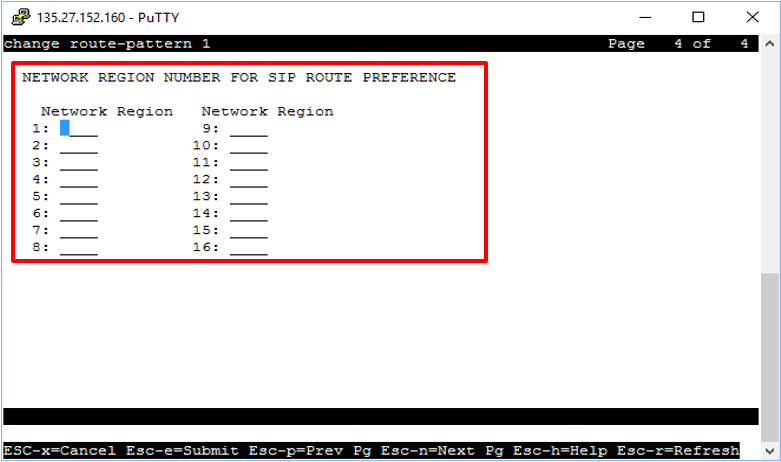
A network region can be populated for each of the route patterns. This network region will be used only when routing SIP trunk calls (SRE Calls) over the route preference (Trunk Group).
Network region field on the route pattern applies only for trunk and OPTIM such as EC500 and telecommuter calls but not for SIP station calls. This overrides the network region field on the SIP signaling group for the above mentioned applicable calls.
Route patterns are as follows:
-
Routing to SIP stations using a non-clustered signaling group
-
Routing to SIP stations using a clustered signaling group
-
Routing to SIP trunk calls using clustered signaling groups
Route pattern to SIP stations using a non-clustered signaling group
-
If the SIP trunk group does not use a clustered signaling group, the Session Manager fields on the SIP station form are not used to route to the SIP station.
-
Two trunk groups and two trunk members are required to reach the SIP station. One to the Primary Session Manager and other to the Secondary Session Manager in a fully redundant configuration.
-
If the Primary Session Manager is not reachable, another trunk group must be selected from the Route Pattern that routes to the Secondary Session Manager using Look Ahead Routing (LAR). For non-clustered signaling group, LAR can be used for both SIP station calls and trunk calls.
-
This is pre-Communication Manager 8.0 functionality and can be used in Communication Manager 8.0 and later.
-
The newer SIP routing functionality using a clustered signaling group is optional and can be used if needed, but not forced.
Route pattern to SIP stations using a clustered signaling group
-
All Session Managers used by all SIP stations on a Communication Manager should be administered on the SIP cluster. Trunk groups should use clustered signaling groups.
-
The Primary Session Manager to route to the station is selected from the SIP station form. As the clustered signaling group can send a message to any Session Manager in the cluster, the call can be sent to the Primary Session Manager using that trunk group.
-
In case of a failover scenario when the Primary Session Manager is not reachable, the secondary Session Manager to reach to the SIP station is taken from the SIP station form. The call is sent using the same trunk group and trunk member. A different trunk group (and signaling group) is not needed.
-
There is no need of Look Ahead Routing (LAR) because the same trunk group and trunk member can be used to route to both Session Managers. Hence, LAR is not applicable if clustered signaling groups are used to route to SIP stations.
Route pattern to SIP trunk calls using clustered signaling groups
-
Session Manager from the SIP cluster is selected in a round robin fashion to route the call.
-
It is assumed that any Session Manager on the cluster can route the call to the intended far-end.
-
On receiving a LAR triggering response, another Session Manager from the cluster is selected to route the call. Up to five attempts (to unique Session Managers) will be done to route the call using the same trunk group and member.
-
If all the five attempts are failed, the next entry in the route pattern can be used to route the call if LAR is enabled.