

AVAYA DOCUMENTATION CENTER
Find answers to your technical questions and learn how to use our products
Administering Avaya IP Office using Manager
SIP Call Hold Scenarios
Hold originated by IP Office
When an IP Office DS extension or non-IP trunk puts a SIP trunk on hold, there is no indication to the network. The voice path is merely switched in the TDM domain to the appropriate hold treatment source (tones, silence or music).
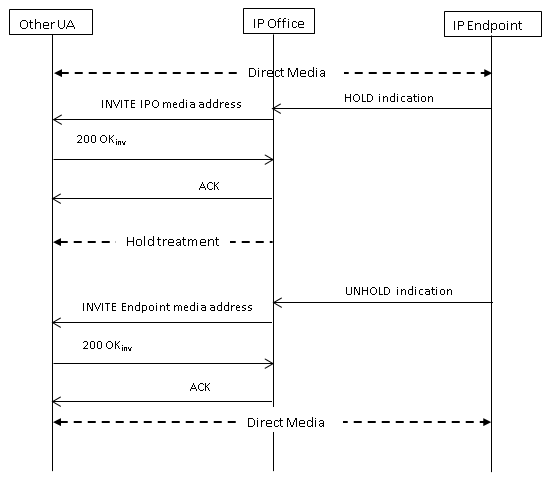
For IP extensions and trunks, be they H.323 or SIP, if the call uses direct media, there will be a re-INVITE sent to redirect the media source from the extension or trunk endpoint to a port on the IP Office in order to connect hold treatment. When the call is then unheld, another INVITE will go out to connect the extension with the far end.
Hold originated by far end
The far end of a SIP trunk can put the IP Office call on hold by sending it an re-INVITE with an SDP Offer containing:
A sendonly attribute. IP Office replies with an
SDP Answercontaining the recvonly attribute.An inactive attribute. IP Office replies with inactive.
A zero media connection address (c=0.0.0.0). IP Office replies with inactive.
Unhold
A held call is unheld by means of an SDP Offer with the sendrecv attribute (or no direction attribute, since sendrecv is assumed if not specified).
Unhold from mutual hold
Either end can unhold the other end by sending a new Offer with the sendrecv or recvonlyattribute. The other end replies with sendonly if the call is still on hold at its end.