AVAYA DOCUMENTATION CENTER
Find answers to your technical questions and learn how to use our products
Administering Avaya IP Office using Manager
SIP Call Transfers (Refer)
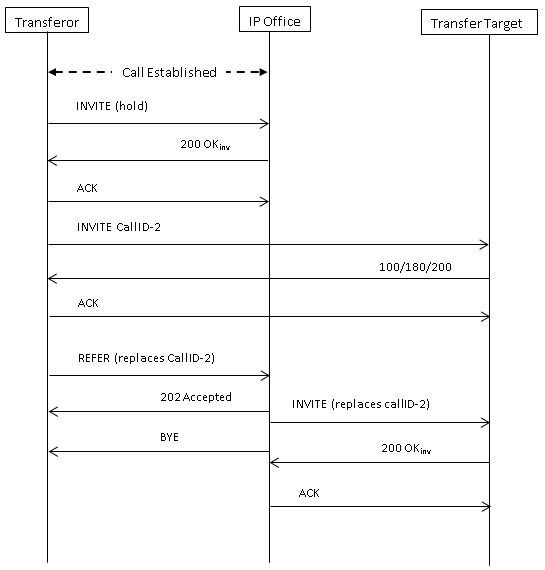
After a SIP call has been established, the SIP REFER method is used by the transferor end of the call to transfer the transferee end to a the transfer target. The REFER message provides the transfer target’s contact information in a Refer-To header. That information is used to establish complete the transfer.
For public SIP trunks, IP Office supports only consultative call transfer using REFER. Consultative transfers are also known as attended or supervised transfers. With consultative transfer, the transferor puts the first call on hold and establishes a consultation call to the transfer target. After the consultation call, the transferor completes the transfer, causing the transferee to connect to the transfer target, replacing the transferor.
REFER can be configured to accept incoming, reject incoming, or decide based on the presence of REFER in the Allow: header in responses to OPTIONS messages. Similarly, there is the same configuration for outgoing REFER.
Although the transferor and transferee must be SIP endpoints, the transfer target can be a TDM, PRI, H.323 or SIP terminal on the same IP Office, or an endpoint reachable over the same SIP line as the REFER request is received from.