

AVAYA DOCUMENTATION CENTER
Find answers to your technical questions and learn how to use our products
Administering Avaya Aura® Communication Manager
ARS Analysis
With ARS, Communication Manager checks the digits in the number called against the ARS Digit Analysis Table to determine how to handle the dialed digits. Communication Manager also uses Class of Restriction (COR) and Facility Restriction Level (FRL) to determine the calling privileges.
Let us look at a very simple ARS digit analysis table. Your system likely has more defined dialed strings than this example. Refer to the following screenshot for ARS Digit Analysis Table.
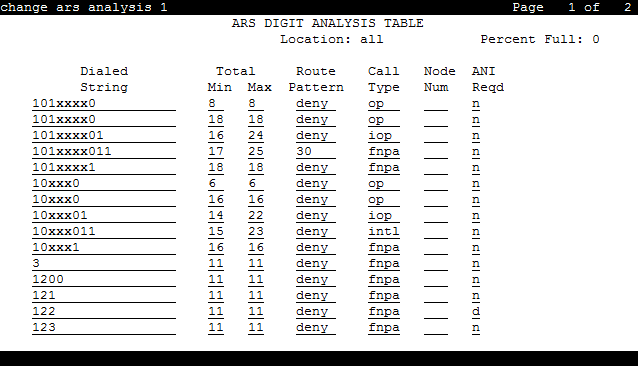
In the ARS Digit Analysis Table screen, the far-left column of lists the first digits in the dialed string. When a user makes an outgoing call, the system analyzes the digits, looks for a match in the ARS Digit Analysis Table, and uses the information in the matching row to determine how to route the call.
Let us say a caller places a call to 1-303-233-1000. Communication Manager matches the dialed digits with those in the first column of the ARS Digit Analysis Table screen.
In this example, the dialed string matches the 1
. Then Communication Manager matches the length of the entire dialed string (11 digits) to the minimum and maximum length columns. In our example, the 11-digit call that started with 1 follows route pattern 30 as an fnpa call.
Tip:
The first dialed digit for an external call is often an access code. If ‘9’ is defined as the ARS access code, Communication Manager drops this digit and analyzes the remaining digits with the ARS Analysis Table.
The Route Pattern points to the route that handles the calls that match this dial string. Call Type tells what kind of call is made with this dial string.
Call type helps Communication Manager decide how to handle the dialed string.