

AVAYA DOCUMENTATION CENTER
Find answers to your technical questions and learn how to use our products
Administering IP Office Voicemail Pro
Distributed Voicemail Servers
Remote IP Office systems in the Small Community Network can be associated with another Voicemail Pro server in addition to the centralized Voicemail Pro server. The additional distributed server then provides all voicemail services, except message storage and collection, for their IP Office. This requires the remote IP Office to have licenses for voicemail operation and the features it requires.
While the distributed server does message recording, it forwards all messages to the central Voicemail Pro server. The messages are transferred between systems using SMTP email. For mailbox users, message waiting indication and message collection is still done using the central Voicemail Pro server. With the support of International Time Zone (ITZ) functionality, the users of the IP Office systems located across the globe receive messages in their voicemail system with their respective local time stamp.
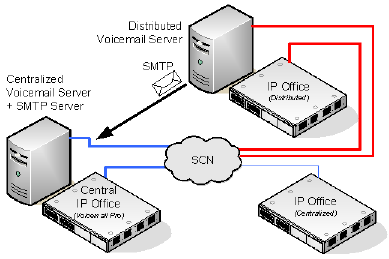
Each IP Office is set up to use Simple Network Time Protocol (SNTP), the time source of the IP Office Network.
Other IP Office systems continue to use centralized voicemail as normal.
An IP Office that is using a distributed Voicemail Pro server cannot also be used as the fallback IP Office for the central Voicemail Pro server.
SMTP SSL/TLS communication is used to exchange information between the servers. If the servers fail to connect using SSL/TLS over SMTP, then plain text communication is used.
Multiple Distributed Servers
Additional distributed Voicemail Pro servers can be added as required by the individual IP Office sites in the Small Community Network.
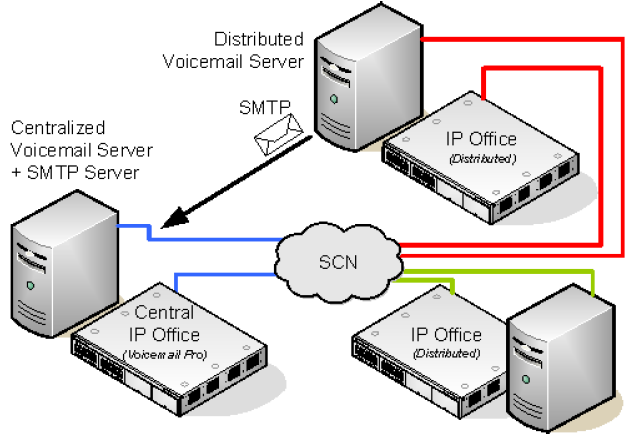
Sharing Distributed Voicemail Servers
The same distributed Voicemail Pro server can be shared by several IP Office systems. The services it provided to each depend on the licenses that each IP Office has.
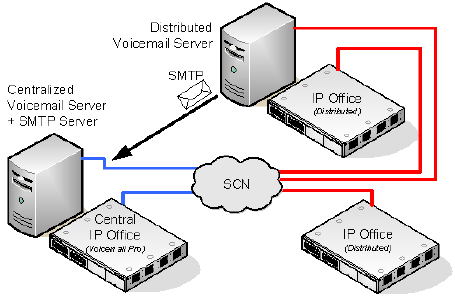
Summary of IP Office Configuration Settings for Distributed Voicemail Servers
IP Office settings |
Central IP Office |
Other IP Office systems |
IP Office with Distributed Server |
|---|---|---|---|
Voicemail Type |
Voicemail Pro |
Centralized Voicemail |
Distributed Voicemail |
Voicemail IP Address |
Set to the central Voicemail Pro server computer's IP address. |
Not used |
Set to the distributed Voicemail Pro server computer's IP address. |
Voicemail Destination |
Not used |
Set to the Outgoing Group ID of the H323 Line to the central IP Office. |
Set to the Outgoing Group ID of the H323 Line to the central IP Office. |
Licenses |
This system needs licenses for Voicemail Pro and all voicemail features required. |
The other IP Office systems only require licenses for UMS and or for Media Manager if required. |
This system needs licenses for Voicemail Pro and all voicemail features required. |
Configuring Distributed Voicemail Server Operation
The centralized Voicemail Pro server for the SCN and its central IP Office are configured as normal.
The Voicemail Pro server software is installed as normal any distributed Voicemail Pro server computer. The distributed Voicemail Pro server is not specifically configured as being a distributed server.
Each IP Office hosting a distributed Voicemail Pro server is configured with the Voicemail Type set to Distributed Voicemail.

The Voicemail Destination is set to the Outgoing Group ID of the H323 trunk to the central IP Office hosting the centralized Voicemail Pro server.
The Voicemail IP Address is set to the IP address of the computer running the distributed Voicemail Pro server for the IP Office.
Note:
If you are using Voicemail Pro in a distributed environment, a distributed server delivers a recorded message to the central voicemail server on completion of the recording. However, the presentation to the voicemail server for message waiting indication (MWI) and access via telephone may be delayed because of the internal processing of the message and the network latency. The delay might be up to 2 minutes in high traffic situations.