

AVAYA DOCUMENTATION CENTER
Find answers to your technical questions and learn how to use our products
Avaya Aura® Communication Manager Feature Description and Implementation
ISDN interworking
Using ISDN interworking, you can have a combination of both ISDN and non-ISDN trunking and station facilities. A non-ISDN trunking facility is any trunk facility supported by the system that does not use the ITU-T recommended Q.931 message set for signaling. Non-ISDN trunking facilities include facilities such as analog trunks, AVD DS1 trunks, and DS1 trunks with bit-oriented signaling (robbed-bit or common channel).
Communication Manager supports the conversion of ISDN signaling to non-ISDN in-band signaling and the conversion of non-ISDN in-band signaling to ISDN signaling for interworking purposes.
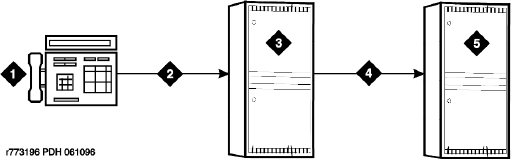
A mixture of ISDN and non-ISDN signaling is required to provide end-to-end signaling when using different types of trunk or station facilities on a call. The figure shows an example of interworking.
|
|
In this example, a call for someone at Switch B comes into Switch A. Using Interworking, the ISDN signaling of the call can be converted at Switch A to non-ISDN in-band signaling before the call forwards to Switch B. Even though the call comes into Switch A on an ISDN trunk, Switch A can send the call to Switch B over a non-ISDN trunk by converting the signaling information.
The system provides accurate CDR billing information on calls that are not interworked. Accuracy of CDR billing information on interworked calls is equivalent to the accuracy provided by the public network.
Communication Manager supports sending a non-ISDN trunk name as the connected name. Therefore, a non-ISDN trunk name can be sent as the connected name even when a call starts out as an ISDN call but is interworked over non-ISDN trunks.