

AVAYA DOCUMENTATION CENTER
Find answers to your technical questions and learn how to use our products
Avaya Aura® Communication Manager Feature Description and Implementation
Uniform Dial Plan example
The section contains an example of UDP administration, and the processing of several calls that use UDP.
To administer UDP, you must assign each UDP code:
To a private network location code (RNX) or node number. The RNX is equivalent to the office code of a central office (CO) in a public network. This RNX determines how the system routes a UDP call.
As either local or remote to Communication Manager.
The same 5-digit extension is used to call a station, regardless of where in the electron tandem network (ETN) that call originates. This example includes three media servers or switches (the table). Each media server and switch has a list of RNX and UDP codes.
Media server or switch |
RNX code |
UDP code |
A |
224 |
41 |
C |
223 |
51 |
C |
223 |
52 |
B |
222 |
60 |
B |
222 |
61 |
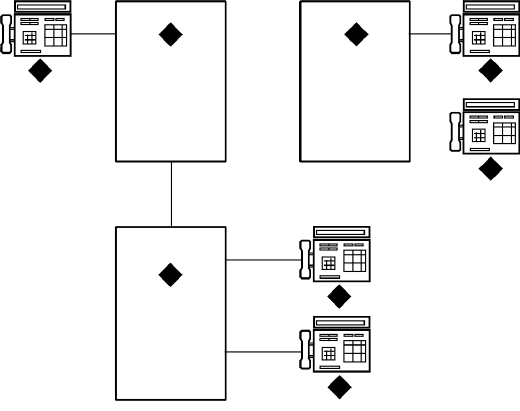
See the figure for an example of a UDP scenario.
|
|
A user at extension 41000 who wants to call extension 61234, has one of the following options:
Dial 61234
Dial the AAR access code, and then dial 222-1234
If the user dials 61234, the system:
Recognizes 61 as a remote UDP
Determines that the associated RNX is 222
Uses AAR to route the call to 222-1234
If the user dials the AAR access code and 222-1234, the system:
Finds the route pattern for RNX 222
Routes the call to the server that is associated with that RNX
When the software uses UDP to route a call to another server or system, the route pattern provides the correct digit deletion and insertion instructions. The receiving system then gets numbers in the format that the receiving system expects.
You can configure the software several different ways.
If AAR is available on the receiving media server or switch:
Subnetwork trunking can be used to insert the Feature Access Code (FAC) for AAR on the server or switch where the call originates
Digit insertion can be used to insert the FAC for AAR on the receiving server
The receiving server uses AAR digit conversion to delete 3 digits and add the digit 6, thus converting the number 222 with 7 digits to an extension.
If AAR is unavailable on the receiving media server or switch, subnetwork trunking must be used on the originating server or switch to delete the 222 and insert the digit 6 at the start of the extension number. This conversion ensures that the receiving server can continue to route the call correctly.
If the user at extension 51234 on media server C dials extension 61234, the call must first go through media server A before the call goes to media server B. When the user dials 61234:
The software recognizes 61 as a UDP code.
The software determines that the associated RNX is 222, and uses the AAR feature to route the call.
The FAC for AAR plus the digits 222-1234 are outpulsed to media server A.
Media server A then recognizes the RNX 222 as a remote server or switch, and routes the call to media server B and extension 61234.
This same type of call routing occurs when an extension at media server B calls an extension at media server C.
If extension 61234 on media server B calls extension 60123, the software recognizes 60 as a local UDP code, and the system routes the call directly to extension 60123.