

AVAYA DOCUMENTATION CENTER
Find answers to your technical questions and learn how to use our products
Avaya Aura® Communication Manager Feature Description and Implementation
D-channel backup with NFAS
With NFAS, you can administer a backup D-channel to improve reliability. The system switches to the backup D-channel, if a signaling link failure occurs on the primary D-channel span.
You administer one D-channel as the primary D-channel, and another D-channel as the secondary D-channel. These assignments ensure that both D-channels are in the same state at the same time, and that neither channel can be used to carry B-channel traffic at any time. The primary D-channel has precedence over the secondary D-channel.
When D-channel backup is activated, the system preserves all calls that are answered. However, some call-related information can be lost. Calls that are not answered when D-channels are switched, can also lose call-related information.
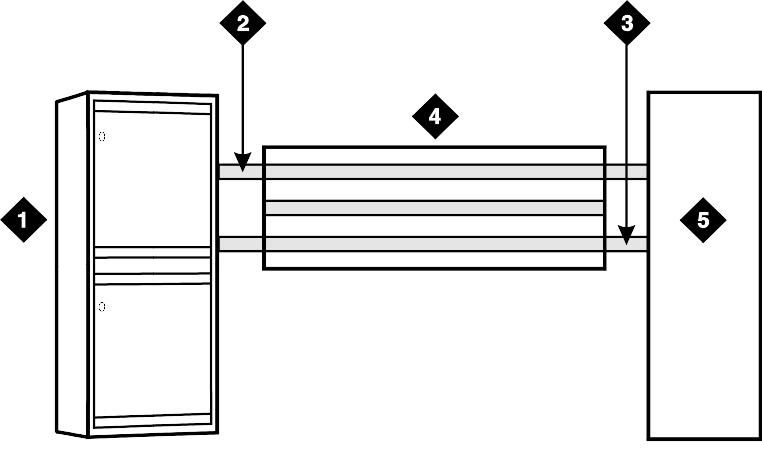
The following figure shows a possible configuration that involves three ISDN-PRIs between a DEFINITY Server and another DEFINITY Server or the public network.
|
|
With T1 (24-channel) interfaces, two of the ISDN-PRIs contain a D-channel and 23 B-channels. The other ISDN-PRI contains 24 B-channels. One of the D-channels is the primary D-channel, and the other is the secondary D-channel. Together, this pair of D-channels signals for all 70 (23+24+23) B-channels in the three Primary Rate Interfaces.
Since the D-channels carry signaling for more than one ISDN-PRI facility, D-channel backup requires the use of NFAS. At any given time, one of the two D-channels is carrying Layer 3 signaling messages, while the other D-channel is active at layer 2, but in standby mode only. Any layer 3 messages received over the standby D-channel are ignored. Since only one of the D-channels can be active at a time, the two D-channels cannot share load. The two D-channels can provide signaling for only a predefined set of B-channels and cannot dynamically back up other D-channels on other interfaces.