AVAYA DOCUMENTATION CENTER
Find answers to your technical questions and learn how to use our products
Avaya Aura® Communication Manager Feature Description and Implementation
Example of Dial Plan Transparency
The single server distributed systems over IP network and WAN-connected media gateways and port networks have introduced the need for dial plan transparency. When a single server is fragmented into a multiple server configuration, the dial plan transparency becomes a problem. For example, when the media gateway loses contact with the primary controller, the media gateway attempts to re-register with an alternate controller or Local Survivable Processor (LSP).
An LSP might become active for different reasons.
The network connection between the media gateway and the primary controller fails.
The primary controller itself fails.
In all the following examples, both the callers are nonIP phones.
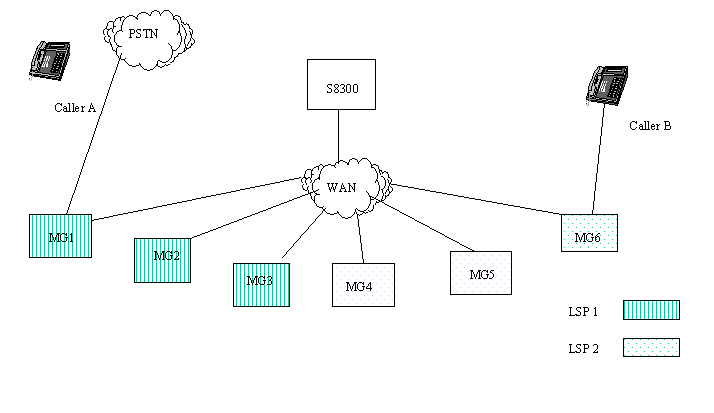
In Figure 1, S8300 is the primary controller for six media gateways: MG1, MG2, and MG3 in Network Region 1, and MG4, MG5, and MG6 in Network Region 2. Each media gateway is administered with a primary controller and an alternate controller or a survivable remote server (LSP). LSP1 is an alternate controller for Network Region 1, and LSP2 is an alternate controller for Network Region 2. When a media gateway loses contact with the primary controller, each media gateway attempts to re-register with the LSP. After successful registration, if caller A on MG1 attempts to call caller B on MG6, LSP1 determines whether caller B exists on the originating LSP, the location where caller B resides, and the LDN number for Network Region 2. The LSP places an outgoing trunk call to the LDN for Network Region 2. When one of the media gateways in NR 2 receives the call, DPT is triggered and the call is routed to caller B through an IP inter-gateway connection. In this example, the call is routed from MG1 to MG6.
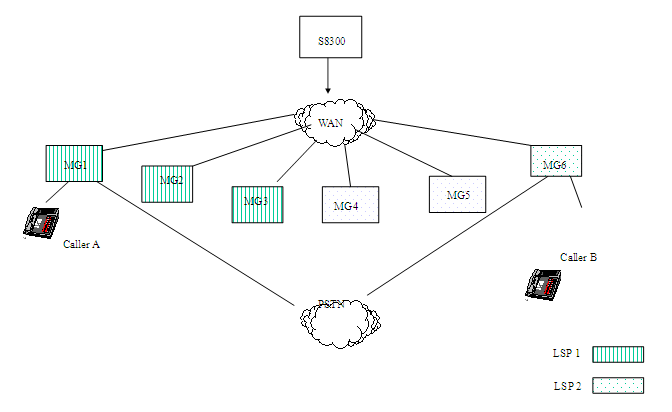
In Figure 2, S8300 is the primary controller for six media gateways: MG1, MG2, and MG3 in Network Region 1, and MG4, MG5, and MG6 in Network Region 2. Each media gateway is administered with a primary controller and an alternate controller or LSP. LSP1 is an alternate controller for Network Region 1, and LSP2 is an alternate controller for Network Region 2. When a network failure occurs, each of the media gateways MG4, MG5, and MG6 loses contact with the primary controller and attempts to re-register with the LSP. In this scenario, if there is a call from PSTN to MG1 for caller B on MG6, S8300 determines whether it can reach caller B through the IP network, determines the Network Region where caller B resides, and places an outgoing trunk call. When a media gateway in Network Region 2 receives a call, DPT is triggered and the call is routed to caller B.
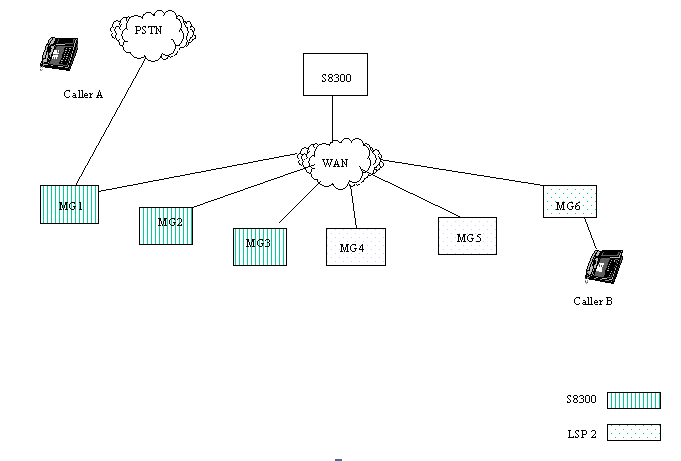
In Figure 3, S8300 is the primary controller for six media gateways: MG1, MG2, and MG3 in Network Region 1, and MG4, MG5, and MG6 in Network Region 2. Each media gateway is administered with a primary controller and an alternate controller or LSP. LSP1 is an alternate controller for Network Region 1, and LSP2 is an alternate controller for Network Region 2. When a network failure occurs, the media gateway (MG1) loses contact with the primary controller and attempts to re-register with LSP1. In this scenario, if caller A on MG1 attempts to call caller B on MG6, LSP1 determines whether it can reach caller B, determines the Network Region to which caller B belongs, and places an outgoing trunk call. When a media gateway in Network Region 2 receives the call, DPT is triggered, and the call is routed to caller B.