

AVAYA DOCUMENTATION CENTER
Find answers to your technical questions and learn how to use our products
Avaya Aura® Communication Manager Feature Description and Implementation
Detailed description of QSIG over SIP
The Q-SIP feature is a mechanism for tunneling QSIG messages over the Session Initiation Protocol (SIP). The Q-SIP feature enables you to:
Use SIP trunking as transport for private networking while maintaining all the QSIG features.
Migrate from QSIG transported over an ISDN private network to QSIG transported over a SIP network, one-communication system at a time.
There are two layers in Q-SIP:
A QSIG layer which provides the QSIG features and basic calls.
A SIP layer which provides transport mechanism.
Each layer has its own trunks.
QSIG layer— The QSIG trunk is available from the originating device, for example, telephone or trunk. This trunk is used internally to provide the QSIG features and basic calls.
SIP layer—The SIP trunk provides the transport mechanism for the QSIG features. The SIP trunk connects two Communication Manager nodes.
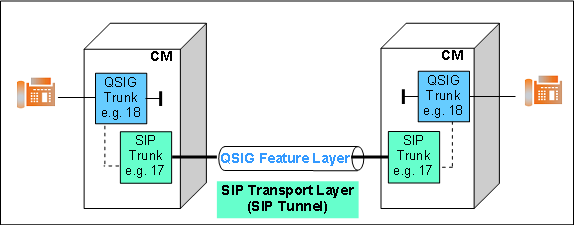
Both the QSIG and SIP trunks require dedicated signaling and trunk groups. That is, you must configure two trunks and two signaling groups in one Communication Manager to get the Q-SIP feature. Q-SIP reduces the actual trunk pool of the system.
Note:
You need to administer H.323 IP trunks for the QSIG signaling. For information on how to administer H.323 IP trunks, see Administration of the QSIG and SIP trunk and signaling groups.
Note:
As an example the QSIG signaling and trunk group is 18 and the SIP signaling and trunk group is 17. The examples in the following sections refer to these signaling and trunk group numbers.