

AVAYA DOCUMENTATION CENTER
Find answers to your technical questions and learn how to use our products
Administering Avaya Call Management System
ACD data tracking
uses the data in the real-time and historical databases to generate standard reports that help you monitor your call center activities. Various agents, split/skill, trunk, trunk group, vector, and VDN activities are tracked at different points in the call process.
call tracking
The following diagram shows howtracks a call from the time the call seizes a trunk until an agent ends After Call Work (ACW) activities.
The trunk table, trunk group table, vector table, VDN table, split/skill table, agent table, and Call Work Code (CWC) table aredatabase tables that store call data. In the following image, thedatabase table positions identify the points wherebegins to collect call data. The arrowheads identify the points where data collection ends.does not record the data in the tables until the call and any ACW is complete.
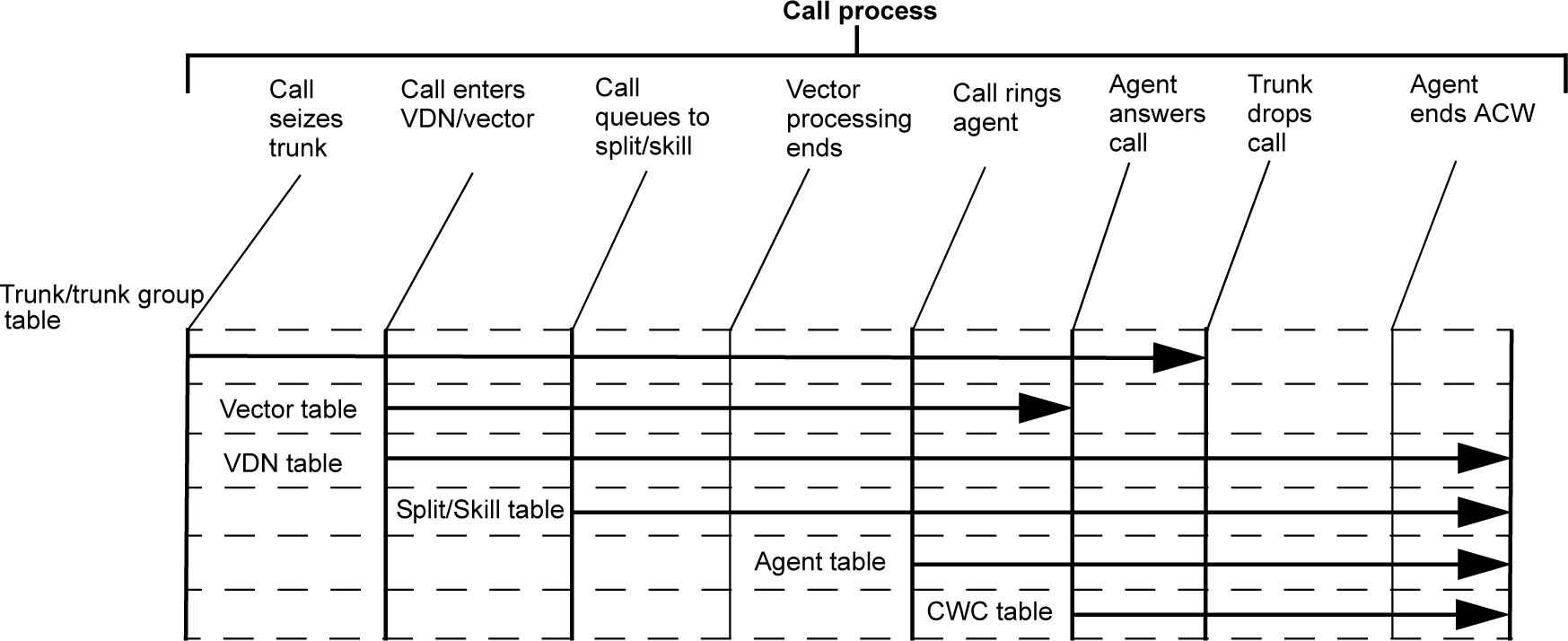
Events that start or stop data collection
Data collection starts or stops when one of these events occur:
-
The Agent table starts collecting data on non-ACD calls when the agent answers or completes dialing.
-
The Split/Skill table stops collecting data when:
-
The ACW for an ACD call ends
-
The call leaves the split queue and is forwarded to another destination . For example, intraflow.
-
The caller abandons the call
-
-
The Vector table stops collecting data for the current vector when the call is:
-
Sent to an ACD agent
-
Connected to a station or trunk
-
Routed to a VDN or vector
-
Abandoned by the caller
-
-
The VDN table stops collecting data for the current VDN when:
-
The ACW for an ACD call ends
-
The call is routed to a trunk or VDN
-
The call is transferred
-
The caller abandons the call
-